

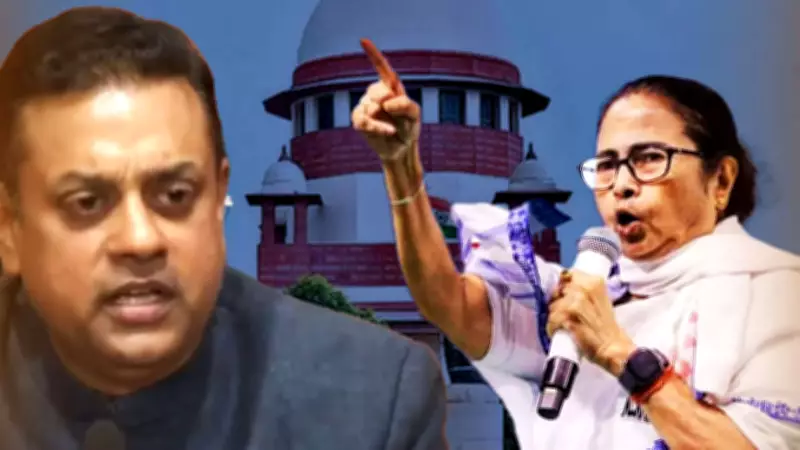
Supreme Court SIR Hearing Ignites Political Firestorm Between BJP and TMC
The Supreme Court's recent hearing on petitions concerning the Special Intensive Revision (SIR) process has erupted into a full-blown political confrontation between the Bharatiya Janata Party and the Trinamool Congress. The judicial proceedings have become a battleground for competing narratives about voter registration integrity and procedural fairness.
BJP Accuses Mamata Banerjee of Constitutional Misconduct
BJP spokesperson and Member of Parliament Sambit Patra launched a scathing attack against West Bengal Chief Minister Mamata Banerjee following the court proceedings. Patra asserted that the Supreme Court had unequivocally confirmed the continuation of the SIR process, directly contradicting claims that the revision would be halted.
"The apex court has made it absolutely clear that the Special Intensive Revision will proceed as planned," Patra declared. He went further to accuse the Chief Minister of deliberately spreading misinformation to the public and using what he described as "objectionable language" against constitutional authorities responsible for overseeing the electoral process.

TMC Counters with Emphasis on Procedural Safeguards
Trinamool Congress leader and senior advocate Kalyan Banerjee offered a starkly different interpretation of the court's directions. He emphasized that the Supreme Court had specifically highlighted procedural safeguards designed to protect genuine voters from arbitrary exclusion.
"The court has made it abundantly clear that Electoral Registration Officers will have the final authority in decision-making," Banerjee explained. "Minor discrepancies in documentation cannot serve as justification for deleting legitimate voters from electoral rolls."
Legal Framework and Verification Protocols
Banerjee elaborated on specific aspects of the court's directions, noting that the judiciary had provided clear guidelines regarding document verification and explanations related to First Information Reports. He stressed that the entire SIR process must be conducted strictly within the established legal framework, ensuring no overreach or procedural violations.
"The Supreme Court has provided a balanced approach," the TMC leader stated. "While the revision process continues, it must adhere to rigorous verification standards and respect the rights of legitimate voters. Electoral Registration Officers cannot act arbitrarily but must follow due process in every case."
Broader Political Implications
This legal dispute has significant ramifications for West Bengal's political landscape, where voter registration has been a contentious issue for years. The SIR process, designed to clean electoral rolls of duplicate or ineligible voters, has become politicized with both major parties accusing each other of manipulating the system for electoral advantage.
The Supreme Court's intervention represents a critical juncture in this ongoing controversy, with both sides interpreting the judicial directions through their respective political lenses. As the SIR process moves forward, the implementation of these court-mandated safeguards will likely become the next flashpoint in this continuing political confrontation.
The timing of this dispute is particularly significant as it unfolds against the backdrop of ongoing political realignments and preparations for future electoral contests in West Bengal and nationally.






