BJP Unveils Ambitious Manifesto for Bengal, Promises Uniform Civil Code and Major Welfare Initiatives
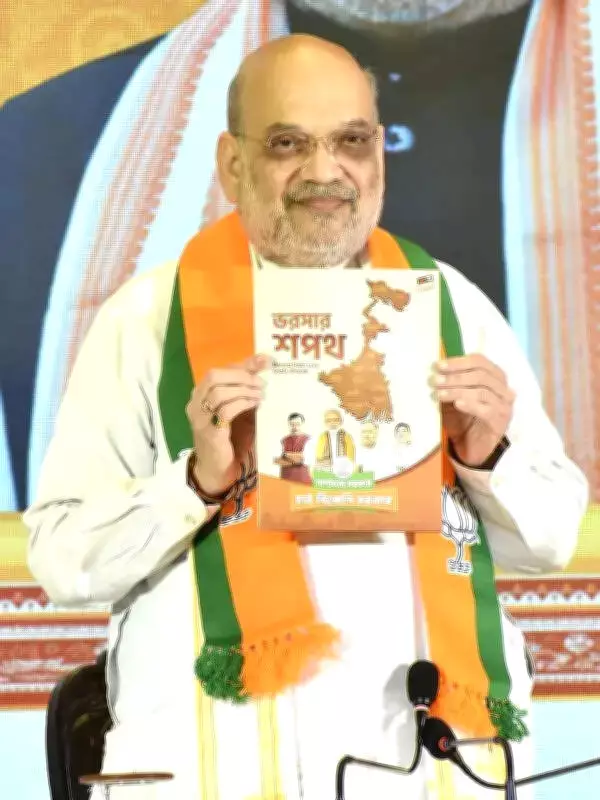
Union Home Minister Amit Shah declared on Friday that the Bharatiya Janata Party (BJP) will implement a Uniform Civil Code (UCC) in West Bengal within six months of assuming office if voted to power in the upcoming assembly elections. The announcement came during the release of the party's 'Sankalp Patra' manifesto for the polls scheduled for April 23 and April 29.
Key Welfare Promises and Economic Support
Addressing the media at a Kolkata hotel, Shah outlined a comprehensive package of welfare measures designed to address poverty and unemployment. A BJP government would provide monthly financial assistance of Rs 3,000 to women and unemployed youth, alongside a one-time grant of Rs 9,000 to farmers. Shah emphasized that these initiatives should not be labeled as freebies, stating, "The gaps we see in Bengal must be bridged first. It is not possible to lift people out of poverty without assistance."
He further noted that in states where BJP is in power, no pro-poor schemes from previous administrations have been discontinued. The manifesto also includes a direct benefit transfer of Rs 50,000 to girls for college enrollment, Rs 21,000 for pregnant women from marginalized families, and free travel on government buses for women.

Uniform Civil Code and Women's Rights
The proposed Uniform Civil Code aims to standardize civil laws across religions without interfering with food habits or religious practices. Shah argued that diverse personal laws, particularly regarding marriage, constitute "appeasement politics" that the BJP intends to end. "The Constitution is based on equal rights for people of different religions. UCC was recommended by the constituent assembly. It will end appeasement," he stated.
BJP leaders highlighted that the UCC would significantly advance women's rights in areas such as inheritance, maintenance, and marriage. Additionally, the manifesto pledges to reserve 33% of government jobs for women and establish Durga Suraksha Squads in urban areas to enhance their security.
Addressing Unemployment and Industrial Growth
To combat unemployment, the manifesto offers Rs 3,000 in monthly support for unemployed youth and a grant of Rs 15,000 to prepare for competitive exams. It sets an ambitious target of generating 1 crore jobs over the next five years. The document also presents a 15-point roadmap for Bengal's development, including:
- Construction of seaports in Tajpur and Kulpi
- A national highway connecting the Sundarbans to Darjeeling
- Completion of stalled Metro Railway and six railway projects
- Operationalization of airports in Purulia, Malda, and Balurghat
- Establishment of industrial units in Singur
Security, Corruption, and Border Management
Shah announced a "detect-delete-deport" strategy to curb infiltration, with plans to seal the Bengal-Bangladesh border. Land will be allocated to the Border Security Force (BSF) to erect fencing within 45 days of the party taking office. The manifesto also commits to ending illegal mining, dismantling the "mafia raj," and eliminating the "cut money" culture and syndicate system.
Corruption cases will be rigorously pursued, with those accused facing imprisonment, and a special commission will investigate all instances of political violence. The BJP promises to issue three white papers on corruption, post-poll violence, and law and order in the state.
Political Strategy and Electoral Implications
In a state with a substantial Muslim population, the UCC proposal is seen as a move to consolidate Hindu votes across caste lines. The welfare measures targeting women aim to woo female voters, traditionally part of Trinamool Congress's core support base. The manifesto also proposes strict laws against "love jihad" and "land jihad," addressing concerns about infiltrators allegedly seizing land in Bengal.
Other pledges include implementing the 7th Pay Commission award for government employees and ensuring immediate payment of dearness allowance arrears. With these promises, the BJP seeks to position itself as a catalyst for transformation, guiding Bengal from "despair to development" through a blend of social reform, economic support, and stringent governance.