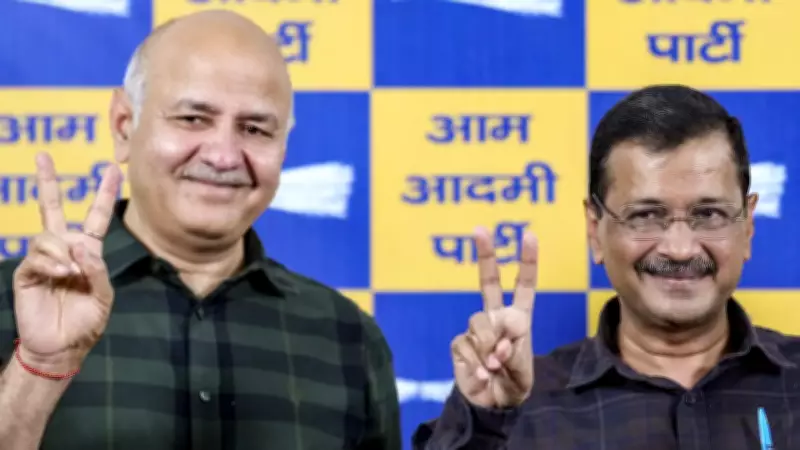
BJP's Strategic Focus on Excise Policy Marks Initial Cracks in AAP's Armor
NEW DELHI: Perceiving the excise controversy as the inaugural vulnerability in the then Aam Aadmi Party (AAP) government's defenses, the Bharatiya Janata Party (BJP) in the city commenced asserting that a political entity born from the Anna Hazare anti-corruption movement had deviated from its foundational anti-graft principles. Long before the saffron party initiated assaults on AAP regarding the "Sheesh Mahal"—a term referencing a contentious renovation of the former chief minister's official residence—it had already positioned the excise issue as an emblem of "corruption" within a party that originated from an anti-corruption crusade.
Street Protests and Sloganeering Amplify BJP's Narrative
Street demonstrations, incisive campaign slogans, and frequent allusions to "ek ke sath ek free"—a jab at the substantial discounts provided at liquor outlets following the implementation of the 2021-22 excise policy—evolved into a persistent motif in BJP protests and rallies. This messaging assisted the party in constructing a narrative that interrogated AAP's moral authority and transformed the controversy into a broader discourse on AAP's integrity, a party that formerly branded itself as "kattar imandar" or staunchly honest.
A senior BJP functionary disclosed on Friday that the then Delhi BJP president, Adesh Gupta, who was scouting for a potent political issue, identified in the liquor controversy a matter capable of adhering to AAP politically. Party members disseminated across slums and among lower-income demographics, and BJP's campaign began to secure traction. Gupta initiated leading protests by slum inhabitants, auto-rickshaw drivers, and senior citizens near the residences of Arvind Kejriwal and his ministers, demanding the dismissal of his deputy Manish Sisodia over the alleged scam.

Investigations and Arrests Bolster BJP's Position
BJP contended that the policy had advantaged the liquor mafia at the expense of public funds. As inquiries advanced, the arrests of Kejriwal and Sisodia over accusations of money laundering connected to the policy further reinforced BJP's stance. A senior Congress functionary, professing to have meticulously observed the maneuvers of both parties concerning the issue, highlighted that multiple bail petitions from Kejriwal and Sisodia were rejected by various judicial tiers since their arrests, and how BJP astutely utilized this as an instrument to communicate that the two were not merely accused but culpable.
AAP lacked responses each instance BJP functionaries declared that courts were denying relief to the two AAP veterans, thereby rendering it inaccurate to label this a case of political vendetta, the Congress member stated. While the liquor controversy constituted the primary significant allegation that adhered to AAP, ultimately it was the "Sheesh Mahal" issue that impacted the party most severely, he remarked. "Additionally, the substandard condition of roads and incessant disputes between the bureaucracy and the political wing of the then government, resulting in developmental stagnation, also contributed to AAP's decline in Delhi," he asserted.