

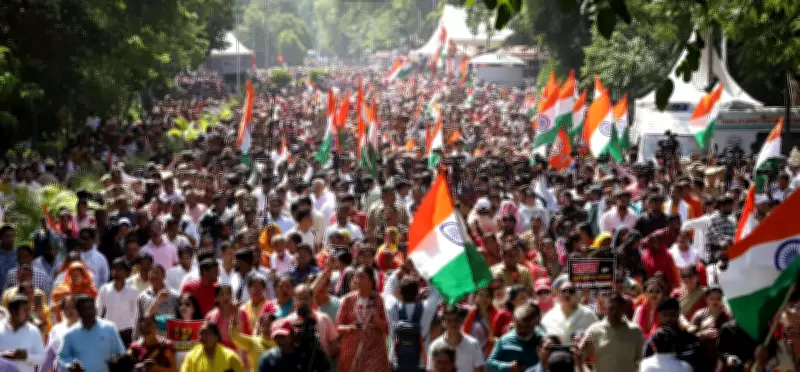
Major Political Showdown in Lucknow Over Women's Reservation Bill
A significant political confrontation unfolded in Lucknow on Tuesday as senior Bharatiya Janata Party leaders, spearheaded by Chief Minister Yogi Adityanath, organized a substantial 'Jan Aakrosh Padyatra' to protest against the Opposition's alleged resistance to the Nari Shakti Vandan Adhiniyam. The march drew participation from thousands of women alongside top party figures, who launched a vigorous assault on the Congress and Samajwadi Party.
Accusations of Conspiracy Against Women's Rights
Deputy Chief Minister Brajesh Pathak led the charge by accusing the Opposition of conspiring to obstruct women's reservation, stating that "the anger of women is now visible on the streets." He criticized the Congress and Samajwadi Party for displaying a "narrow mindset" by opposing the bill in Parliament and claimed that women across Uttar Pradesh are mobilizing against them.
"The agitated sisters of the state are on the streets, politically exposing these parties. They will face the consequences in upcoming elections," Pathak asserted, highlighting the electoral implications of the issue.

Electoral Warnings and Commitment to Reservation
Echoing these sentiments, Deputy Chief Minister Keshav Prasad Maurya issued a stark warning, suggesting that the Opposition would suffer electorally if women's reservation is not ensured. "Can any party win elections without women voters? If reservation is denied, Samajwadi Party and Congress will not receive any votes in 2027," he declared, reaffirming the government's dedication to securing reservation for women.
Rajya Sabha MP Arun Singh further condemned the Opposition, alleging that they celebrated after opposing the bill in Parliament. "This reflects their mindset. After denying women their rights, they applauded. The country's women will not forgive this," he remarked, emphasizing the perceived betrayal.
Branding the Opposition as Anti-Women
Union Minister and Uttar Pradesh BJP Chief Pankaj Chaudhary branded the Opposition bloc as an "anti-women alliance," arguing that the legislation aimed to ensure 33% reservation for women in Parliament and state assemblies to strengthen their role in policymaking. He contrasted this with the government's efforts toward women's empowerment, accusing the Opposition of opposing every positive initiative due to blind opposition to Prime Minister Narendra Modi.
Political Ramifications and Future Confrontations
The padyatra, characterized by energetic slogans and demonstrations, was portrayed by BJP leaders as a powerful display of support for women's rights and political representation. This event is poised to intensify political confrontations in the lead-up to the 2027 Uttar Pradesh Assembly elections, with both sides expected to sharpen their narratives around women-centric policies and representation.
The issue has become a central flashpoint, likely to influence voter sentiment and campaign strategies in the coming years, as parties vie for the support of women voters in one of India's most politically significant states.






