

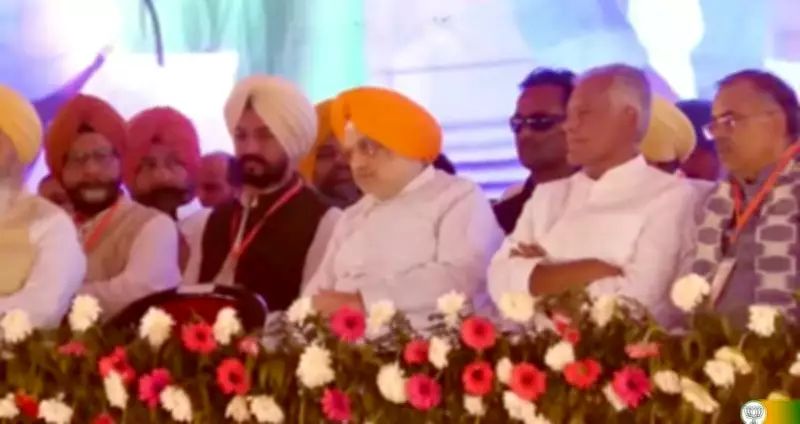
Amit Shah's Moga Rally Marks BJP's Push for Expansion in Punjab
Senior BJP leader and Union Home Minister Amit Shah arrived at the party's 'Badlav Rally' in Moga on Saturday, donning a saffron turban as he addressed a large gathering of supporters. The event, aimed at strengthening the BJP's presence in Punjab, saw significant turnout, with state BJP chief Sunil Jakhar and other senior leaders welcoming Shah on stage.
Notable Absence of Amarinder Singh Sparks Speculation
Former Punjab chief minister Amarinder Singh was conspicuously absent from the rally, fueling speculation in political circles. However, his wife and Patiala MP Preneet Kaur, along with daughter Jai Inder Kaur, were present at the venue, adding to the intrigue surrounding the event.
Bittu Highlights Growing Support for BJP in Punjab
Addressing the crowd earlier in the day, Union Minister Ravneet Singh Bittu emphasized that the large turnout reflected the people's eagerness to hear Amit Shah and their increasing support for the BJP in the state. He asserted that residents are now seeking a 'double-engine government,' referring to BJP governance at both the central and state levels.

Bittu credited Amit Shah's leadership for expanding the BJP's political footprint across India, noting that wherever the party governs, it strives to meet public expectations. He also took a swipe at the ruling Aam Aadmi Party government in Punjab, alleging that its financial policies, guided by party chief Arvind Kejriwal, have plunged the state into a fiscal crisis.
According to Bittu, the state administration is struggling to release salaries and pensions on time, which he described as a result of poor fiscal management. The rally is viewed as a major political show of strength by the BJP as it aims to expand its base in Punjab ahead of future elections.
Sharma Raises Concerns Over Law and Order and Drug Menace
BJP state working president Ashwani Sharma urged Union Home Minister Amit Shah to intervene and address what he called Punjab's deteriorating law and order situation. Referring to recent violent incidents, Sharma painted a grim picture of the challenges facing the state.
Drawing a stark contrast with the past, he remarked that Punjab's youth, once known for their hard work in agriculture and vibrant presence in sports, are increasingly falling victim to drug addiction. 'Today, the same youth are being found lifeless in drains, consumed by intoxication,' Sharma said, highlighting a deepening crisis.
He further alleged that this situation reflects a serious governance failure and stressed the need for strong leadership. Sharma asserted that only a BJP-led government could effectively tackle the drug menace, restore law and order, and safeguard the future of Punjab's younger generation.
Jakhar Criticizes Congress and Pitches BJP as Alternative
Training his guns on the Congress, state BJP chief Sunil Jakhar criticized the main opposition party for its 'conspicuous silence' over the alleged failures of the AAP government. He claimed that instead of holding the government accountable, Congress leaders are consumed by internal rivalries and factional infighting.
Drawing a historical parallel, Jakhar noted that a similar power struggle between two senior Congress leaders in the 1980s had pushed Punjab into 'two decades of bloody turmoil.' He warned that by prioritizing internal disputes over state safety, the Congress is once again failing the people of Punjab.
Jakhar further claimed that the prevailing situation has left citizens feeling increasingly insecure. 'Today, no citizen feels safe,' he said, adding that strong and decisive leadership is needed to restore stability and public confidence. Pitching the BJP as the alternative, Jakhar asserted that only a BJP-led government could address Punjab's challenges and ensure its safety and development.
The remarks came during the BJP's political mobilization event in Punjab, where party leaders sought to highlight issues such as crime, drugs, and governance while positioning the party as a viable alternative in the state's political landscape.






