

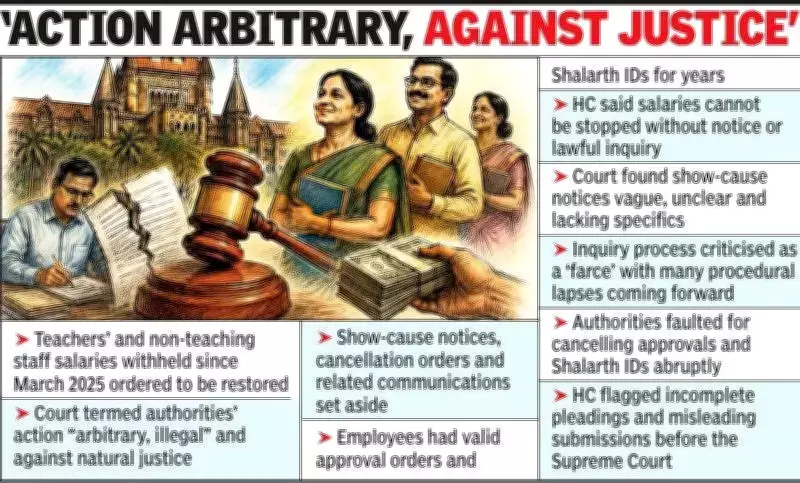
The Nagpur bench of the Bombay High Court recently quashed a series of orders that had stopped the salaries of teachers and non-teaching staff in aided primary and upper primary schools. The court observed that the action was arbitrary, illegal, and in breach of natural justice.
Court Ruling and Orders
The division bench partly allowed a large batch of writ petitions and directed that the petitioners' salaries, withheld since March 2025, be restored and continued. The court also set aside show-cause notices, cancellation orders, and related communications issued by the education officer (primary), Zilla Parishad, Nagpur, and the superintendent of the Pay and Provident Fund Unit.
Scope of Petitions
The petitions covered a wide group of assistant teachers, shikshan sevaks, junior clerks, and peons working in several aided schools. Many of these employees had served for 10 to 15 years and had received approval orders and Shalarth IDs from competent authorities.

Legal Basis and Precedent
Finding no legal basis for stopping their salaries without due process, the bench said the dispute was fully covered in its earlier ruling in Shrikant Ganpatrao Pawar and others versus State of Maharashtra and others, decided on April 21, 2025. The court stated, "The petitioners are entitled to their salary, as they have been working without a break in service."
Criticism of Authorities
The judges criticised the manner in which the authorities acted. The ruling noted that salaries were stopped "without any notice or without there being any fault on their part." The teachers continued to work, schools continued to function, and the employees were also assigned election and census duties, the court observed. The court held that the authorities could not abruptly cancel approval orders and Shalarth IDs without issuing proper notices or conducting a lawful inquiry. It said the action violated Article 14 of the Constitution and amounted to punishing employees for no fault of theirs.
Procedural Lapses
The bench also flagged serious procedural lapses in the matter. It noted that pleadings were not complete in most matters when the Supreme Court was told otherwise in proceedings related to one of the petitions. In examining the state's case, the bench found that the show-cause notices were vague and lacked specific allegations. "At the foundation itself, that is, show cause notices are vague, not specific, lack details and/or unintelligible," the court observed, adding that such notices denied the employees a fair chance to respond.
Inquiry Process Questioned
The judges also questioned the inquiry process adopted by the authorities. Referring to records in one of the petitions, the court said the scrutiny appeared to be "only a farce without proper consideration of documents." It noted that copies of outward registers were not supplied, concerned education officers were not present, and in some cases, present parties were shown as absent.






