

Canadian Politician's Remarks on Indian-Origin Officials Ignite Immigration Debate
A social media post by Canadian political figure Daniel Tyrie has sparked significant controversy online, reigniting heated discussions over immigration, identity, and representation within public institutions. Critics suggest that Canadian leaders may be adopting political rhetoric similar to that seen south of the border in the United States.
Tyrie's Post and the Backlash
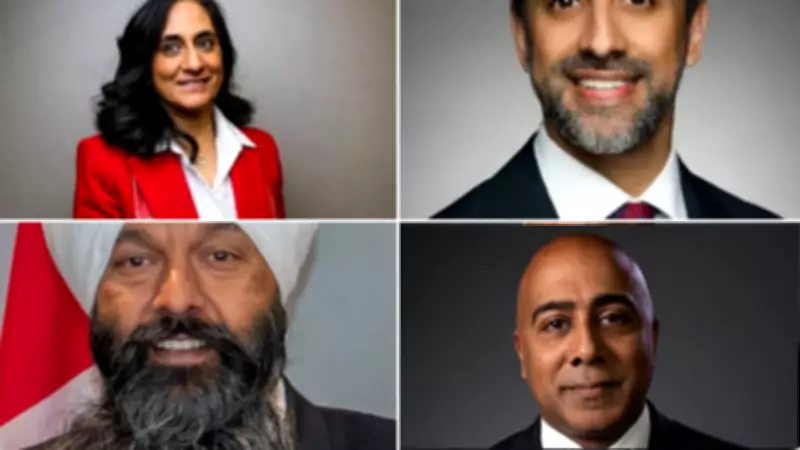
The controversy began when Tyrie posted on X, asking, "How is Global Affairs Canada run completely by Indians?" He shared photos of several South Asian officials working in the Canadian government, presenting them as evidence of what he described as overrepresentation. The officials featured included Arun Thangaraj, Maninder Sidhu, Randeep Sarai, and Anita Anand.
However, users on X quickly pointed out that many of these officials were born in Canada, challenging Tyrie's narrative. One user responded, "It's not. They are all Canadian. Moreover, they all were born in Canada. And you forgot to show the white guy, Dominic Leblanc, the Minister of Intergovernmental affairs." Another user emphasized performance over ethnicity, writing, "Whatever their background is... main question is... are they doing a good job or not, if not then kick them out. Foreign Minister is doing a good job till now."

Background of the Officials
Arun Thangaraj, the Deputy Minister of Transport Canada, was born in Canada. Maninder Sidhu, a Parliamentary Secretary, was born in India but immigrated to Canada as a young child; his parents arrived in the early 1980s as international students and later built a family business in Surrey, British Columbia.
Randeep Sarai, the Liberal Member of Parliament for Surrey Centre, was born on April 15, 1975, in Vancouver and raised in Burnaby; his Sikh parents had immigrated from Punjab before his birth. Anita Anand, the former Minister of National Defence and current Member of Parliament for Oakville, was born in Kentville, Nova Scotia, in 1967; her parents, both doctors from India, immigrated to Canada in the early 1960s.
Tyrie's Defense and Community Context
When confronted about the Canadian-born status of these officials, Tyrie defended his stance. He wrote, "To be Canadian is to be a part of an intergenerational lineage stretching back to the pioneers who settled and built this great nation." He added, "Someone born to two Indians in Canada is still Indian. This isn't rocket science." Tyrie also argued that ethnic diversity was being framed incorrectly, stating, "Nothing 'diverse' about four Indians. Unless you're using the modern definition of diversity, non-White."
This incident highlights the growing presence of the Indian-origin community in Canada. Estimates place the population between 1.8 million and 2.9 million people, making it one of the largest overseas Indian diasporas and accounting for approximately 5.1% of Canada's total population. Census data shows the community grew by 17.5% compared to the previous census, reflecting its expanding influence in business, politics, and public service.
Broader Implications
The backlash against Tyrie's remarks underscores ongoing tensions in Canadian society regarding immigration and multiculturalism. As the Indian diaspora continues to grow and integrate into various sectors, debates over representation and identity are likely to persist, shaping public discourse and policy discussions in the future.






