

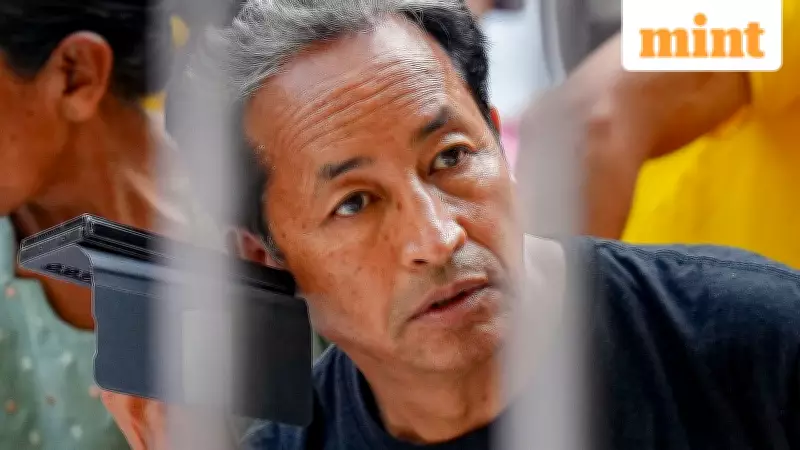
Centre and Ladakh Administration Allege Wangchuk Sought to Spark Gen Z Agitation in India
The Central government and the Union Territory of Ladakh administration presented a stark warning to the Supreme Court on Monday, February 2, asserting that prominent climate activist Sonam Wangchuk had deliberately attempted to instigate a youth-led protest movement in India, mirroring recent unrest seen in Nepal and Bangladesh. Solicitor General Tushar Mehta, representing the authorities, informed a bench comprising Justices Aravind Kumar and PV Varale that Wangchuk's rhetoric was carefully designed to mobilize the younger generation, even drawing parallels to historic uprisings like the Arab Spring.
Legal Proceedings and Allegations of Instigation
The Supreme Court was hearing a crucial plea filed by Gitanjali J Angmo, Wangchuk's wife, challenging his detention under the stringent National Security Act (NSA), which permits detention for up to twelve months without formal charges. During the arguments, Solicitor General Tushar Mehta elaborated on the government's stance, alleging that Wangchuk had crafted his speeches with precision to incite agitation among India's Gen Z population.
"He carefully crafted his speech to instigate Gen Z and asked for agitations like in Nepal and Bangladesh, using speeches of Mahatma Gandhi to cover the real intention," Mehta stated emphatically before the bench. The solicitor general further contended that Wangchuk's language deliberately created a divisive narrative, referring to the government as "them" and the people of Ladakh as "us," while also invoking calls for "plebiscite" and "referendum"—terms historically associated with separatist movements in regions like Jammu and Kashmir.

Government's Defense of Preventive Detention
Mehta underscored the sensitivity of Ladakh's geopolitical position, noting that the region shares borders with both China and Pakistan, making it a fragile area requiring heightened security vigilance. "There is no them or us but we are all Indians. Ladakh is a place which shares borders with two countries... The area is very fragile. The speeches made by him have to be taken into account in totality," he argued, emphasizing that Wangchuk's actions were misleading young people and misappropriating Gandhi's teachings to mask subversive intentions.
Detailing the procedural aspects of Wangchuk's detention, Mehta explained that the district magistrate had issued the preventive detention order after reviewing substantial evidence, including videos of Wangchuk's speeches. "It took four hours for the order of preventive detention to get executed as after the district magistrate passed the order, a DIG rank officer went to him and explained everything and showed him videos of his speeches. Grounds of detention was explained to him," Mehta informed the court, highlighting the thoroughness of the process.
Rebuttal of 'Borrowed Material' Argument
Addressing criticisms that the detention relied on "borrowed material"—evidence not directly witnessed by the district magistrate—Mehta dismissed such claims as fundamentally flawed. "This argument of 'borrowed material' itself suffers from inherent fallacy as the district magistrate does not need to go to each and every place where he made the speech and hear it firsthand," he asserted. He clarified that officials who had personally heard and recorded Wangchuk's speeches had presented the relevant materials to the magistrate, forming a legitimate basis for the detention order.
The court proceedings remained inconclusive, with arguments scheduled to resume on Tuesday, leaving the legal battle over Wangchuk's detention under the NSA ongoing. The case has drawn significant attention, linking environmental activism with national security concerns in a sensitive border region.






