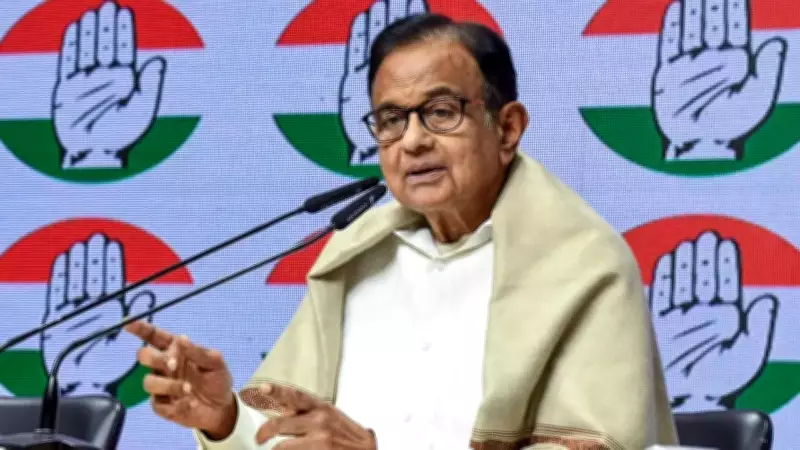
Chidambaram Delivers Scathing Critique of Union Budget 2026-27
Former Union home minister and senior Congress leader P Chidambaram launched a sharp criticism of the Union Budget 2026-27 presented by Finance Minister Nirmala Sitharaman, declaring that it "failed the test of economic strategy and economic statesmanship." The veteran politician delivered his assessment during a press conference following the budget presentation in Parliament, raising fundamental questions about the government's economic approach.
Budget Ignores Economic Survey Recommendations
Chidambaram questioned whether the government had even considered the Economic Survey 2025-26 before formulating the budget. "I am not sure if the government and the Finance Minister had read the Economic Survey 2025-26. If they had, it appears they have decided to discard it completely, and fall back on their favourite pastime of throwing words—usually acronyms—at the people," he stated bluntly.
The former finance minister expressed concern that the budget speech was filled with announcements but lacked clarity on outcomes. "The Finance Minister peppered her speech with schemes and programmes. She is not tired of adding to the number of schemes, programmes, missions, institutes, initiatives, funds, committees, hubs, etc. I counted at least 24. I leave it to your imagination how many of these will be forgotten and vanish by next year," Chidambaram remarked.

Limited Impact of Income Tax Changes
Regarding the changes in income tax rates announced in the budget, Chidambaram argued that their impact would be minimal. "Months after the passing of the Income Tax Act, 2026, which will come into force on 1 April, 2026, the Finance Minister has tinkered with some rates," he said, suggesting the adjustments were minor.
He emphasized that income tax changes matter little to most citizens, noting that "the overwhelming majority of the people have no concern with income tax or income tax rates." The indirect tax reliefs announced in paragraphs 159, 160 and 161 were dismissed as "minor concessions" that would have limited effect on household budgets.
Budget Fails to Address Major Economic Challenges
Chidambaram outlined at least ten major challenges that the budget failed to address, despite being highlighted by the Economic Survey and economic experts:
- The penal tariffs imposed by the United States creating stress for manufacturers, especially exporters
- Protracted trade conflicts weighing on investment decisions
- The growing trade deficit, particularly with China
- Low Gross Fixed Capital Formation (approximately 30 percent) and private sector reluctance to invest
- Uncertain outlook for Foreign Direct Investment (FDI) flow
- Persistent outflow of Foreign Portfolio Investment (FPI) for several months
- Agonizingly slow pace of fiscal consolidation
- Continued high fiscal deficit and revenue deficit, contrary to FRBM targets
Ground Realities Ignored in Budget Formulation
The senior Congress leader argued that the budget ignored pressing ground realities faced by households and businesses across India:
- The persistent gap between officially announced inflation numbers and actual household expenditure on essentials
- The closure of lakhs of MSMEs and survival struggles of remaining small businesses
- Precarious employment situation, especially concerning youth unemployment
- Deteriorating infrastructure in urban areas affecting quality of life
Questionable Fiscal Management and Expenditure Cuts
Chidambaram criticized the government's fiscal management during 2025-26, stating that "even by an accountant’s standards, it was a poor account of the management of the finances." He presented concerning figures:
Revenue receipts fell short by Rs 78,086 crore, while capital expenditure was cut by Rs 1,44,376 crore. "Actually, the Centre’s capital expenditure has fallen from 3.2 percent of GDP in 2024-25 to 3.1 percent in 2025-26," he revealed.

More troubling, according to Chidambaram, was where these cuts occurred. "In revenue expenditure, the cuts have fallen in heads that concern the common people," he emphasized. He highlighted a particularly steep cut in a flagship scheme: "Expenditure on the much-vaunted Jal Jeevan Mission was cruelly cut from Rs 67,000 crore to a paltry Rs 17,000 crore."
Lack of Fiscal Ambition and Prudence
The former finance minister expressed disappointment with the fiscal deficit trajectory outlined in the budget. "After months-long exercise, the revised estimate of the fiscal deficit has adhered to the budget estimate of 4.4%, and the projection for 2026-27 is that the fiscal deficit will fall by a meagre 0.1 percent of GDP," he noted.
Chidambaram concluded that "it is certainly not a bold exercise in fiscal prudence and consolidation," reinforcing his overall verdict that the budget represents a failure of economic strategy and statesmanship at a critical juncture for India's economy.