Congress Intensifies Criticism of India-US Interim Trade Agreement
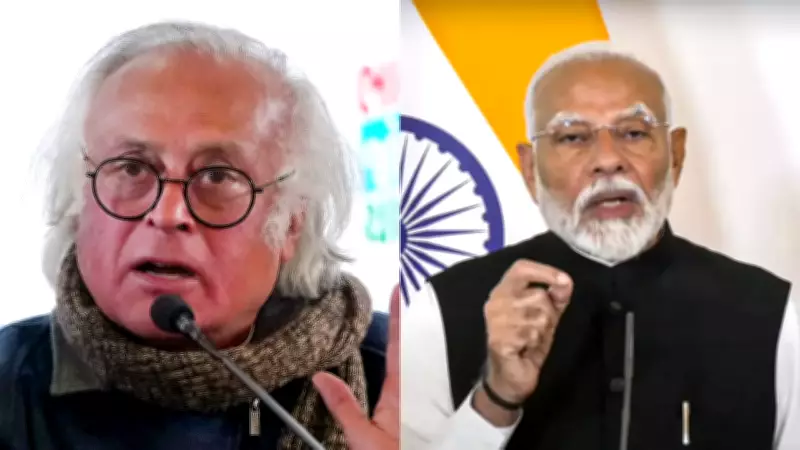
Congress general secretary Jairam Ramesh launched a scathing attack on the central government regarding the proposed India-US interim trade agreement, labeling it as evidence of "Abki baar Trump se haar" (This time, defeat by Trump). He demanded the framework be placed in "cold storage" and thoroughly renegotiated.
Allegations of One-Sided Deal and Farmer Impact
Ramesh argued that the terms disproportionately favor the United States, with India conceding significant ground without securing adequate benefits. He specifically highlighted commitments to reduce or eliminate tariffs on a wide range of US industrial goods, food, and agricultural products.
"The first commitment we have made is to reduce or eliminate tariffs on a wide range of food and agricultural products. Our demand to the PM is to put this in cold storage," Ramesh stated in an interview with PTI.

He warned that this import liberalization clause would directly and negatively impact soybean, maize, fruits, nuts, and cotton farmers across multiple states, including Jammu and Kashmir, Bihar, Madhya Pradesh, Rajasthan, Maharashtra, and Himachal Pradesh.
Questioning Timing and Political Motives
The Congress leader sharply questioned the timing of the agreement's announcement, which came amid legal uncertainty in the US. He referenced the recent US Supreme Court verdict that struck down most of former President Donald Trump's earlier global tariff measures, ruling the administration had exceeded its authority.
"Why did you hurriedly strike a deal when you knew the verdict could go against Trump?" Ramesh asked, pointing to the government's awareness of the pending court decision since December.
He further alleged a political motive, suggesting the February 2 announcement was orchestrated to manage headlines and counter criticism from Congress leader Rahul Gandhi in Parliament regarding external security failures.
Legal Context and Framework Provisions
The controversy unfolds against a complex legal backdrop. The US Supreme Court's 6-3 ruling found that the Trump administration improperly used the International Emergency Economic Powers Act of 1977 to impose broad tariffs, affirming that taxation power primarily rests with Congress.
In response, Trump announced new global tariffs under Section 122 of the Trade Act of 1974, initially at 10% and later raised to 15%.
Ramesh noted that the interim trade framework includes a provision allowing either party to modify commitments if circumstances change. He asserted that India now has the right to revise its obligations following Trump's tariff alterations.
Congress Plans Farmer Mobilization
Sharpening its political campaign, the Congress party announced plans to organize a "Maha Kisan Maha Chaupal" (Grand Farmers' Assembly) in multiple states to mobilize agricultural communities and discuss the trade deal's potential consequences.
- The first assemblies are scheduled for March 7 in Bhopal and Yavatmal, Maharashtra.
- A subsequent event will be held in Sri Ganganagar, Rajasthan.
- The party is coordinating with various farmers' organizations.
Ramesh drew parallels to the government's withdrawal of the three farm laws after prolonged protests, stating, "Three black laws were withdrawn. It took 14-15 months, but PM Modi was forced to withdraw them."
He concluded with a pointed critique: "Prime Minister does 'taareef' (praise), while Trump keeps imposing 'tariffs'. I'm telling you this based on President Trump's statements."
Ramesh reiterated his call for the joint statement to be shelved and the terms renegotiated, emphasizing that the current deal is one-sided and detrimental to the interests of countless farmers across India.