

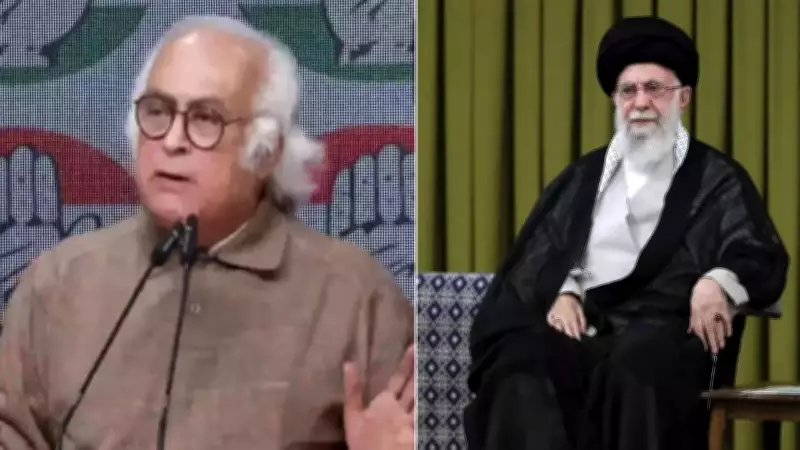
Congress Leader Jairam Ramesh Questions PM Modi's Silence on Iran Supreme Leader's Death
Congress leader Jairam Ramesh on Friday launched a sharp critique against Prime Minister Narendra Modi, questioning his apparent hesitation in condemning the death of Iran's late Supreme Leader Ali Khamenei. Ramesh recalled his earlier characterization of Modi as a "compromised PM" and suggested that the Prime Minister's reluctance stems from a desire to avoid antagonizing key allies.
Accusations of Avoiding Conflict with US and Israeli Allies
In a pointed social media post, Ramesh claimed that PM Modi specifically wants to "avoid antagonising his American and Israeli friends," directly referencing US President Donald Trump and Israeli Prime Minister Benjamin Netanyahu. The Congress leader highlighted what he perceives as a significant diplomatic inconsistency in the government's approach to international relations.
"Why the hesitancy now? A compromised PM no doubt wants to avoid antagonizing his American and Israeli 'friend,'" Ramesh wrote in his post on platform X, formerly known as Twitter. He further questioned the complete silence from both PM Modi and India's External Affairs Ministry following the assassination of Ayatollah Khamenei, who served as Iran's constitutional head of state.

Contrasting Responses to Iranian Leadership Deaths
Ramesh drew a stark comparison between the government's current silence and its previous response to the death of former Iranian President Ebrahim Raisi. He noted that when President Raisi died in a mysterious helicopter crash in May 2024, the Modi government had promptly ordered a one-day state mourning on May 21, 2024, and Parliament subsequently held an obituary reference when it convened on July 1, 2024.
The Congress leader emphasized this discrepancy, stating: "Ayatollah Khamenei, the constitutional head of state in Iran, was assassinated on Feb 28, 2026 by the US and Israel. The PM is silent. The EAM is silent. Parliament is yet to have an obituary reference."
India's Diplomatic Positioning and BRICS+ Considerations
Ramesh's criticism extends beyond the immediate response to Khamenei's death to broader diplomatic concerns. He pointed out that while India has rightly condemned Iran's attacks on Gulf states, the government has remained completely quiet regarding the initial US-Israeli assault on Iran that precipitated the current conflict.
The Congress leader highlighted an important geopolitical consideration: Iran remains a member of the BRICS+ forum, which India currently holds the presidency of this year. This positioning creates complex diplomatic challenges for India as it navigates relationships with conflicting international powers.
Background of the Incident and Regional Implications
Ali Khamenei was killed earlier this month in a coordinated military strike carried out jointly by Israel and the United States. Following his death, he was succeeded by his second-oldest son, Mojtaba Khamenei, continuing the family's leadership of Iran.
The assassination has occurred against a backdrop of escalating regional tensions, including:
- Saudi Arabia intercepting drones headed toward the Shaybah oil field
- Israeli strikes targeting 10 Hezbollah positions in Beirut
- Continued military operations throughout the Middle East
Ramesh's remarks follow India's support for a United Nations Security Council resolution condemning Iran's attacks on Middle Eastern nations. The Congress leader's critique raises questions about diplomatic consistency and strategic positioning as India balances relationships with Western allies, regional partners, and fellow BRICS+ members during a period of significant international tension.






