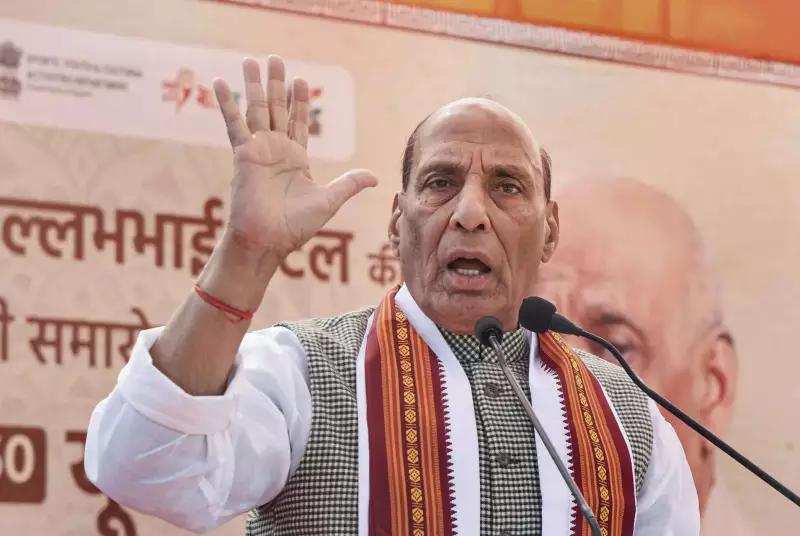
The Indian National Congress has launched a sharp attack on Defence Minister Rajnath Singh, accusing him of spreading falsehoods about the country's first Prime Minister, Jawaharlal Nehru. The party has demanded a public apology from the senior BJP leader for his recent claim that Nehru wanted to use public funds to build the Babri mosque.
Diary Entry Presented as Proof
The political controversy erupted after Singh made the statement at a public rally in Gujarat. In response, Congress spokesman Jairam Ramesh, on Saturday, presented what he claims is the original evidence to debunk the minister's assertion. Ramesh shared excerpts from a book containing the diaries of Maniben Patel, the daughter of India's first Deputy Prime Minister, Sardar Vallabhbhai Patel.
Ramesh posted on social media platform X the original Gujarati diary entry from pages 212-213 of the book titled 'Samarpit Padchhayo Sardarno'. The book is authored by CA RS Patel 'Aaresh' and was published by the Sardar Patel Vallabhbhai Patel Memorial Society in 2025.

A Clash of Narratives
"There is a huge difference between what is contained in the original diary entry and what Rajnath Singh and his fellow 'distorians' are propagating," Jairam Ramesh stated emphatically. He accused the Defence Minister of fabricating the narrative solely to "improve his relationship" with Prime Minister Narendra Modi.
The Congress has dismissed Singh's remarks as a blatant "lie" and a product of "WhatsApp university." This counter comes despite the BJP initially citing Maniben Patel's accounts as the source for their claim about Nehru's stance on the Babri Masjid.
Demand for Accountability and Apology
Going beyond mere rebuttal, the principal opposition party has called for formal accountability. "The defence minister must apologise for the falsehoods he is spreading, simply to improve his relationship with the PM," Ramesh asserted, framing the issue as one of historical integrity versus political convenience.
The row highlights the ongoing and intense political battle over historical narratives and legacies in India. By invoking the personal diary of a figure closely associated with Sardar Patel, a leader often celebrated by the ruling dispensation, the Congress aims to challenge the BJP's version of history on its own terms.
The ball is now in the court of Rajnath Singh and the BJP to either provide corroborating evidence for their original claim or respond to the Congress's demand for an apology. The incident underscores how historical interpretation remains a potent and contentious tool in contemporary Indian politics.