

Congress Criticizes Modi Government's 'Dalaal' Statement, Highlights Past Diplomatic Outreach
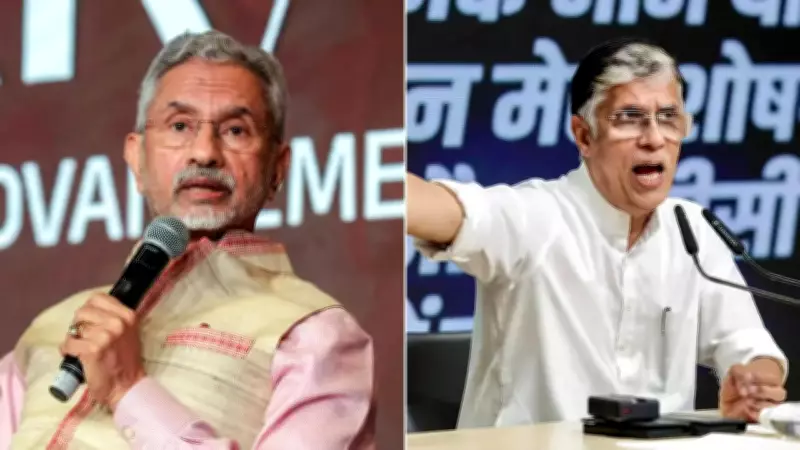
In a sharp political exchange, the Congress party has launched a pointed critique against the Narendra Modi-led central government following remarks by External Affairs Minister S. Jaishankar that India does not position itself as a "dalaal" or broker nation like Pakistan. The opposition has questioned the consistency of this stance by recalling past diplomatic initiatives undertaken by Prime Minister Modi.
Congress Leader Pawan Khera's Social Media Challenge
Congress spokesperson Pawan Khera took to social media platform X to pose a direct question to the government. "Was India a 'Broker Country' when Modi was desperate to mediate between Russia & Ukraine? Selective brokering or selective memory?" Khera wrote, referencing earlier efforts by the Indian government to facilitate dialogue in the Russia-Ukraine conflict. This comment underscores the opposition's attempt to highlight perceived contradictions in the government's foreign policy narrative.
Jaishankar's Remarks at All-Party Meeting on West Asia Crisis
The controversy stems from a high-level all-party meeting convened at the Parliament complex to discuss the escalating tensions in West Asia, particularly involving Iran. During this gathering, External Affairs Minister S. Jaishankar, according to sources cited by PTI, explicitly stated, "We are not a dalaal nation." He further contextualized this by noting that Pakistan's mediation efforts are not novel, pointing out that the United States has utilized Pakistan in such roles since 1981.

This meeting occurred against a backdrop where nations like Pakistan and Turkey have intensified their roles as potential intermediaries between Washington and Tehran, aiming to de-escalate the volatile situation. The government used the forum to rebut opposition claims of silence, asserting active diplomatic engagement.
Government's Defense and Key Concerns Outlined
In response to criticism that India displayed moral weakness by not promptly condoling the death of Iran's Supreme Leader, the government clarified that Foreign Secretary Vikram Misri visited the Iranian embassy immediately upon its reopening to sign the condolence book. Officials emphasized that New Delhi's primary focus remains twofold:
- Ensuring the security of the substantial Indian diaspora residing in the Gulf region.
- Securing domestic energy needs through diversified and advanced procurement strategies.
The government reassured attendees that there is no cause for panic, detailing that India maintains robust crude oil and gas stocks, with procurement now spanning 41 countries as part of a strategic diversification effort.
Opposition's Dissatisfaction and Demand for Parliamentary Debate
Despite these explanations, opposition leaders expressed significant dissatisfaction with the government's responses. Congress leader Tariq Anwar criticized the administration, stating that while Pakistan assumes a mediator's role, India remains a "mute spectator." He, along with other opposition figures, demanded an immediate debate on the West Asia situation in both houses of Parliament—Lok Sabha under Rule 193 and Rajya Sabha under Rule 176.
The nearly two-hour meeting saw representation from a broad spectrum of political parties. Key government attendees included Defence Minister Rajnath Singh, Home Minister Amit Shah, Finance Minister Nirmala Sitharaman, Health Minister JP Nadda, and Parliamentary Affairs Minister Kiren Rijiju. The opposition was represented by leaders such as Mukul Wasnik (Congress), Dharmendra Yadav (Samajwadi Party), Sasmit Patra (BJD), Sanjay Jha (JD-U), Srikant Shinde (Shiv Sena), Sanjay Singh (AAP), John Brittas (CPI-M), Supriya Sule (NCP-SP), Arvind Sawant (Shiv Sena-UBT), and Asaduddin Owaisi (AIMIM).

Broader Implications for India's Foreign Policy Stance
This political skirmish highlights ongoing debates about India's role in global diplomacy. The Congress party's questioning seeks to scrutinize the Modi government's strategic consistency, especially in light of past mediation attempts. Meanwhile, the government's firm "non-broker" stance, coupled with its focus on diaspora safety and energy security, outlines a pragmatic approach to international crises, prioritizing national interests over intermediary roles.
The exchange underscores the delicate balance India maintains in its foreign policy, navigating complex geopolitical landscapes while addressing domestic political scrutiny. As tensions in West Asia persist, the demand for transparent parliamentary discussion reflects the opposition's push for greater governmental accountability in foreign affairs.





