

Congress Severs Decade-Old Alliance, Charts Independent Course for 2026 Bengal Elections
In a decisive political maneuver, the Indian National Congress has formally terminated its decade-long electoral alliance with the Left Front in West Bengal. The party announced on Thursday its resolution to "go it alone" and contest all 294 seats in the crucial 2026 Bengal Legislative Assembly elections. This strategic pivot sets the stage for a highly competitive four-cornered contest in the state, fundamentally reshaping the political landscape.
High Command Meeting Seals the Fate of Alliance Politics
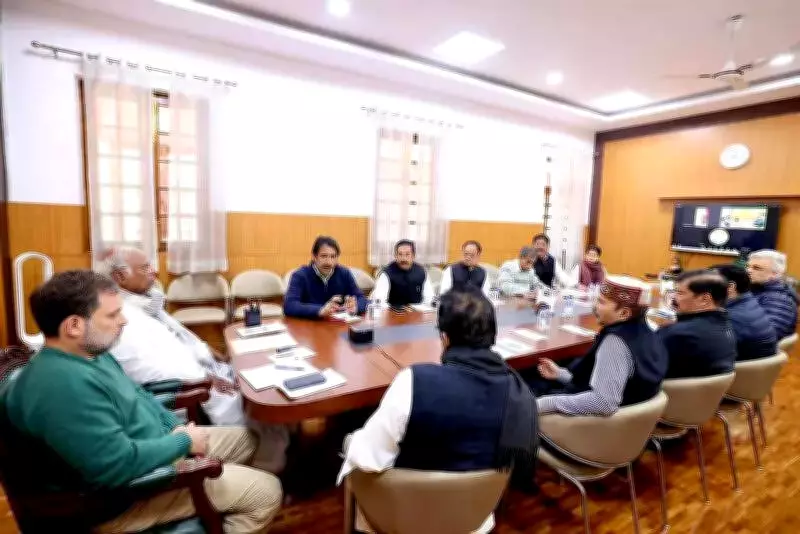
The landmark decision was finalized during a pivotal meeting convened at the official residence of Congress President Mallikarjun Kharge at 10, Rajaji Marg in New Delhi. The session saw the participation of key national and state leaders, including Congress general secretary and Bengal in-charge Ghulam Ahmad Mir, who articulated the party's new direction. "We decided to walk alone and it was a collective decision of the leadership," Mir stated unequivocally. "We will contest in all 294 seats. Our earlier alliance with the Left Front did not boost the morale of our party workers at the ground level."
The meeting, which had been postponed twice previously, also included Congress leader Rahul Gandhi and prominent Bengal functionaries such as state party president Subhankar Sarkar, senior leader Adhir Chowdhury, and Malda South MP Isha Khan Chowdhury. Several state-level leaders participated virtually, underscoring the meeting's significance.

Internal Divisions and Strategic Calculations
This decision culminates intense internal deliberations within the Pradesh Congress Committee, which had been deeply divided over the alliance question. The party was effectively split into two distinct camps. The Murshidabad unit, under the stewardship of former PCC president Adhir Chowdhury, had vocally advocated for maintaining the alliance with the Left Front. In contrast, the Malda unit strongly opposed any seat-sharing arrangement, reflecting broader ideological and strategic disagreements.
During the high-stakes meeting, Adhir Chowdhury presented arguments in favor of continuing the alliance, highlighting historical precedents. He noted that the 2016 alliance with the Left had propelled Congress to become the principal opposition party in the West Bengal Legislative Assembly. Furthermore, he referenced the Sagardighi by-election victory, where Congress triumphed with Left Front support, despite both parties failing to secure any seats in the polarized 2021 assembly elections.
Ground Realities and Electoral Aspirations
However, the prevailing sentiment within the party leadership leaned decisively towards independence. Pradesh Congress functionaries, while acknowledging the party's strengthened position in approximately 60 constituencies, ultimately deferred the final decision to the high command. Subhankar Sarkar, the state Congress president who favored assessing the party's strength independently, emphasized the changing dynamics. "The youth were in favour of fighting alone this time," Sarkar remarked. "The high command kept their opinion in mind before coming to this decisive conclusion."
Ghulam Ahmad Mir reinforced this perspective, stating, "Electors in Bengal and workers in the state have the aspiration of fighting alone this time." This sentiment reflects a strategic assessment that an independent campaign could energize the party's base and attract a broader electorate disillusioned with existing political formations.
Performance Metrics and Broader Political Equations
The decision also follows an analysis of recent electoral performances. In the 2024 Lok Sabha elections, Congress secured leads in 13 parliamentary segments, predominantly in the Malda and Murshidabad regions. The party demonstrated a notable improvement in its vote share, despite inconsistencies and challenges within the alliance framework. This performance likely bolstered confidence in the party's capacity to contest independently.

Moreover, sources indicate that the Congress high command considered the complex political equation between the CPI(M)-led Left Democratic Front and the Congress-led United Democratic Front in Kerala. The dynamics of this relationship in another politically significant state may have influenced the strategic calculus for Bengal, ensuring a coherent national approach to alliance politics.
Implications for West Bengal's Political Future
This unilateral move by Congress dramatically alters the electoral arithmetic in West Bengal. The state now faces the prospect of a four-cornered contest involving the ruling Trinamool Congress, the Bharatiya Janata Party, the Left Front, and an independent Congress. This fragmentation could lead to unpredictable outcomes, with vote shares becoming critically important in a multi-polar contest.
The decision to contest all 294 seats independently signals Congress's ambition to reclaim its political space in Bengal, a state where it once held significant influence. It represents a bold gamble to rebuild the party from the ground up, prioritizing organizational morale and worker enthusiasm over short-term electoral arithmetic. As the 2026 elections approach, all political actors will be closely monitoring the impact of this realignment on West Bengal's volatile and vibrant democracy.





