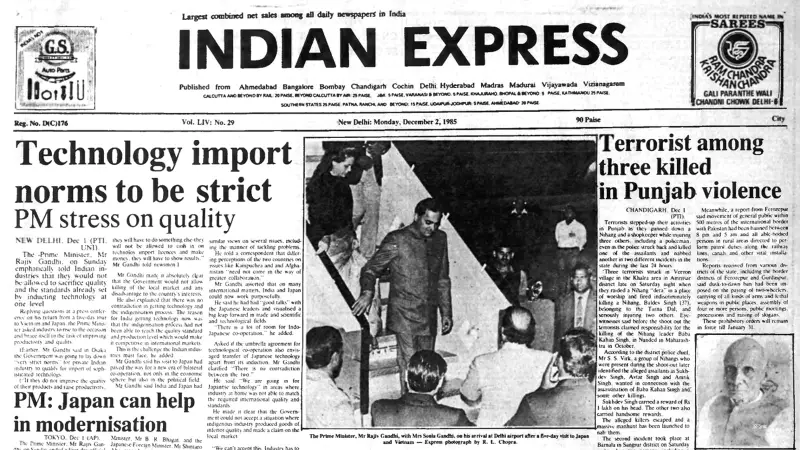
December 2, 1985, marked a day of significant diplomatic engagement and sombre national reflection for India. Prime Minister Rajiv Gandhi was wrapping up a crucial overseas mission, while back home, the nation continued to grapple with the aftermath of a devastating industrial disaster.
Rajiv Gandhi's Push for Modernisation in Japan
Prime Minister Rajiv Gandhi concluded his four-day official visit to Japan on this day. The central theme of his trip was clear: to seek Japanese expertise and collaboration to modernise India's economy. During his stay, Gandhi held multiple meetings with Japanese leaders, primarily focused on cementing agreements where Japan could provide technological and financial assistance for India's development plans.
Beyond economic ties, the Prime Minister also identified a broader area for potential cooperation. He suggested that India and Japan could work together in the field of nuclear disarmament, indicating a desire to expand the bilateral relationship beyond mere commerce into global strategic issues.

The Bhopal Gas Tragedy: A Meagre Offer and a Small Pension
While the PM was abroad, the shadow of the Bhopal gas disaster, which had occurred just a year earlier in December 1984, loomed large. On this day, Union Carbide's offer of $5 million as aid for the victims came under sharp scrutiny. An editorial opinion highlighted that this sum was a "mere pittance," translating to roughly Rs 300 per victim. This was starkly contrasted against the ongoing suffering of thousands, who were facing frightening long-term health effects as admitted by the government itself.
Interestingly, the Madhya Pradesh government, led by Chief Minister Motilal Vora, had expressed satisfaction with this offer, calling it an act of "magnanimity" by the company. In a separate development, it was announced that widows of the tragedy would start receiving a monthly pension of Rs 200 under a social security scheme. CM Vora was to distribute the first instalment at a function in Bhopal. The same scheme was already providing Rs 60 per month to 2,842 destitutes in the gas-affected areas.
A Nation Mourns a Sarvodaya Leader
The day also saw India lose a respected freedom fighter and social reformer. Acharya Dada Dharmadhikari passed away at the age of 87 in Sevagram near Wardha. A veteran Sarvodaya leader and member of the Constituent Assembly, his death marked the end of an era. He was survived by his three sons, including Justice C S Dharmadhikari of the Bombay High Court.
Thus, December 2, 1985, presented a snapshot of a nation at a crossroads: actively seeking a modern future through international partnerships, while painfully dealing with the consequences of a tragic industrial past and bidding farewell to the stalwarts of its independence movement.