

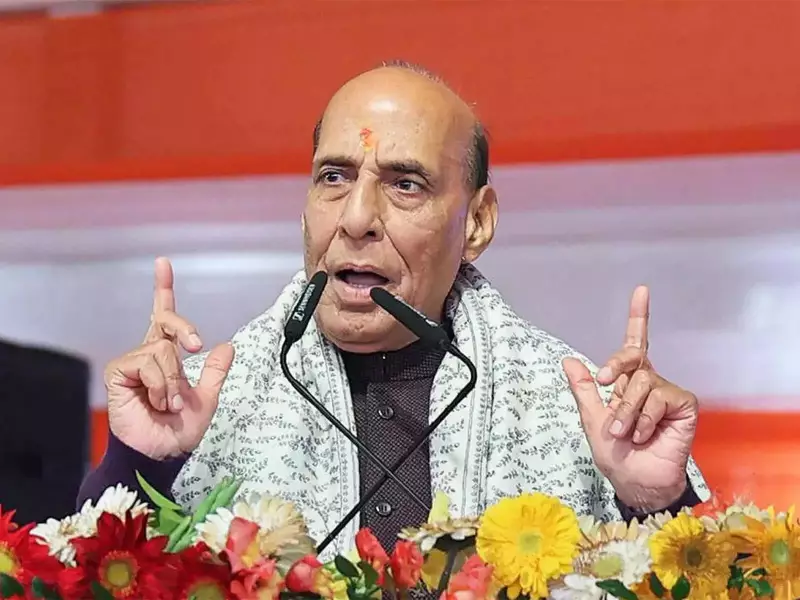
Defence Minister Rajnath Singh issued a stark warning on Friday about a dangerous new pattern of terrorism emerging within India, one driven not by the uneducated but by the highly qualified. Speaking at the 104th foundation day of Bhupal Nobles' University in Udaipur, Singh labelled this phenomenon "white-collar terrorism" and expressed deep concern over educated individuals engaging in anti-national acts.
The Alarming Case of the Delhi Bomb Blast
To illustrate his point, Singh pointed to the chilling case of the November 10 car bomb explosion near Delhi's Red Fort, which resulted in the deaths of 15 people. He revealed that the perpetrators behind this attack were medical doctors. "The perpetrators of the (Delhi) bomb blast were doctors – those who write 'Rx' on prescriptions, yet have RDX in their hands," Singh stated, as quoted by PTI.
Investigations into the explosives-laden i20 car detonation led officials to uncover what they described as a 'white-collar' terror module. This led to the arrest of several individuals, including three doctors identified as Dr. Umar-un-Nabi, who drove the car, Muzammil Ganai, Adeel Rather, and Shaheena Saeed.

Education Must Foster Values, Not Just Competence
Singh used this example to launch a broader critique of modern education, arguing that the pursuit of knowledge without a moral compass is incomplete and dangerous. "Today, an alarming trend of white-collar terrorism is emerging in the country. Highly-educated people are working against society and the country," he said.
He elaborated that the true purpose of education extends far beyond professional success. "The purpose of education is not only professional success but also the development of morality, ethics and human character," the Defence Minister asserted. He presented a chain of ideals: knowledge leads to competence, which leads to prosperity, and prosperity should lead to righteousness, the true source of happiness.
Clarifying that his reference to religion was not about ritualistic practice, Singh explained, "When I talk about religion, it should not be associated with going to the temple, mosque or church for prayer. Religion is a sense of duty." He warned that education devoid of this sense of duty and morality could prove fatal to society.
India's Progress and Future Challenges
Shifting focus to national development, Singh expressed strong optimism about India's growing self-reliance in defence. He praised the work of several defence startups and said, "I am confident that in the next 15-20 years, India will become fully self-reliant in weapons."
On the economic front, he noted that India is currently the world's fourth-largest economy and is firmly on track to become the third-largest by 2030. He emphasized that universities would play a pivotal role in this journey, especially in tackling multidisciplinary global challenges like environmental crises, health pandemics, and digital ethics.
Singh also spoke about the transformative power of emerging technologies like Artificial Intelligence and Machine Learning, stressing the need to harness them positively for national development.
Advice for Students and Teachers
The minister concluded his address with key advice for the academic community. He urged students to think big, avoid letting self-respect turn into arrogance, and to shun a small-minded approach. He hailed teachers as the backbone of the education system and the initiators of great social change in India.
On academic research, Singh pushed for a practical, solution-driven approach. "Mere publication in journals cannot be the ultimate goal of research; its goal should be to bring about changes on the ground," he stated, advocating for research that impacts policymaking and solves social problems.
The event was attended by Chittorgarh MP CP Joshi, Nathdwara MLA Vishvaraj Singh, and several other political leaders.






