Delhi Footbridge Collapse Claims Woman's Life in Roop Nagar
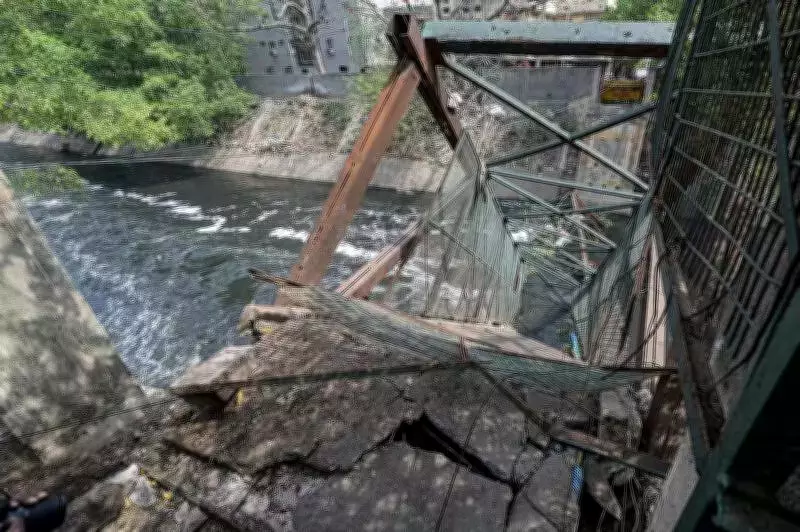
A tragic incident unfolded in north Delhi on Tuesday when a 60-foot iron foot overbridge spanning the Najafgarh drain collapsed, resulting in the death of a woman who fell into the drain water. The structure, located in Roop Nagar, gave way in a slanted form on the Roop Nagar side, highlighting severe infrastructure neglect.
Rescue Operations and Police Response
Following a PCR call at 9.28 am, emergency teams from the police, fire brigade, National Disaster Response Force, and other agencies swiftly arrived at the site near Block 3. Six boat club rescuers conducted an extensive search over 200 meters of the area, retrieving the woman's body after one and a half hours of efforts.
Police identified the victim as likely a beggar in her 50s, though she remains unidentified, with locals confirming they did not know her. DCP (north) Raja Banthia stated that a case under Section 106 (1) of the Bharatiya Nyaya Sanhita, pertaining to causing death by negligence, has been registered at Roop Nagar police station.

Structural Deficiencies and Resident Accounts
The bridge, which connected Rajpura Gurmandi village with Roop Nagar, exhibited clear signs of deterioration. Residents described it as dilapidated, with rusted iron structures, poor-condition nets, and a walking path made of slabs. The water below was flowing strongly, adding to the danger.
Eyewitness Tina, a cook who was just steps away, recounted the horrifying moments. "I noticed the bridge shaking and initially thought monkeys were on it. Then the vibrations intensified, and it collapsed. I saw the woman trying to get up before falling into the drain," she said, adding that she ran home screaming and crying. Tina, who had used the bridge for 12 years, noted it often shook, but she never anticipated such a catastrophe.
Another cook, Sanju, and a woman had just crossed the bridge when they heard warnings to run, seconds before it collapsed with a loud crash. Shopkeeper Totaram described the sound as "just like a blast."
Community Concerns and Safety Neglect
The area, near Delhi University, hosts at least five schools, including government institutions, along with numerous hostels and PG accommodations. Residents expressed relief that the collapse did not occur during peak hours, such as early morning or around 1-2 pm, when many college students, school children, and office-goers use the bridge.
Arvind, a hostel worker, emphasized, "Several children use this bridge to cross. At least four-five people on both sides were about to step on it when it fell." Another resident pointed out that the bridge was less crowded due to most classes and examinations being off, potentially averting a larger tragedy.
Locals revealed that children and others frequently use the bridge to save 10-15 minutes instead of taking the longer main-road route, which is also considered risky. Despite police efforts to install barricades and iron railings to prevent crossing, these measures are often ignored or removed, especially by two-wheeler users. Neeta Mardi, a Roop Nagar resident who witnessed the collapse from her balcony, noted, "Garbage is also thrown onto the bridge, worsening its condition."
This incident underscores critical issues of infrastructure maintenance and public safety in urban areas, raising questions about accountability and preventive measures to avoid future tragedies.