

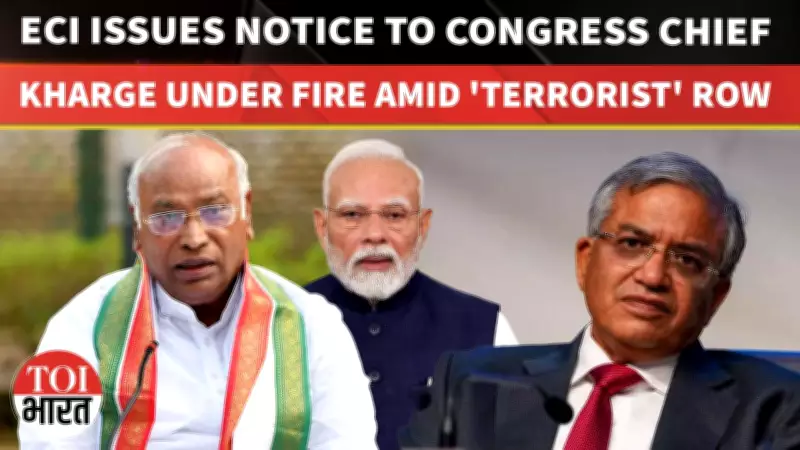
Election Commission Takes Action Against Congress President Over Controversial Statement
The Election Commission of India has formally issued a notice to Congress President Mallikarjun Kharge in response to his highly contentious remark labeling Prime Minister Narendra Modi as a "terrorist." This decisive move comes directly after the Bharatiya Janata Party lodged an official complaint, accusing Kharge of blatantly violating the Model Code of Conduct that governs political conduct during election periods.
BJP's Allegations and Demand for Strict Measures
In its detailed complaint, the BJP has strongly argued that Kharge's inflammatory language constitutes a serious breach of electoral decorum and ethical campaigning standards. The party has emphatically called upon the Election Commission to implement stringent disciplinary actions to uphold the integrity of the democratic process. This incident has injected fresh volatility into an already heated political atmosphere as the nation navigates a critical election season.
Kharge's Defense and the Escalating Political Confrontation
Congress President Mallikarjun Kharge has publicly asserted that his comments were grossly misinterpreted and taken out of their original context. He maintains that his intention was not to personally malign the Prime Minister but to critique certain governmental policies. Despite this clarification, the controversy has rapidly intensified, fueling a fierce war of words between India's two largest political parties and drawing widespread media scrutiny.

The Election Commission's notice mandates Kharge to provide a comprehensive explanation for his statements, evaluating whether they transgress the Model Code of Conduct's provisions against personal attacks and unsubstantiated allegations. This development underscores the Commission's vigilant role in monitoring campaign rhetoric to ensure fair and respectful political discourse.
Broader Implications for Electoral Conduct and Political Accountability
This episode highlights the escalating tensions and aggressive campaigning tactics that have characterized the current electoral landscape. It raises significant questions about the boundaries of political criticism and the enforcement of conduct codes designed to prevent the degradation of public debate. As the Election Commission deliberates on this matter, its ruling could establish a crucial precedent for handling similar disputes in the future, reinforcing the principles of accountability and civility in Indian democracy.
The outcome of this case is being closely watched by political analysts, legal experts, and citizens alike, as it may influence campaign strategies and communication norms for the remainder of the election cycle and beyond.






