Farmers' Protest Leads to Cancellation of Ravi-Beas Tribunal Visit in Ropar
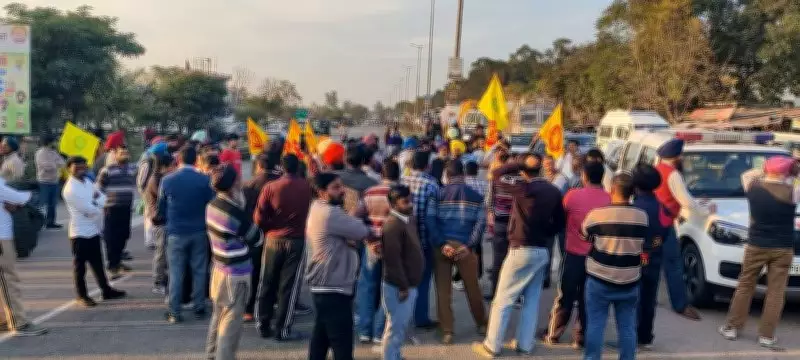
A planned visit by the Ravi-Beas Waters Tribunal (RBWT) to inspect key river infrastructure sites in Ropar district was abruptly cancelled on Friday following widespread protests by the Kirti Kisan Union. The farmers' demonstration, which included road blockades and traffic disruptions, was linked to fears that the tribunal's inspection could signal renewed efforts to revive the contentious Sutlej-Yamuna Link (SYL) Canal project.
Inspection Deferred Amid Law and Order Concerns
According to district administration officials, the tribunal members were scheduled to examine the Bhakra Dam project area and Lohand Khad, where water from the Anandpur Sahib Hydel Canal re-enters the Sutlej River. However, citing potential law and order issues, authorities decided to defer the visit. Officials stated that the inspection would be rescheduled after further consultations with all stakeholders involved in the long-standing water dispute.
Farmer leaders took to social media to voice their suspicions, alleging that the tribunal's visit was part of a broader push by the Union Government to advance the SYL canal initiative. Protesters emphasized that Punjab faces severe water scarcity and lacks surplus water to share with neighboring states, warning against any moves that could restart canal construction activities.

Historical Context of the Ravi-Beas Water Dispute
The roots of the Ravi-Beas water conflict trace back to 1955, when initial allocations of surplus waters were made during an inter-state conference. Following the reorganization of Punjab in 1966, disputes emerged between Punjab and the newly formed state of Haryana over water sharing rights.
In 1976, the Government of India issued a notification reallocating the water share of erstwhile Punjab between Punjab and Haryana after the two states failed to reach a consensus. This allocation was later revised through the 1981 Agreement, signed by Punjab, Haryana, and Rajasthan, which established the following water shares:
- Punjab: 4.22 Million Acre Feet (MAF)
- Haryana: 3.5 MAF
- Rajasthan: 8.6 MAF
- Delhi: 0.2 MAF (fixed allocation)
- Jammu & Kashmir: 0.65 MAF (fixed allocation)
Role of the Ravi-Beas Waters Tribunal
The RBWT was constituted in April 1986 under the Inter-State River Water Disputes Act, as part of the Rajiv-Longowal Accord, to adjudicate disputes related to the sharing of Ravi and Beas waters. The tribunal submitted its initial report on January 30, 1987, but references from the governments of Punjab, Haryana, Rajasthan, and the Government of India seeking clarifications and raising objections have remained pending, prolonging the proceedings for decades.
As of February 2026, the tribunal continues to operate with Justice Vineet Saran as Chairman and Justices P Naveen Rao and Suman Shyam as members. The matter has seen extensive litigation, repeated extensions of the tribunal's tenure, and ongoing disagreements over water availability assessments and utilization patterns.
SYL Canal Project and Ongoing Tensions
The SYL canal project was designed to transport Haryana's allocated share of Ravi-Beas waters. While Haryana asserts its entitlement based on allocation agreements and legal rulings, Punjab consistently argues that it suffers from water scarcity and cannot afford to part with additional resources.
The cancelled Ropar inspection was intended as a routine procedural step to gather updated hydrological and technical data on river flows, canal systems, and current ground realities—a standard practice in inter-state water adjudication. However, given the heightened sensitivities surrounding the SYL issue, even such routine measures continue to provoke strong political and public reactions in Punjab.
With the tribunal's proceedings still active and references pending, the Ravi-Beas water dispute remains one of India's longest-running inter-state river conflicts, ensuring that the SYL canal issue stays firmly in the national spotlight.