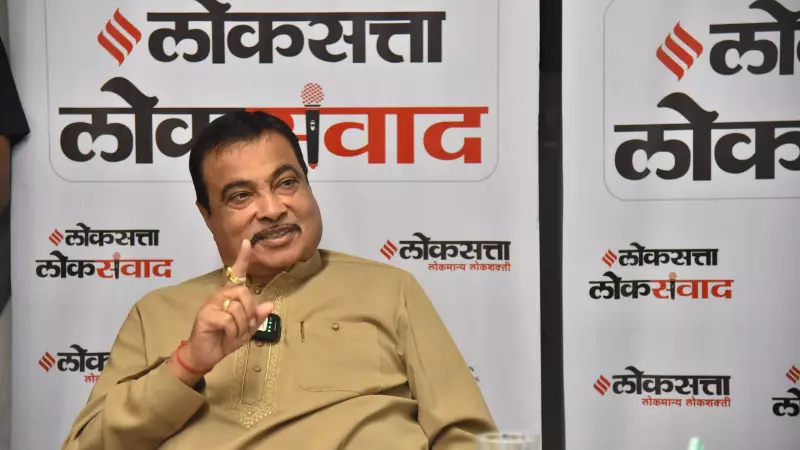
Union Minister for Road Transport and Highways Nitin Gadkari has made a strong case for a fundamental shift in Indian politics, arguing that democracy should be defined by performance and development rather than identity-based appeals. He made these remarks during a visit to The Indian Express office in Nagpur on Monday, December 29, 2025.
The Core Argument: Conviction Over Convenience
Gadkari drew a clear distinction between two styles of politics. He labeled them as 'politics of conviction' and 'politics of convenience.' He firmly aligned himself with the former, stating that his focus is on public service and welfare, not merely on attaining power. "Politics is not about ruling, it is about serving people," he asserted. The minister emphasized that he rejects politics based on caste or religion, believing that people will vote based on tangible work. "Whether I get power or not doesn't matter," he added, underscoring his commitment to this principle.
He pointed out that when politicians fail to deliver on performance, they often resort to caste and religion as shortcuts to electoral success. Gadkari believes the public's primary expectation is development, though he acknowledged that aspirations are endless. "People remember what they did not get more than what they received," he noted, highlighting the need for continuous effort.

Nagpur as a Showcase of Development
Gadkari repeatedly cited his home city of Nagpur as a practical example of his performance-oriented philosophy. He presented a series of infrastructure and civic achievements to back his claims.
On water management, a critical issue in many Indian cities, Gadkari made a significant claim. He stated that Nagpur has not witnessed any drinking water protests in the last ten years. This, he explained, is due to major upgrades including the expansion of the Kanhan water supply to 175 Million Liters per Day (MLD) and machinery modernization. He further revealed that 350-400 MLD of recycled water is supplied to power projects at Koradi and Khaparkheda, mitigating scarcity.
Addressing past criticism about concrete roads causing flooding, Gadkari defended the policy. He explained that a detailed study of the Nag River was conducted after incidents two years ago, leading to actions like widening the river and clearing encroachments. He justified concrete roads by citing Nagpur's black soil, which is unsuitable for long-lasting bitumen roads. "Concrete roads built over the last 30 years have lasted," he said, insisting that Nagpur is now a pothole-free city.
Future Vision: Clean Mobility and Environmental Stewardship
Looking ahead, Gadkari outlined ambitious plans for urban transport and environmental sustainability in Nagpur. He announced a gradual shift to Compressed Natural Gas (CNG) for vehicles, with 160 new CNG pumps planned across the city. He also declared that all city buses will become electric within the next two years.
On a national scale, he set a bold target for the Indian automobile sector, which currently ranks third globally. "India must aim to become the global leader in the automobile sector," he stated, stressing the importance of alternative fuels to achieve self-reliance.
Countering labels of being 'anti-environment,' Gadkari listed his ecological priorities. These include transplanting 100-year-old trees instead of cutting them, developing ecology parks, and working on water purification and waste management. "I want a garbage-free, clean and pollution-free system, and I stand by this commitment completely," he affirmed.
A Plea for Constructive Democracy
Concluding his address, Gadkari called for a more mature political culture. He advised against the "politics of revenge" and mocking opponents, stating that wishing harm upon others is never right in a democracy. He emphasized that strengthening democracy is a shared responsibility of its four pillars: the media, the judiciary, the legislature, and the executive.
Finally, he addressed organizational unity, stating that there are no differences between the Rashtriya Swayamsevak Sangh (RSS) and the Bharatiya Janata Party (BJP). His visit was part of the 'Loksatta Lok Samvad' initiative ahead of Nagpur's municipal elections.