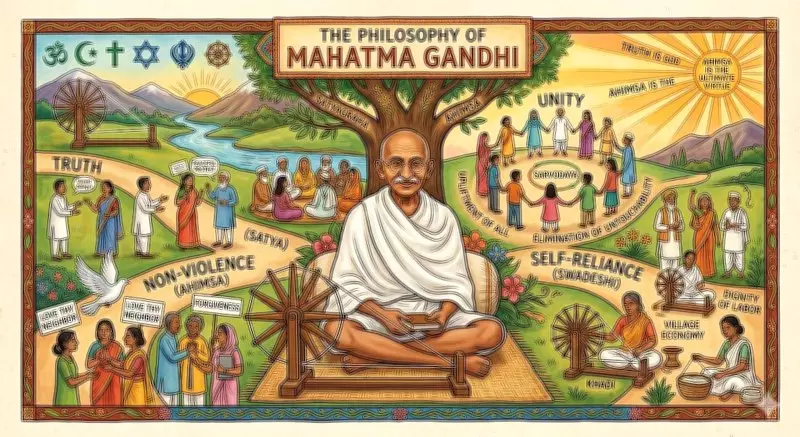
Mahatma Gandhi is often remembered as a political leader who led India to independence, but his legacy extends far beyond that. He was a profound thinker whose ideas on nonviolence, self-reliance, and social justice continue to inspire millions worldwide. This article delves into Gandhi's philosophical contributions, highlighting how his thoughts on truth, simplicity, and civil disobedience were not just tools for political change but a way of life.
The Philosophical Foundations of Gandhi
Gandhi's thinking was deeply rooted in ancient Indian traditions, yet he reinterpreted them in the context of modern challenges. His concept of ahimsa (nonviolence) was not merely a political tactic but a moral principle that governed all actions. He believed that violence only begets more violence, and true change comes through love and understanding. This philosophy was influenced by the Bhagavad Gita, Jainism, and the teachings of Jesus Christ, among others.
Truth and Satyagraha
For Gandhi, truth (satya) was God. He coined the term Satyagraha, which means 'holding onto truth.' This was not passive resistance but active, nonviolent civil disobedience. Gandhi believed that by adhering to truth, individuals could transform society. His experiments with truth, as documented in his autobiography, show how he applied this principle in personal and public life.

Self-Reliance and Swadeshi
Gandhi's economic philosophy emphasized swadeshi (self-reliance). He advocated for local production and consumption to reduce dependence on foreign goods. This was not just an economic strategy but a moral one, aiming to empower villages and promote sustainable living. His vision of a decentralized economy, where communities produce their own necessities, remains relevant today in discussions on sustainability.
Gandhi's Social Reforms
Beyond politics, Gandhi worked tirelessly for social reform. He fought against untouchability, promoted women's rights, and advocated for education for all. His ideas on sarvodaya (welfare of all) envisioned a society where every individual could thrive. He believed that true independence meant freedom from poverty, caste discrimination, and social injustice.
Legacy and Relevance
Gandhi's thinking has influenced global leaders like Martin Luther King Jr. and Nelson Mandela. In contemporary India, his ideas are still invoked in debates on nonviolence, environmentalism, and social justice. However, his legacy is also contested, with critics pointing to his limitations on issues like caste and sexuality. Nonetheless, his role as a thinker who challenged conventional wisdom remains undeniable.
In conclusion, Mahatma Gandhi was not just a leader who mobilized millions; he was a philosopher who offered a blueprint for a better world. His emphasis on ethics, simplicity, and nonviolence provides timeless lessons for humanity. As we navigate modern complexities, revisiting Gandhi's thoughts can inspire us to build a more just and peaceful society.