

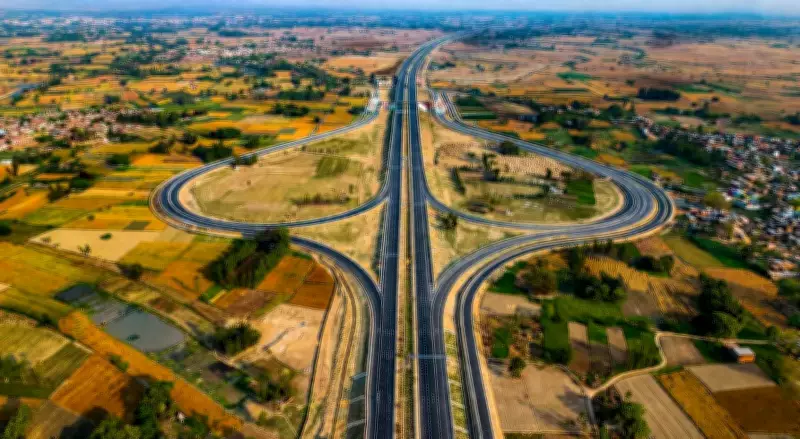
The Uttar Pradesh Expressways Industrial Development Authority (UPEIDA) has announced the toll rates for the newly inaugurated Ganga Expressway, which was opened to the public on Wednesday. Commuters traveling the 594-kilometer stretch between Meerut and Prayagraj will have to pay Rs 1,800 for a single trip in a motor vehicle.
Toll Rates for Different Vehicle Categories
The toll for two-wheelers, three-wheelers, and tractors has been set at Rs 905 for a single journey. Mini buses and commercial vehicles will be charged Rs 2,840 per trip. Buses, trucks, heavy construction machinery, and earth-moving vehicles will pay Rs 5,720 and Rs 8,760, respectively. Vehicles with seven or more axles, such as heavy haulers, trailers, and cranes, will incur the highest user charge of Rs 11,265 for a single trip.
Discounts for Return Trips Within 24 Hours
Commuters who return within 24 hours via the Ganga Expressway will benefit from a reduced fare. Private toll companies have been instructed to deduct 80% of the actual round-trip charges. For example, a car owner would pay approximately Rs 2,880 instead of Rs 3,600, while a two-wheeler rider would pay Rs 1,448 instead of Rs 1,810. Similar discounts apply to other vehicle categories.

Expressway Features and Benefits
The six-lane Ganga Expressway connects 12 districts across western, central, and eastern Uttar Pradesh. Developed under a public-private-partnership model with a budget of Rs 36,230 crore, the project was completed in three years and three months. The expressway is divided into four packages: the first 129.70-kilometer stretch was built by IRB Infrastructure, while the remaining three stretches, totaling 151.70 km, 155.70 km, and 156.8 km, were constructed by Adani Road Transport Limited, an entity of Adani Enterprises Limited.
Previously, a commuter traveling from Meerut to Prayagraj via Aligarh, Etah, Kanpur, and Fatehpur would take an average of 11 to 13 hours to cover approximately 700 kilometers. With the new expressway, travel time is reduced to six to seven hours, thanks to a maximum permissible speed of 120 kilometers per hour.
Safety and Security Measures
UPEIDA Additional CEO Sri Hari Pratap Shahi confirmed that adequate arrangements have been made to ensure commuter safety. Nine wayside amenities will be monitored through cameras, and security personnel will be deployed. Six police patrolling vehicles will maintain vigil in each package to regulate traffic and enforce rules. Additionally, 18 advanced ambulances, eight heavy-duty cranes, eight towing vans, and four hydraulic cranes will be stationed to handle obstructions and hazards.
Commuters in distress can call the centralized emergency number 14449. Medical posts providing first aid have been established at 19 exits and two main plazas at the start and end of the expressway. An ambulance with a driver and two paramedics will be on standby at each of the 21 locations. Additional police patrolling vans may be deployed if congestion or bottlenecks occur at intersections with national highways.
AI-Based Surveillance for Crash Detection
Adani Enterprises, which will collect tolls on three packages, announced the use of artificial intelligence-based surveillance cameras to generate real-time alerts for car crashes. The emergency response system will be activated immediately to assist individuals in need. The AI system provides exact location coordinates to emergency response vehicles. Adani Enterprises developed 464 kilometers of the stretch, approximately 80% of the overall project.
According to Uttar Pradesh government estimates, the expressway will help save Rs 25,000 to Rs 30,000 crore annually by improving logistics efficiency.






