High Voter Turnout Myths Debunked: Expert Reveals Why Incumbents May Benefit
For decades, political analysts have operated under a fundamental assumption: high voter turnout spells trouble for incumbent governments. This conventional wisdom has been cited in countless election analyses, suggesting that when more people vote, it indicates dissatisfaction with the status quo and a desire for change. However, recent data from key Assembly polls is challenging this long-held belief, prompting a reevaluation of what high participation truly signifies in modern Indian politics.
Record-Breaking Turnout in Recent Assembly Elections
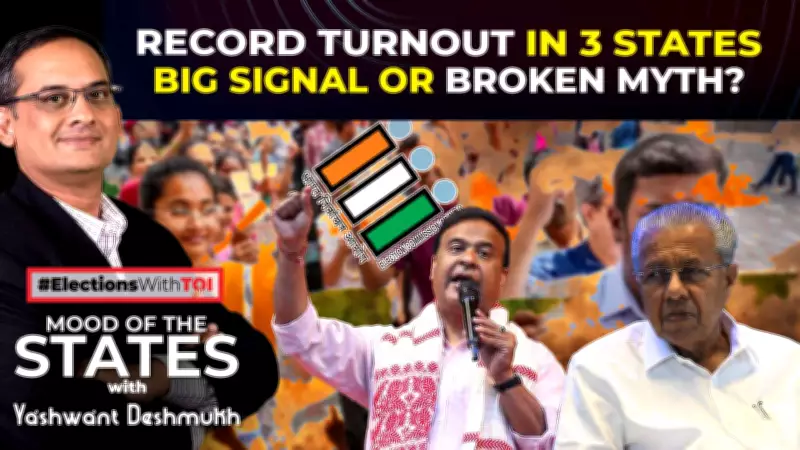
The April 9 Assembly elections witnessed unprecedented voter engagement across multiple states. Assam and Puducherry both recorded their highest-ever voter turnout numbers, while Kerala achieved its second-highest participation rate in history. These remarkable figures initially sparked speculation about potential anti-incumbency waves, but deeper analysis reveals a more nuanced picture that contradicts traditional political narratives.
In an exclusive analysis for TOI's Mood Of The States, renowned political analyst Yashwant Deshmukh of C-Voter presents compelling evidence that this surge in voter participation might actually work in favor of incumbent governments rather than against them. His research suggests that the composition of this increased turnout, particularly the gender dynamics, could be quietly reshaping electoral outcomes in unexpected ways.

The Women Voter Factor: A Game-Changer for Incumbents
Deshmukh's central argument focuses on the significant increase in women voters who participated in these recent elections. This demographic shift represents a potentially transformative development in Indian electoral politics. Historically, women's voting patterns have shown greater stability and different priorities compared to male voters, often favoring continuity and development-oriented governance over radical change.
In Kerala specifically, where the Left Democratic Front government led by Chief Minister Pinarayi Vijayan has implemented numerous women-centric policies and welfare programs, the increased participation of women voters could translate into substantial electoral gains. Deshmukh suggests that this demographic surge might be responding positively to incumbent initiatives rather than expressing dissatisfaction with current leadership.
Rethinking Conventional Political Wisdom
The traditional assumption that high turnout equals anti-incumbency sentiment is being rigorously questioned. Deshmukh's analysis indicates that:
- Increased participation can reflect voter enthusiasm for existing governance rather than opposition to it
- Demographic shifts within the voting population, particularly gender balance, can fundamentally alter electoral dynamics
- Modern voters may be motivated by different factors than previous generations, with development and stability sometimes outweighing desire for change
- The quality and composition of increased turnout matters more than the raw percentage increase alone
This paradigm shift in understanding voter behavior has significant implications for political strategy, campaign planning, and governance approaches. If high turnout can indeed benefit incumbents under certain conditions, political parties may need to reconsider their fundamental assumptions about what drives electoral success.
Broader Implications for Indian Democracy
The reevaluation of the high turnout-incumbency relationship comes at a crucial time for Indian democracy. As voter participation continues to increase across the country, understanding what motivates this engagement becomes increasingly important for both political analysts and policymakers.
Deshmukh's findings suggest that Indian voters are becoming more sophisticated in their political choices, with turnout reflecting complex calculations about governance quality, policy implementation, and future prospects rather than simple anti-establishment sentiment. This evolution in voter behavior represents a maturing of democratic processes that could lead to more stable and predictable electoral outcomes.

As political parties digest these insights, the coming election cycles will test whether this new understanding of voter turnout holds across different regions and political contexts. What remains clear is that conventional wisdom about electoral dynamics must continually evolve to reflect the changing realities of India's vibrant democracy.