

From WWI Messengers to Republic Day Daredevils: The Evolution of Military Motorcycle Display Teams
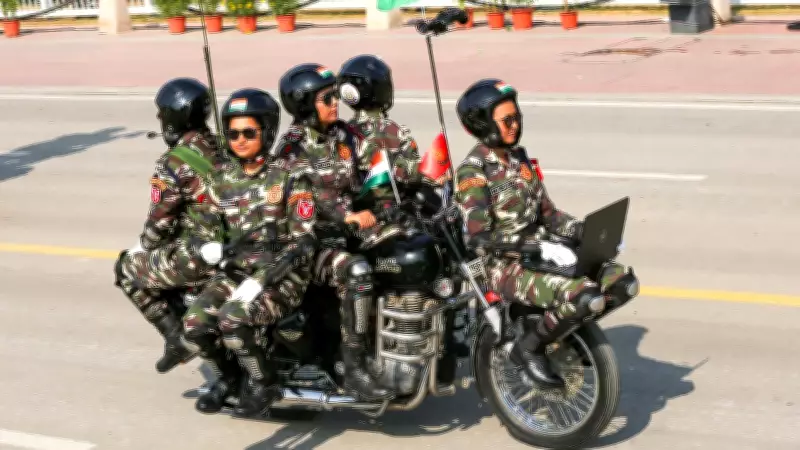
The motorcycle displays by teams from the Central Reserve Police Force (CRPF) and the Sashastra Seema Bal (SSB) during the Republic Day Parade in New Delhi have recently sparked considerable debate on social media platforms. Military veterans, in particular, have voiced strong criticism, arguing that these acrobatic performances appear unmilitary and reduce the dignity of uniformed services to mere caricatures.
The Genesis of Despatch Riders in Wartime
The origins of these display teams can be traced back to the Despatch Riders (DRs) of World War I. During this global conflict, the British army introduced motorcycle-borne messengers to carry crucial despatches between headquarters and field units, thus giving birth to the term Despatch Riders. Initially, these riders were integrated into the Royal Engineers, specifically within the emerging communications organization that included the Signals branch, which managed wire- and telegraph-based communications for British forces.
Following the war, the Signals branch evolved into a separate Corps of Signals in 1920, becoming the central hub for all Army communication methods, both at headquarters and in field formations.

Dangerous Role in World War I
During World War I, Despatch Riders proved to be a reliable alternative for transmitting messages, as wire-based communications were often intercepted or disrupted by enemy forces. With telephone communication being the primary method at the time, DRs provided the only secure means for Army, Corps, and Divisional commanders at the rear to send messages to brigades and battalions at the front lines.
This role was fraught with peril, as many DRs faced German shelling, gas attacks, and treacherous road conditions. Their contributions were vital to the war effort and the outcome of battles, yet their sacrifices have frequently been overlooked in historical narratives.
Historical records available online indicate that casualty rates among Despatch Riders were exceptionally high. Operating alone while delivering messages, they were vulnerable to machine-gun fire, artillery, snipers, ambushes, and mechanical failures. The use of motorcycles for short-range messaging was a revolutionary concept at the time, often complemented by carrier pigeons, which were also employed to send messages to forward troop locations. Thus, DRs played a crucial role in maintaining steady communication channels within the command structure of that era, with Triumph motorcycles serving as their primary mode of transportation.
Despatch Riders in the Indian Army and Beyond
By the time World War II erupted, Despatch Riders had become an integral component of the Indian Army. They continued to transport vital messages, orders, maps, and information to and from various field formation headquarters. From the Normandy landings and Operation Market Garden in Europe to the challenges in the deserts of North Africa and the jungles of Burma, DRs were present in all major battles, essential to every formation.
The Advent of DR Display Teams
According to Major General V K Singh (Retd), who has documented the history of the Corps of Signals, the first Despatch Rider display by the Dare Devils—the Signals display team—was organized in Shimla on March 10, 1935. This display was part of the Silver Jubilee celebrations marking the accession of King George V and Queen Mary to the British throne.
Initial stunts included riding while standing on the motorcycle, navigating through a circle of fire, and riding while facing backwards. The team's mass motorcycle-riding displays earned them a place in the Guinness Book of World Records, a feat later replicated by other Army teams.
From 1935 to 1950, most major Army Signal units maintained small display teams of about 10 members. These teams performed at various unit functions and military exhibitions. Major General Singh notes that organizing and training these distributed teams posed significant challenges, leading to the decision to consolidate them into a single, larger team.

Since their inception, the Dare Devils have performed hundreds of displays across India, including at Republic Day Parades, the 1982 Asian Games, the 1987 SAF Games, the 1994 Third National Games, and the Fourth Military World Games, among many others.
Expansion to Other Forces
The Army Service Corps (ASC) also boasts a Despatch Rider display team known as the Tornadoes, while the Corps of Military Police (CMP) team is called Shvet Ashva. The popularity of these displays has inspired the Central Armed Police Forces (CAPFs) to form their own teams, which incorporate unique features that have sometimes been criticized as over the top.
In the context of modern information warfare, particularly following events like Operation Sindoor, adversaries such as Pakistan have not missed opportunities to target these Republic Day displays. They have flooded the internet with AI-generated images that ridicule the display teams and mock their performances, highlighting the ongoing challenges in the digital age.





