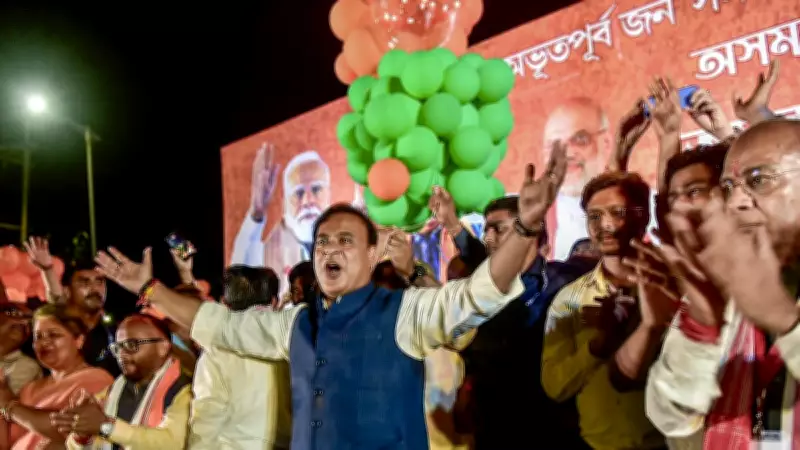
The BJP has successfully saffronised Assam's political landscape, as evidenced by the results of the 2026 Assam Assembly elections. The party bagged 60 seats out of a total of 126, while its allies, the Asom Gana Parishad (AGP) and the Bodoland People's Front (BPF), were elected in 14 and 12 constituencies, respectively. This marks a significant shift from the traditional Sankar-Ajan ideological spectrum to a Sankar-Madhab ‘only’ narrative, reflecting the deepening influence of the BJP's Hindutva agenda in the region.
Electoral Performance and Coalition Dynamics
The BJP's performance in the 2026 elections underscores its growing dominance in Assam. With 60 seats, the party fell just short of a majority but, together with its allies, secured a comfortable ruling coalition. The AGP, a regional party with a long history in the state, managed to win 14 seats, while the BPF, representing the Bodo community, won 12. This coalition, known as the North-East Democratic Alliance (NEDA), has been instrumental in consolidating the saffron vote across diverse communities.
Shift from Sankar-Ajan to Sankar-Madhab
The phrase 'Sankar-Ajan' traditionally refers to the ideological space occupied by the two great saints of Assam: Srimanta Sankardeva and Madhavdeva. However, the BJP has effectively narrowed this space to 'Sankar-Madhab only', emphasizing a singular, homogenized version of Assamese identity rooted in Hindutva. This strategy involved sidelining the more secular and pluralistic interpretations of the saints' teachings, instead promoting a narrative that aligns with the BJP's core ideology.

Key Strategies Employed by the BJP:
- Cultural Nationalism: The party leveraged Assamese cultural symbols, particularly the legacy of Sankardeva and Madhavdeva, to project itself as the true guardian of Assamese identity.
- Anti-Incumbency and Development: The BJP capitalized on anti-incumbency sentiments against the previous Congress government and highlighted its own development initiatives, such as infrastructure projects and welfare schemes.
- Citizenship and Identity Politics: The implementation of the National Register of Citizens (NRC) and the Citizenship Amendment Act (CAA) were used to polarize voters along religious lines, consolidating Hindu votes behind the BJP.
- Alliance Management: By forging alliances with regional parties like the AGP and BPF, the BJP broadened its appeal among different ethnic groups while maintaining a unified front.
Impact on Regional Politics
The saffronisation of Assam has profound implications for the state's political landscape. The BJP's success has marginalized traditional parties like the Congress, which won only 25 seats. The Congress's decline reflects its inability to counter the BJP's aggressive Hindutva campaign and its failure to address local issues effectively. Additionally, the rise of the BJP has led to a reconfiguration of alliances, with smaller parties either aligning with the saffron camp or struggling to remain relevant.
Challenges and Criticisms
Critics argue that the BJP's saffronisation has come at the cost of Assam's pluralistic traditions. The emphasis on a singular cultural identity has alienated minority communities, particularly Muslims and indigenous tribal groups. There are also concerns about the erosion of secularism and the increasing communalization of public discourse. Furthermore, the BJP's focus on Hindutva has sometimes overshadowed critical issues like unemployment, flood management, and infrastructure development.
Future Outlook:

- The BJP is likely to continue its cultural nationalist agenda, further embedding Hindutva in Assam's social fabric.
- The opposition, particularly the Congress and regional parties, will need to reinvent themselves to challenge the BJP's dominance.
- The coalition with AGP and BPF may face strains over time, as regional parties seek to assert their distinct identities while remaining in the saffron alliance.
In conclusion, the 2026 Assam Assembly elections mark a watershed moment in the state's political history. The BJP's saffronisation has transformed the electoral landscape, shifting the ideological axis from Sankar-Ajan to Sankar-Madhab ‘only’. While this has yielded electoral dividends, it also raises questions about the future of Assam's diverse cultural heritage and the resilience of its secular traditions.