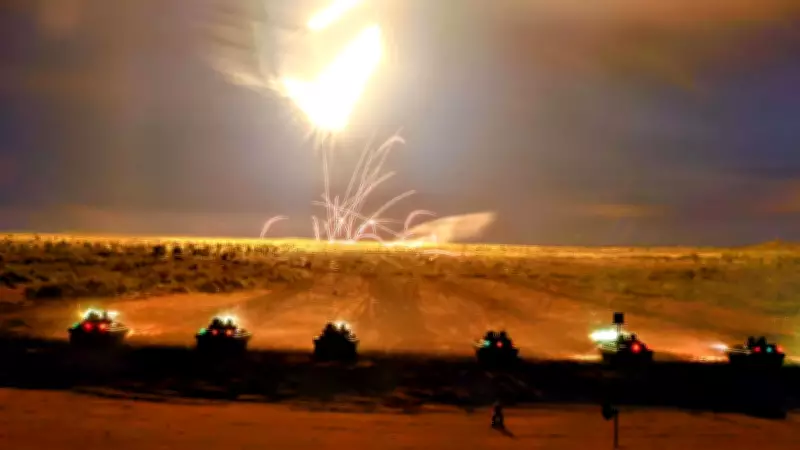
India was compelled to launch Operation Sindoor as a punitive response to the deadly terror attack in Pahalgam, which claimed 26 lives in a cold-blooded manner. The 88-hour operation demonstrated the unique ability of the Indian armed forces to initiate and conclude an armed conflict against a nuclear-armed power.
Lessons from Operation Sindoor
The operation highlighted India's capability to strike any target across Pakistan. In the first few minutes, India simultaneously hit targets separated by over 500 kilometers, ranging from mountainous Muzaffarabad in the north to arid Bahawalpur in the south. As the conflict escalated, the Indian armed forces struck a Surface-to-Air Missile battery in Karachi on the Arabian Sea coast and a critical bunker at Nur Khan Air Base in Rawalpindi near the Himalayan foothills, while also targeting key air bases and radar locations across Pakistan.
Pakistan attempted to retaliate by targeting Indian air bases and the crucial S-400 Triumf air defence complex with a supersonic CM-400AKG missile, which was shot down before reaching its target. Another Pakistani missile fired towards Delhi was intercepted by a Medium Range Surface-to-Air Missile (MR-SAM), negating Pakistan's offensive efforts. However, one Pakistani projectile did land at the Indian Air Force airstrip in Udhampur. The four-day operation underscored India's conventional superiority over Pakistan but also highlighted the need to strengthen defences against evolving threats such as drones and missiles.

Air Defence Modernization
India has embarked on a journey to develop its own system similar to the Israeli Iron Dome, named Mission Sudarshan Chakra. This system, being developed by the Defence Research and Development Organisation (DRDO), was announced by the Prime Minister during his Independence Day speech months after the kinetic phase of Operation Sindoor ended. The upcoming layered air defence system will be capable of firing interceptor missiles at ranges of 350 km, 250 km, and 150 km. The first phase is expected to be ready by 2029, with DRDO testing parts of the system since August 2025. Besides missiles of different ranges, the overall architecture will also incorporate directed energy weapons such as high-powered lasers.
The Indian Air Force is likely to receive the fourth S-400 system in the coming months and the fifth contracted system by the end of the year. The fourth system is expected to be deployed on the western front, while the first system is in Punjab, the second in northern Gujarat, and the third in the eastern sector.
Efforts are also underway to improve the armed forces' capability against drones. Various methods are being explored, including specific missile systems such as the Bhargavastra missile system developed by Solar Industries. The army is also procuring ammunition for 40mm, 30mm, and 23mm guns, and exploring new age methods such as electromagnetic systems, lasers, and radio frequency jammers to counter drones. The importance of a robust air defence system was demonstrated during Operation Sindoor, while the ill effects of lacking such a system were evident in West Asia, where Iranian missiles and drones hit vital targets across a wide arc from Oman to Israel.
Harnessing Drone Power
Drones have proven their utility in recent conflicts. The armed forces, once slow to adapt, are now quickly realigning with the latest technology. They are imbibing the latest drone technology even as the field evolves rapidly. The army is procuring drones for various purposes, including attack, reconnaissance, and logistics. Systems range from small First Person View (FPV) drones to pseudo satellites that fly at super high altitudes, powered by the sun.
The army is also restructuring internal units to use these systems more effectively, with the induction of Ashni platoons for the infantry, Divyastra batteries and Shaktiban regiments for artillery, and Shaurya squadrons for armoured regiments. According to Lt General PR Shankar (Retd), former Director General of Artillery, drone and unmanned technologies have added a new dimension to firepower delivery, being novel, flexible, and devastatingly effective at low cost. Loitering munitions, in particular, will increasingly be in demand, complementing missile systems for deep strikes with precision.

Rocket Force
The Indian army chief earlier this year spoke about the requirement of a rocket-cum-missile force. The army is now seeking its own such force to send long-range vectors deep into enemy territory without risking fighter aircraft or other expensive platforms. During Operation Sindoor, Pakistan attempted to hit targets deep inside India with Fatah-II rockets, which were intercepted over Sirsa. India used long-range missiles effectively, destroying various Pakistani airbases and the early warning radar system with Brahmos, SCALP, and Rampage missiles.
Most of these strikes could be carried out by upcoming variants of the indigenous Pinaka Multi-Barrel Rocket Launch (MBRL) system. A variant with a 200 km range is currently under development. The army has also acquired the Precise & Universal Launching System (PULS), which has a range of 300 km and very high accuracy. These systems are cost-effective and have proven effective in recent conflicts. Even countries with effective air defence shields, like Ukraine, have struggled to tackle these systems, forcing defenders to deplete expensive surface-to-air missile stocks.
5th Generation Fighters
Low observability, or stealth, has been critical since the First Gulf War in 1991, when American F-117s and B-2s struck Baghdad. The F-117 constituted 2.5% of coalition shooters on the opening night but destroyed 31% of targets. Even now, the F-35 led the air campaign to bomb Iran in June 2025 and Venezuela earlier this year.
The Indian Air Force currently lacks a fifth-generation platform. India is developing its own Advanced Medium Combat Aircraft (AMCA), expected to enter service by 2035. Meanwhile, China operates the J-20 and is inducting the J-35, which Pakistan is also expected to acquire. To bridge the gap, the Indian Air Force is reportedly considering the Russian Sukhoi-57 as an interim measure.
Persistent ISR & Satellites
To maintain perpetual surveillance of the enemy, the three services are establishing Space Based Surveillance (SBS) capabilities. They plan to deploy a constellation of 52 satellites over five years, providing the ability to monitor enemy movements, keep watch on borders, and establish satellite-based communication networks. Half of the satellites will be built by the private industry, while the remainder will be built by ISRO.
The armed forces are also seeking stratospheric airships capable of flying at 25 to 35 km, well above commercial airliner altitudes of 10-12 km. These systems will cue targets using low probability of intercept radars and electro-optics. Additionally, high altitude pseudo satellites—solar-powered autonomous unmanned aircraft—are being procured to fly at 60,000 feet for up to 90 days. These assets will create a web of persistent surveillance, complementing the existing High Altitude Long Endurance (HALE) and Medium Altitude Long Endurance (MALE) UAVs.
Jointness
During Operation Sindoor, the three services acted cohesively and in a coordinated manner. Planning and execution were synchronized, with targets divided between the army and air force. Air defence was handled jointly. India's military modernisation is centered on restructuring through Integrated Theatre Commands (ITCs), designed to unify Army, Navy, and Air Force capabilities by geography and function. Studies are underway to establish Theatre Commands for land borders, maritime operations, and joint air defence. Chief of Defence Staff Gen Anil Chauhan emphasizes that jointness and integration are prerequisites, with ITCs separating operational roles from administrative functions, enabling commanders to focus on security. These reforms mark a shift toward multi-domain operations, integrating space, cyberspace, digitization, and data-centric warfare.
Information Warfare: Narrative Dominance
General Anil Chauhan stated that 15% of the armed forces' effort went into countering fake narratives initiated by Pakistan. The Indian armed forces, in conjunction with the Ministry of Information and Broadcasting (MIB), countered the disinformation campaign launched by Pakistan's Inter Service Public Relations (ISPR). The Press Information Bureau's Fact Check Unit (FCU) worked overtime to debunk fake Pakistani narratives almost in real time. Over 1,400 URLs spreading fake news were blocked by the MIB.
Operation Sindoor was a massive success for India, demonstrating that no terror target in Pakistan is safe. Pakistan learned that even with its armed forces fully alert, Indian weapons will still hit the pride of the Pakistani armed forces, as evident in Karachi, Sargodha, and Nur Khan. The Indian armed forces have analyzed the 88-hour kinetic operation minute-by-minute and are now closing capability gaps while building on strengths. As Operation Sindoor is paused, not stopped, India has sent a clear 'desist or else' message to Pakistan, with the next 'or else' potentially being one that no narrative could wipe off.