

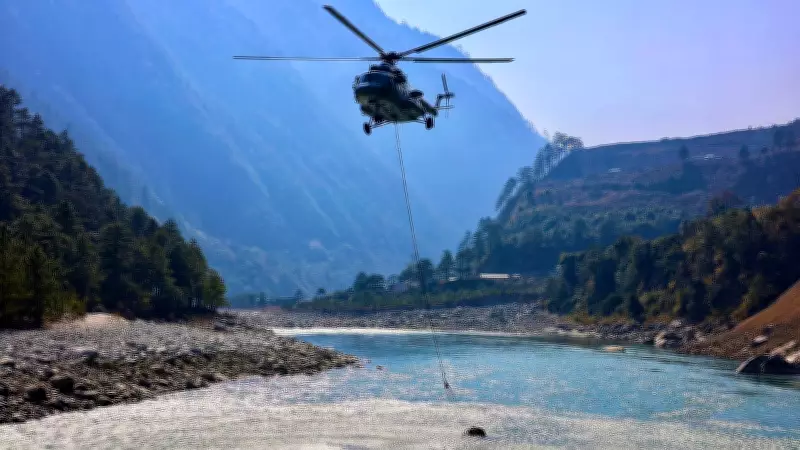
IAF Launches High-Altitude Firefighting Mission in Arunachal's Lohit Valley
The Indian Air Force has deployed its formidable Mi-17V5 helicopters in a daring aerial firefighting operation to combat a massive forest fire raging through the challenging terrain of Arunachal Pradesh's Lohit Valley. In a display of exceptional skill and precision, the helicopters successfully dropped approximately 12,000 litres of water over the fire-affected zones, marking a significant intervention in one of India's most ecologically sensitive regions.
Challenging Operations at 9,500 Feet Altitude
The firefighting sorties were conducted at an extraordinary altitude of around 9,500 feet, where thin air and rugged geography create conditions far more demanding than typical operations in plains areas. According to IAF officials, the aircraft navigated narrow ridgelines above the Lohit River, targeting areas that remain largely inaccessible to ground crews due to steep slopes and dense forest cover.
The aerial intervention was initiated following a formal request from the Arunachal Pradesh government, as local forest and disaster response teams encountered significant difficulties reaching the blaze on foot. Movement through the challenging landscape was severely hampered by sharp ridges and thick vegetation, necessitating specialized aerial support.

Multi-Agency Response and Safety Measures
Army units stationed in the eastern sector joined the coordinated effort, working alongside state forest officials to establish fire lines and monitor the spread of flames. This collaborative approach between military and civilian agencies demonstrates India's growing capability in disaster response and environmental protection.
District authorities implemented precautionary measures by relocating residents from vulnerable locations and arranging basic relief provisions. Fortunately, no casualties or major property damage have been reported thus far, though the ecological impact of the fire remains a concern for conservationists.
Social Media Recognition and Public Response
Videos and images from the operation have generated widespread attention across social media platforms, with numerous users praising the courage and professionalism of the IAF pilots and crews. One social media comment highlighted: "Whether it's defending borders or saving ecosystems, the Indian Air Force always delivers, exceptional work in the Lohit Valley."
Another user emphasized the technical difficulty of the mission, noting: "That's some serious flying under pressure, dropping 12,000 liters at 9,500 feet is no joke. Major respect for protecting that ecosystem." The operation has been widely recognized as demonstrating both exceptional flying skills and a strong commitment to environmental conservation.
Context and Significance
This mission follows closely on the heels of a similar wildfire operation in the Khonoma-Dzukou Valley of neighboring Nagaland, indicating a pattern of increased fire incidents in the northeastern Himalayan region. The successful execution of such challenging high-altitude operations showcases the IAF's evolving capabilities in non-traditional roles beyond conventional defense operations.
The Mi-17V5 helicopters, known for their versatility and performance in difficult conditions, proved particularly well-suited for this demanding mission. Their ability to operate effectively in rarefied Himalayan air while carrying substantial water payloads represents a significant advancement in India's aerial firefighting capabilities.
As climate patterns continue to evolve and forest fires become more frequent in sensitive ecosystems, such coordinated responses between military and civilian agencies will likely play an increasingly crucial role in India's environmental protection strategy. The Lohit Valley operation serves as both a testament to current capabilities and a model for future disaster response initiatives in challenging terrains across the country.






