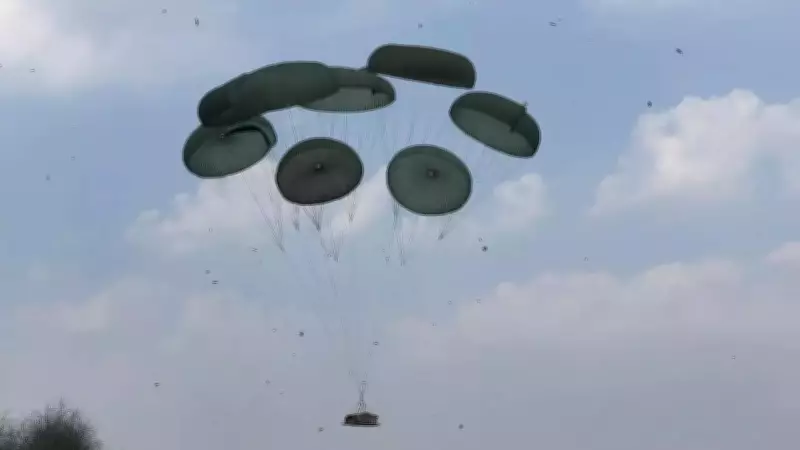
Indian Army Validates Indigenous Heavy Drop System for Strategic Deployment
The Indian Army has achieved a significant milestone by successfully testing a new indigenous system designed for air-dropping heavy military vehicles and equipment into remote and inaccessible areas. This development marks a crucial advancement in the nation's defence capabilities, particularly for operations in challenging terrains.
Advanced System Details and Development
The system, officially designated as the Advance 28-ft Heavy Drop System – 20T (Type V), underwent rigorous validation during trials conducted at the Mahajan Field Firing Ranges on February 17, 2026. Developed by Airbornics Defence & Space in collaboration with the Defence Research and Development Organisation (DRDO) through its Aerial Delivery Research and Development Establishment, this project is a key component of the broader Make in India initiative aimed at boosting indigenous defence manufacturing.
Operational Capabilities and Mechanism
This heavy drop system is engineered to deploy large cargo and mechanised military platforms from transport aircraft, with a remarkable capacity to handle payloads of up to 20 tonnes. It is fully compatible with heavy-lift aircraft such as the Lockheed Martin C-130J Super Hercules and the Boeing C-17 Globemaster III, ensuring versatility in military logistics.

The system features a newly developed 28-foot platform integrated with an advanced parachute setup. This configuration utilises a pack of two 28-foot extractor parachutes combined with a four-point link system, which allows for the safe and controlled extraction of heavy loads from aircraft and their subsequent lowering to the ground.
Recent Trial and Strategic Implications
In a departure from previous tests, the latest trial involved the actual air-drop of an armoured vehicle, specifically a BMP armoured personnel carrier weighing approximately 15 tonnes. Conducted under near-realistic operational conditions, this test employed the twin extractor system to manage the heavier load and ensure stable deployment, demonstrating the system's robustness and reliability.
The successful validation of this system enables mechanised platforms to be deployed in high-altitude regions and remote areas where road access is limited or slow. This capability is expected to significantly enhance the Indian Army's operational responsiveness, allowing forces to react more swiftly during critical missions and emergencies.
Furthermore, the trial confirmed that heavy combat platforms can be effectively deployed from various classes of transport aircraft, broadening the strategic options available for military planning and execution. This innovation underscores India's growing prowess in defence technology and its commitment to self-reliance in national security.