

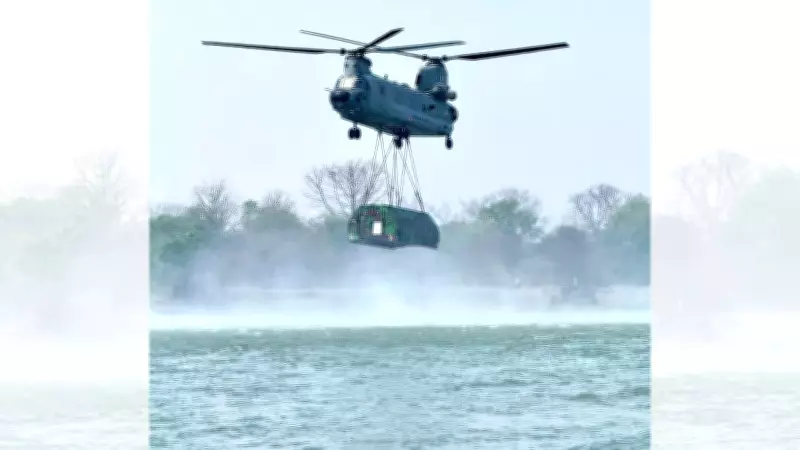
Indian Armed Forces Achieve Milestone with Chinook Helicopter Deployment of Assault Bridge
In a historic first, the Indian Army and Air Force have successfully deployed a heavy-duty assault bridge using a Chinook helicopter during a joint exercise in the Western Sector. This innovative maneuver marks a significant advancement in the military's ability to rapidly establish critical bridging infrastructure, crucial for both combat scenarios and emergency relief operations.
Enhancing Offensive and Response Capabilities
The pontoon assault bridge, a vital component for offensive formations, is designed to facilitate the crossing of water bodies such as rivers and canals, which are common in the operational terrain of the Indian Army's Western Command. Traditionally, these bridge segments are transported by Tatra trucks and assembled on-site to create spans of up to 300 meters, supporting heavy equipment like the T-90 Bhishma Main Battle Tank.
By leveraging the Chinook helicopter, India's heaviest operational chopper with a lifting capacity of 10 tons, the forces can now deploy these bridges at breakneck speeds. This capability is particularly valuable in riverine areas of Punjab and Jammu, where water obstacles have historically posed challenges, as seen in conflicts like the 1971 war's Meghna heli-bridge operation.

Strategic Implications and Joint Operations
This development underscores the growing synergy between the Indian Army and Air Force, enhancing joint war-fighting capabilities under the JAI strategy, which emphasizes Jointness, Atmanirbharta (self-reliance), and Innovation. The exercise exemplifies efforts toward greater integration, following recent large-scale drills such as Exercise Trishul.
Beyond military applications, the ability to airlift assault bridges proves invaluable during natural calamities, enabling quicker deployment of temporary pontoon bridges to improve access to affected regions. The Chinook, previously used in high-altitude areas from Arunachal to Ladakh, replaces the Mi-26 in this role, showcasing India's commitment to modernizing its defense infrastructure.
This milestone not only boosts offensive potential but also reinforces the armed forces' readiness to address diverse challenges, from battlefield maneuvers to humanitarian crises, ensuring a more agile and responsive defense posture.






