

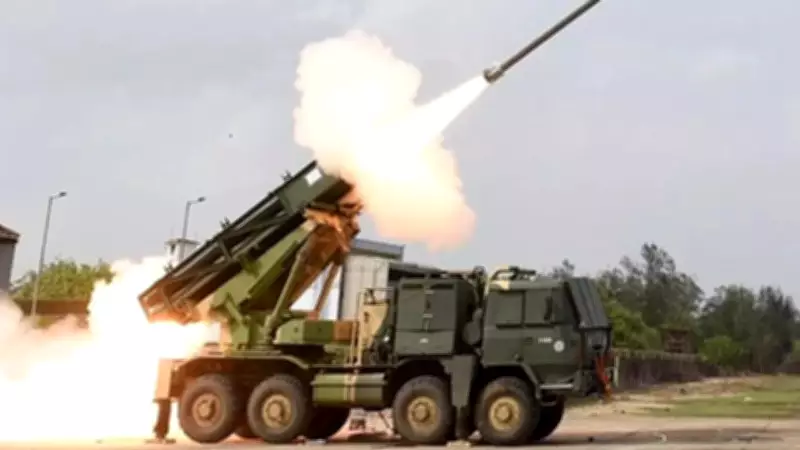
The recent conflicts between Russia and Ukraine, as well as the United States and Iran, have fundamentally altered the paradigms of military power and its application. The extensive use of drones, rockets, artillery, and missiles in these wars has sparked a debate in India regarding the creation of a dedicated Indian Rocket Force. However, this idea remains shrouded in hazy uncertainty and poor imagination. Rather than reactively mimicking the structures of our adversaries, India must develop a force tailored to its specific requirements and based on existing strengths. We must not reinvent the wheel. India does not have the bandwidth—in terms of time, space, or finances—to handle a completely new system.
Conceptual Foundations for the Indian Rocket Force
The Indian Rocket Force cannot be driven solely by the availability of hardware. It must be grounded in a clear concept and operational philosophy. To put this in perspective, Pakistan's newly minted Army Rocket Force focuses on removing its blind spot exposed during Operation Sindoor: deterrence and deep strike in the conventional domain. China's PLARF projects nuclear ambiguity and anti-carrier (A2/AD) capabilities for its Pacific theater. The Russian force is purely nuclear and strategic in nature. India's requirements are far more nuanced.
Five Key Goals for the Indian Rocket Force
Any Indian Rocket Force must achieve five conceptual goals. First, it must possess conventional deterrence capability to prevent adversaries from embarking on misadventures through the promise of overwhelming precision fire. Second, it needs the capability to strike deep using its long-range vectors, both current and futuristic. Third, unlike the rocket forces of other countries that operate in silos, which is not conducive to battlefield synergy, India requires a force that can reinforce the firepower requirements of frontline troops during contact battles. It must provide additional firepower from battalion to corps commanders during such engagements. Fourth, the force must promote, enhance, or enable maneuver, or generate maneuver by fire in seemingly static battlefields. The principle is to restore maneuverability to the battlefield. This also involves horizontal escalation, as witnessed in Iran. The force must enable India's strategic goals to be achieved without direct troop engagement. Fifth, the force must be multiplicative and complementary, not divisive. It should promote jointness between the Army, Navy, and Air Force, acting as a force multiplier rather than becoming a competitor for resources.

Two Pillars: Firepower and ISR
The force revolves around two pillars: firepower and ISR (Intelligence, Surveillance, and Reconnaissance). Firepower in contemporary warfare rests on DRAM: Drones, Rockets, Artillery, and Missiles. However, one must realize that although modern warfare has segregated these elements, they have always been part and parcel of the Regiment of Artillery in thought and deed for over a quarter of a century in India. Any attempt to disaggregate them is pure foolishness, as it violates two basic principles of war: Concentration of Force and Economy of Effort. This is especially highlighted because some myopic vested interests in the Army have believed in the principle of "Divide and Rule" to accrue benefit to their "lanyard" buddies. This has always been to India's detriment, and we are suffering for it already. Enough of such nonsense. If we are generals, we need to look beyond our lanyards and regimental loyalties and work for the nation.
The second pillar is ISR. Without "eyes" in the form of advanced sensors, speedy communication, and networking, firepower is "blind." An effective "kill chain" is the seamless pairing of the sensor and shooter through impenetrable networks. The age-old process of seeing, acquiring, and hitting a target remains a fundamental requirement. This requires integrating space links, electronic warfare (EW) capabilities, and persistent UAV surveillance to ensure that long-range vectors can strike with precision.

Leveraging Existing Assets: Artillery Divisions
Fortunately, India does not need to start from scratch. It already possesses a "gold mine" in its three Artillery Divisions, which have been in existence for over 25 years. These divisions already have all the elements and structural DNA of a rocket force: 155/130 mm guns, Grad, Pinaka, and Smerch MBRLs, and Brahmos missile regiments. They have the communication and networking architecture with a streamlined command and control system. This capability existed long back when the author commanded an Artillery Division. If these divisions are now equipped with latest or upgraded missiles, ammunition, UAVs, and some other specially purposed equipment, we have a rocket force in place. Hard to believe? It is there in the open for all blind men to see. It is as easy and simple as that. Of course, there is a need to inject modern technology and equipment into the system and staff it jointly.
Expansion and Strategic Deployment
To truly secure its borders and maritime interests, India needs to expand from three artillery divisions to eight or nine. These should be strategically stationed to cover both the northern and Western Fronts, as well as our maritime borders, including the Andaman and Nicobar Islands. If the Andaman and Nicobar Islands must become the unsinkable aircraft carrier of menace as the Chinese have long feared, an artillery division in the Andamans—suitably equipped with long-range missiles and capable of providing a potent A2/AD (Anti-Access/Area Denial) capability—is the answer.
Overcoming Mental Hurdles
A cool and sane analysis will indicate that the hurdle is not financial or physical, but mental. For too long, the Artillery Division has been treated as a reinforcing entity within the confines of a corps battle rather than an organization of national power projection. It is time to shed this myopic and outdated thinking, which rests on the faulty premise that artillery is a support arm. In fact, repurposing the artillery divisions with a new concept as explained will be a huge jump in operational capability at the strategic level. It will also save the government exchequer from incurring huge costs of raising a duplicative "Rocket Force." It will promote jointness and contribute to theaterization. If India can overcome its "failure of imagination," one gets "more bang for the buck." One last point: to achieve anything of what has been stated, the Indian Army must stop stuffing NCC with high-caliber artillery officers. Get the gunners on the job. They made India proud in Kargil and during Operation Sindoor. They will deliver again and again.





