India's Drone Warfare Ambitions: Scaling from Nagastra-1 to Project KAL
The ongoing confrontation between the United States and Iran has starkly revealed a new reality in modern warfare: the decisive advantage no longer rests solely with tanks, fighter jets, or missiles, but increasingly with swarms of inexpensive, expendable, and intelligent unmanned systems. From Iran's deployment of Shahed-series loitering munitions to America's reverse-engineered low-cost strike platforms, this conflict underscores a structural transformation in how wars are fought and sustained. Unmanned aerial systems have evolved from auxiliary assets to central elements shaping strategy, dictating operational tempo, and redefining cost equations. A drone costing tens of thousands of dollars can now neutralize assets worth millions, making endurance, scalability, and production capacity as crucial as technological sophistication.
The Age of Cheap Precision: Why Drones Are Redefining Warfare
Recent conflicts, particularly the Russia-Ukraine war and the US-Iran confrontation, deliver a clear lesson: warfare has entered an era where affordability and mass production are as critical as precision. Loitering munitions, often called kamikaze drones, exemplify this shift by combining the persistence of surveillance platforms with the lethality of guided munitions. They can loiter over target areas, identify opportunities, and strike with minimal warning, offering a cost-effective alternative to traditional missiles. Iran's Shahed-136, with a range of around 2,000 kilometres and a modest warhead, has become the archetype of this model. Its strength lies in simplicity and scalability, produced in large numbers to alter the economics of air defence by forcing adversaries to expend costly interceptors on low-cost threats. The United States has acknowledged this shift with its Low-cost Unmanned Combat Attack System, developed by reverse-engineering captured Shahed drones, reflecting a pragmatic recognition that the future of warfare hinges on mass-producible systems alongside exquisite platforms.
Where India Stands in the Global Drone Race
India occupies a transitional space in the global drone hierarchy, positioned between technological competence and industrial under-preparedness. It is neither a laggard nor a leader but a capable yet constrained player attempting to bridge the gap between innovation and scale in an ecosystem defined by mass production and cost efficiency. At a capability level, India has made undeniable progress over the past decade, developing or inducting systems across the entire drone spectrum, from high-altitude long-endurance platforms to tactical surveillance UAVs, loitering munitions, and counter-drone technologies. Indigenous programmes such as Nagastra, ALS-50, and Switch UAVs demonstrate that Indian industry can design and deploy mission-ready systems tailored to diverse terrains, from deserts to high-altitude borders. Operation Sindoor reinforced this by showing that Indian forces can integrate drones into real-time combat scenarios with measurable impact.

However, global leadership in drone warfare is no longer determined by the ability to build a few advanced systems but by the capacity to produce thousands of affordable, expendable platforms and sustain their deployment over extended periods. This is where India's position becomes more complex. The United States dominates the high-end segment with platforms like the MQ-9 Reaper while adapting to mass drone warfare economics. Russia and Ukraine have demonstrated industrial-scale drone warfare, deploying hundreds of thousands of units annually. Turkey has carved a niche with cost-effective combat drones like the Bayraktar series, and Iran has mastered producing simple but effective long-range kamikaze drones in large numbers. Even Pakistan has moved aggressively through Chinese collaboration.

Against this backdrop, India's challenge is not one of design but of depth. Its production runs remain limited, often in the hundreds, constraining operational flexibility and deterrence value. Without large-scale orders, manufacturers struggle to justify investments in assembly-line production, creating a cycle where low demand limits supply capacity, and limited capacity restricts demand. Supply chain dependencies on critical components such as sensors, semiconductors, and communication modules from external sources could create vulnerabilities in prolonged conflict scenarios if global supply chains are disrupted.
That said, India is not static. Policy interventions, including production-linked incentives, eased drone regulations, and increased defence procurement from domestic players, are gradually reshaping the landscape. The entry of private players and startups has injected agility, accelerating innovation cycles. Programmes like iDEX and emergency procurement during Operation Sindoor have shown that the system can respond quickly and at scale in the short term. Emerging projects such as long-range kamikaze drones and swarm systems indicate India's acute awareness of future trends, shifting focus from standalone platforms to networked systems, swarming, autonomy, and resilience in contested electronic environments.
Operation Sindoor: India's Drone Moment
Operation Sindoor marked a doctrinal shift in India's military thinking, integrating drones across multiple layers of combat operations rather than treating them as supplementary assets. From frontline reconnaissance to deep-strike missions, drones played a central role, demonstrating the effectiveness of a networked drone ecosystem. First-person view drones provided real-time situational awareness, loitering munitions conducted precision strikes, surveillance UAVs extended operational visibility, and counter-drone systems ensured protection against hostile unmanned threats. This layered approach reduced risk to personnel, improved response times, and enhanced battlefield efficiency. However, the scale of deployment remained limited, with India reportedly using around 100 drones during the operation, a fraction of numbers seen in contemporary conflicts elsewhere. The lesson was clear: capability exists, but scale does not.
Nagastra-1: India's Indigenous Loitering Munition
At the heart of India's indigenous drone capability lies the Nagastra-1, a loitering munition developed through collaboration between private industry and defence startups. Designed as a portable, precision-strike system, it represents India's attempt to build a homegrown equivalent to global kamikaze drones. The Nagastra-1 is a lightweight, man-portable system that can be carried in two backpacks, combining a fixed-wing UAV with a pneumatic launcher, ground control station, and communication systems. With flight endurance up to 60 minutes and a range of 15 kilometres in manual mode, extendable to 30–40 kilometres autonomously, it offers flexibility across operational scenarios. Equipped with day and night surveillance cameras, it can identify and track targets before executing a strike with a warhead weighing 1 to 1.5 kilograms, minimizing collateral damage. Its man-in-loop system allows operators to make real-time decisions, abort missions mid-flight, and recover the drone using a parachute mechanism, enhancing cost efficiency. During Operation Sindoor, the Nagastra-1 was deployed for precision strikes against selected targets, validating the concept of indigenous loitering munitions in operational conditions. However, orders for a few hundred units fall short of the thousands required for sustained high-intensity conflict.
Beyond Nagastra: The Broader Drone Ecosystem in Sindoor
Operation Sindoor's significance lay in creating a layered, multi-platform drone ecosystem where different unmanned systems performed specialised roles within an integrated operational framework. This marked a shift from earlier doctrines where drones were largely limited to surveillance. In Sindoor, they became central to decision-making, strike execution, and defensive operations. At the higher end, India deployed loitering munitions like the Israeli-origin Harop for suppression of enemy air defences. Mid-tier systems like SkyStriker and indigenous platforms such as ALS-50 added depth. At the tactical level, short-range surveillance drones and first-person view drones delivered real-time intelligence. Counter-drone systems like Bhargavastra ensured protection. What made this ecosystem effective was its integration, but constraints persist with high-end capabilities relying on imports and overall deployment limited by production capacity.
The Cost Dilemma: MQ-9B vs Mass Drones
India's acquisition of 31 MQ-9B Predator drones, at an estimated $3.5 billion, represents a significant enhancement in surveillance and strike capability with high-altitude, long-endurance UAVs. However, this investment reflects a focus on high-end capability rather than mass deployment. In contrast, the economics of drone warfare increasingly favour low-cost, expendable systems, where tens of thousands of kamikaze drones could potentially be produced for the same cost, offering greater flexibility in prolonged conflicts. This highlights the need for balance in a modern drone force, requiring both sophisticated systems for strategic missions and large numbers of affordable platforms for tactical operations.
Project KAL and Sheshnaag-150: India's Answer to Shahed
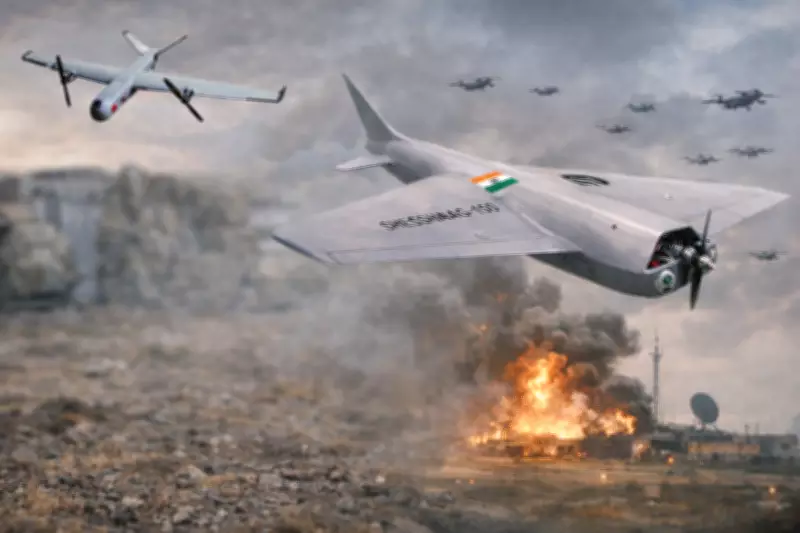
Recognising the need for long-range, low-cost strike capabilities, Indian defence startups are developing systems mirroring the operational philosophy of the Shahed-136. Project KAL, developed by a Noida-based company, is designed as a long-range kamikaze drone with endurance of three to five hours, aligning with deep-penetration warfare requirements. The Sheshnaag-150 represents a more ambitious evolution as a swarm-capable attack drone with an operational range exceeding 1,000 kilometres and endurance over five hours, intended to strike strategic targets. Its swarm capability allows multiple drones to operate in coordination, overwhelming enemy air defences through sheer numbers and synchronised behaviour, reflecting the next stage of drone warfare. Both projects remain in development, with success depending on technological performance and the ability to scale production.
Vayu Baan and the Evolution of Air-Launched Drones
Another significant development is the Vayu Baan programme, focusing on air-launched unmanned systems and signalling a shift towards deeper integration of drones within combat operations. Designed to be deployed from helicopters, these compact platforms can function as surveillance assets or precision-guided munitions, expanding tactical reach without increasing risk to personnel. With an expected range over 50 kilometres and endurance around 30 minutes, they are suited for missions like real-time reconnaissance and target acquisition in contested environments. This concept aligns with global trends of manned-unmanned teaming, enhancing battlefield flexibility and survivability.
The Scale Problem: Hundreds vs Thousands
The most critical challenge facing India's drone programme is scale. Modern conflicts have shown that effectiveness is determined not solely by technological superiority but by the ability to sustain operations over time. Ukraine and Russia have deployed hundreds of thousands of drones in a single year, indicating the future trajectory of warfare. India's deployment during Operation Sindoor, while operationally significant, remains modest by comparison. Orders for systems like Nagastra-1 in the hundreds do not justify large-scale production lines, making scaling up during a conflict difficult. This issue is not merely industrial but strategic, as a country unable to produce drones at scale risks being outpaced in prolonged engagements.
Where Is India's Shahed?
India's push for indigenous defence manufacturing has delivered visible results in the drone segment, with platforms like Nagastra-1, ALS-50, and emerging systems like Sheshnaag-150 reflecting growing domestic capability. Much of this progress is driven by the private sector, supported by government initiatives. Yet, the central question remains: where is India's equivalent of the Shahed-136? The answer lies in the gap between capability and scale. While India can build effective loitering munitions and long-range strike drones, it has not yet translated this into mass production. Supply chain dependencies, regulatory complexities, and fragmented demand constrain large, sustained production lines. The Shahed is a model of warfare built on simplicity, affordability, and industrial-scale manufacturing, where India still lags. Projects like KAL and Sheshnaag-150 show the technological foundation exists, but without urgency and scale, progress remains incomplete.
The Road Ahead: From Capability to Capacity
Operation Sindoor marked the beginning of India's drone-centric warfare doctrine, demonstrating that the country can design, deploy, and integrate unmanned systems effectively. The next phase will be defined by scale, integration, and innovation. Building assembly-line production capabilities, investing in swarm technologies, and developing resilient communication systems will be critical. Equally important will be integrating drones into everyday military operations, with plans to establish dedicated drone units within infantry formations indicating a shift towards institutionalising unmanned systems. The future battlefield will be dominated by networks of interconnected systems operating across domains, where adaptability and scalability are as important as technological sophistication. India has taken the first steps; the challenge now is to accelerate.