

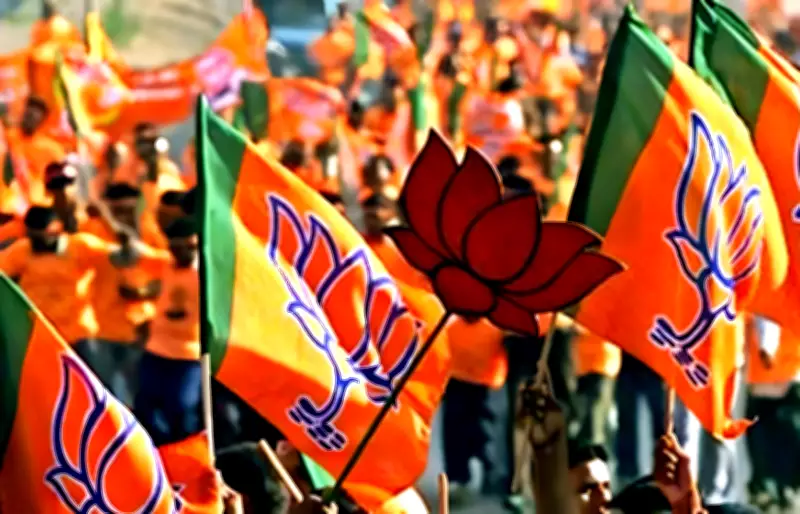
The political map of India today appears decisive, almost settled. Large parts of the country are under the rule of the Bharatiya Janata Party (BJP) or its alliance partners. As of May 2026, the BJP-led National Democratic Alliance (NDA) is in power in 21 out of 31 states and Union Territories, numbers that point to the sheer dominance of the ruling coalition.
However, politics rarely works in straight lines. A closer look reveals a more layered picture. The BJP is clearly the most powerful political force today, but the hue of its dominance is not uniform across regions. In some states, it is overwhelming; in others, it depends on allies; and in a few regions, it is still trying to break through.
This makes the current state of politics intriguing. The BJP is not just winning elections; it is expanding its footprint across the country. On May 4, when the results of assembly elections in five states and Puducherry are announced, it will be interesting to see how much more the BJP and its allies gain in this round of political battle.

Strongholds: Where BJP Sets the Rules
Starting with the Hindi heartland and parts of the West, this is where the BJP does not just compete but defines the contest. States like Uttar Pradesh, Madhya Pradesh, and Gujarat remain its biggest power centers. In Uttar Pradesh, the BJP won a comfortable majority in 2022 with over 250 seats and a vote share of around 41-42%, holding on despite anti-incumbency. In Madhya Pradesh, it returned to power in 2023 with 163 out of 230 seats and nearly 48% vote share, one of its strongest performances. Gujarat remains its most secure bastion due to Prime Minister Narendra Modi. In the 2022 election, the BJP won a record 156 out of 182 seats with a vote share crossing 52%, turning a once-competitive state into near one-party dominance.
Add to that Rajasthan, Chhattisgarh, and Haryana, where the BJP has consolidated in recent years. In Rajasthan (2023), it crossed the majority mark with 115 seats and over 42% vote share. In Chhattisgarh, it staged a comeback with 54 out of 90 seats and around 47% vote share. In many of these states, the BJP’s vote share hovers around or above 45%, creating a winner-takes-all dynamic where a divided opposition struggles to catch up. This consistency is attributed to a mix of Hindutva politics and welfare delivery, often called labharthi politics, where schemes that directly reach beneficiaries have helped convert support into loyalty.
How BJP Expanded Beyond Its Base
If the Hindi heartland is the BJP’s comfort zone, its real political story lies in how it pushed beyond it. For years, states like Odisha and Maharashtra were seen as strongholds of regional parties, but that has changed in the last 12 years. In Odisha, the BJP has steadily grown from a marginal force to the ruling party. In the 2019 assembly elections, it increased its tally to 23 seats and around 32% vote share, emerging as the principal opposition. By 2024, it translated that rise into power, effectively ending decades of regional dominance of the Biju Janata Dal (BJD).
Maharashtra was a more complex story where the BJP eventually appointed its own chief minister. In the 2019 assembly elections, the BJP won 105 seats with 26% vote share, the single largest party. Since then, through splits in the regional forces of Shiv Sena and the Nationalist Congress Party (NCP) and by managing the Mahayuti alliance, the BJP has ensured it remains the central force in government. This demonstrates the BJP’s flexibility: it does not rely on a single route to power. In some states, it wins outright; in others, it reworks alliance equations to emerge on top. A key part of the strategy has been social expansion beyond dominant caste blocs, targeting smaller Other Backward Class (OBC) groups and communities, which has helped weaken traditional regional vote banks.

The Fine Print: Where BJP Still Needs Allies
Despite sweeping the map, the BJP’s dominance comes with conditions in several states. At the Centre, the current Modi government 3.0 depends on allies like the Telugu Desam Party (TDP) and the Janata Dal (United) (JD(U)). In Bihar, the BJP is no longer just a junior partner; it has managed to convince Nitish Kumar to step aside and now has its own chief minister. In the 2025 assembly elections, the alliance swept the state, with the BJP itself emerging as the single-largest party with 89 seats, its strongest-ever performance. The BJP’s dominance got approval after Nitish Kumar stepped aside, paving the way for Samrat Choudhary to take over as chief minister, marking the party’s first direct leadership of the state government. The BJP also reinforced its position in the 2024 Lok Sabha elections, winning 12 seats, the same as its partner JD(U), with 21% vote share contributing to the NDA’s overall 47% vote share. However, Bihar is not yet a pure BJP state; the party still needs JD(U) and Chirag Paswan’s parties’ numbers, as it does not stand at the majority mark on its own.
In Andhra Pradesh, the BJP’s electoral presence remains limited with a single-digit vote share, and it functions as a junior partner in a TDP-led arrangement. In the Northeast, the BJP has built a wide governing network through the North-East Democratic Alliance (NEDA). In Assam, it is strong on its own, winning 60 out of 126 seats in 2021 with around 33% vote share (higher with allies). But in states like Nagaland and Meghalaya, it governs with regional partners and holds a smaller seat share. In these regions, the BJP’s influence is shared and negotiated.
The Unfinished Map: Where BJP Is Still Pushing
Despite these expansions, there are still major gaps. The South remains the biggest challenge for the BJP. In Tamil Nadu, which voted in a single phase on April 23, the BJP’s vote share was 2.6% in 2021, though it has grown since then in pockets. However, the party remained structurally dependent on the All India Anna Dravida Munnetra Kazhagam (AIADMK) in the just-concluded 2026 elections, relying on the alliance to stay electorally relevant against the dominant Dravidian players. Despite attempts to build an independent base, the BJP is still some distance away from emerging as a standalone force in the state.
In Kerala, the BJP has struggled to break into the bipolar contest. In 2021, it failed to win a single seat, with a vote share of 11.4%, showing presence but not conversion into seats. West Bengal is the key battleground. In the 2021 assembly election, the BJP made a major leap, winning 77 out of 294 seats with 38.4% vote share, up from near insignificance a decade earlier. But it still fell short of dislodging the ruling party, which secured 215 seats with around 48% vote share. This gap between strong vote share and actual power is what the BJP is trying to close in 2026. These states show that while the BJP is expanding, there are still parts where regional identity and leadership matter.
2026 Elections: The Real Test
This is why the 2026 assembly elections are critical. States like West Bengal, Tamil Nadu, and Kerala will test whether the BJP can convert presence into power. In Assam, the BJP under Chief Minister Himanta Biswa Sarma is looking to retain power, building on its 2021 performance. In West Bengal, the stakes are highest; the BJP is trying to push beyond its 38.4% vote base and convert it into a majority. In Tamil Nadu, even a jump to 15-20% vote share or a 20-30 seat presence would mark a major shift. In Kerala, the focus remains on incremental gains, expanding vote share beyond the current base. In Puducherry, the BJP’s test will be whether it can move beyond coalition dependence and expand its standalone footprint in the Union Territory. These elections will show whether the BJP’s growth is still expanding, stabilizing, or reducing.
So, Is India BJP-Dominated?
The short answer: yes and no. Yes, because no other party matches the BJP’s reach at present. It governs most states, is at the Centre, and often sets the national political agenda. But also no, because this dominance is not uniform. There are still several states where the BJP is not in power. Recently, its power was challenged during a special Parliament session when the Modi government failed for the first time to get a bill passed in the Lok Sabha, as it fell short of the two-thirds majority (272) required for a Constitution Amendment Bill. The BJP had this number on its own with 282 and 303 seats respectively in 2014 and 2019. India at present is not a one-party system, and it probably will not be in the future. The BJP clearly leads the political landscape today, but there are still gaps, as a few major regional players still command their bastions. The map is mostly saffron, but not entirely. And we will know on May 4 if the map turns more saffron or takes a different hue.





