India's Prestigious Awards: A Deep Dive for UPSC Current Affairs
As India celebrates its Republic Day, the nation honors exceptional individuals with its highest civilian, gallantry, and service awards. These accolades symbolize appreciation for notable achievements across various professions, serving as a cornerstone of national recognition. For UPSC Civil Services Examination (CSE) aspirants, understanding these awards is crucial, as questions on them frequently appear in prelims and mains. This article delves into the details of India's top awards, their history, categories, and relevance to competitive exams.
Why Are These Awards in the News?
Recently, actor Dharmendra Singh Deol and former Kerala Chief Minister V S Achuthanandan were posthumously honored with the Padma Vibhushan. In total, the President approved 131 Padma awards this year, including five Padma Vibhushan, 13 Padma Bhushan, and 113 Padma Shri awards. Additionally, Group Captain Shubhanshu Shukla, the first Indian to the International Space Station, received the Ashoka Chakra, India's highest peacetime gallantry award. On the eve of Republic Day, President Droupadi Murmu approved gallantry awards for 69 other Armed Forces personnel, six posthumously. These developments highlight the importance of familiarizing oneself with India's award system.
Civilian Service Awards: Bharat Ratna and Padma Awards
Among India's most prestigious honors are the Civilian Awards, instituted by the Government of India in 1954. Initially, two awards were established: Bharat Ratna and Padma Vibhushan, with the latter having three classes later renamed as Padma Vibhushan, Padma Bhushan, and Padma Shri in 1955.

Bharat Ratna: The Jewel of India
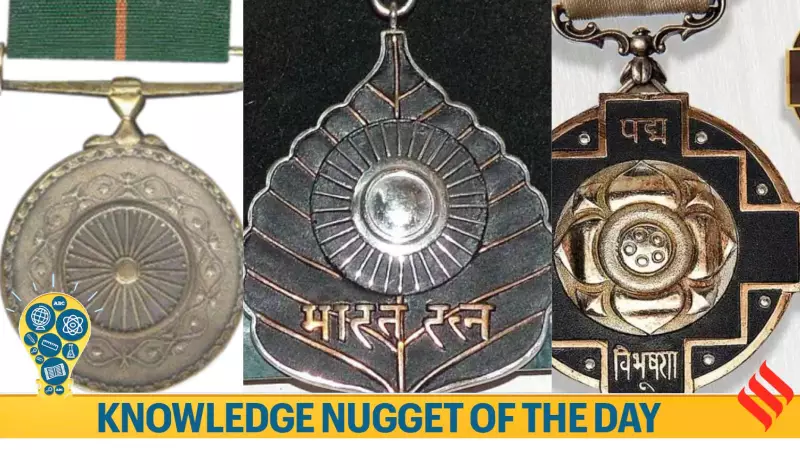
Bharat Ratna, meaning 'Jewel of India', is the nation's highest civilian honor, bestowed for exceptional contributions to India's progress and prosperity. Established in 1954 by President Rajendra Prasad, the award features a bronze medallion shaped like a peepal leaf, embossed with the sun on one side and the Ashok Chakra with the motto 'Satyameva Jayate' on the reverse.
Originally awarded for achievements in literature, science, arts, and public services, the criteria expanded in 2011 to include any field impacting India and its people. Recommendations for Bharat Ratna are made by the Prime Minister to the President, with the Ministry of Home Affairs (MHA) serving as the nodal ministry. Typically, no more than three awards are given per year, and recipients receive a Sanad (certificate) and medallion without any monetary grant.
Padma Awards: Recognizing Diverse Excellence
Padma Awards are conferred in three categories: Padma Vibhushan, Padma Bhushan, and Padma Shri. They cover various disciplines such as art, social work, public affairs, science, engineering, trade, industry, medicine, literature, education, sports, and civil service. Announced on Republic Day eve and conferred by the President at Rashtrapati Bhawan in March or April, these awards have been interrupted only in 1978, 1979, and between 1993 and 1997.
Awardees receive a certificate and medallion but no cash reward. Notably, a Padma awardee can be upgraded to a higher award after five years. Nominations are reviewed by the Padma Awards Committee, headed by the Cabinet Secretary and including the Home Secretary, Secretary to the President, and four to six eminent persons, with recommendations submitted to the Prime Minister and President for approval.
2026 Padma Award Winners Highlights
This year's Padma Vibhushan recipients include Shri Dharmendra Singh Deol (posthumous) in Art from Maharashtra, Shri K T Thomas in Public Affairs from Kerala, Ms. N Rajam in Art from Uttar Pradesh, Shri P Narayanan in Literature and Education from Kerala, and Shri V S Achuthanandhan (posthumous) in Public Affairs from Kerala. Padma Bhushan awardees feature notable names like Ms. Alka Yagnik in Art from Maharashtra, Shri Mammootty in Art from Kerala, and Shri Vijay Amritraj in Sports from the United States of America.

Gallantry Awards: Honoring Bravery
Gallantry awards are divided into wartime and peacetime categories. Wartime awards, such as the Paramvir Chakra, Mahavir Chakra, and Vir Chakra, recognize bravery in the face of the enemy, primarily for armed forces personnel. Peacetime awards, including the Ashoka Chakra, Kirti Chakra, and Shaurya Chakra, can be awarded to armed forces, paramilitary, police, or civilians for acts of valor outside combat.
As per a government press release, the Param Vir Chakra is for the most conspicuous act of bravery in enemy presence, while the Ashok Chakra is for similar acts other than in the face of the enemy. Police Gallantry medals are announced twice yearly on Republic Day and Independence Day, and Civilian Gallantry medals, like the Jeevan Raksha Padak Awards, honor lifesaving acts by civilians.
Service Medals: Recognizing Dedication
Service medals acknowledge distinguished service and contributions by personnel in the Armed Forces, Paramilitary Forces, and Police. The President's Medal for Distinguished Service (PSM) is for special distinguished records, and the Medal for Meritorious Service (MSM) is for valuable service characterized by resourcefulness and devotion to duty, announced on Republic Day and Independence Day.
Beyond the Nugget: Can Awards Be Used as Prefixes or Suffixes?
According to Article 18(1) of the Indian Constitution, awards cannot be used as prefixes or suffixes to recipients' names, as it prohibits the state from conferring titles other than military or academic distinctions. However, award winners may mention their honor in biodata or letterheads, such as "Awarded Bharat Ratna by the President" or "Recipient of Bharat Ratna Award," as clarified by the MHA.
UPSC Practice Question
Consider the following statements regarding Bharat Ratna and Padma Awards (UPSC CSE 2021):
- Bharat Ratna and Padma Awards are titles under Article 18(1) of the Constitution of India.
- Padma Awards, instituted in 1954, were suspended only once.
- The number of Bharat Ratna Awards is restricted to a maximum of five in a particular year.
Which statements are incorrect? (a) 1 and 2 only (b) 2 and 3 only (c) 1 and 3 only (d) 1, 2 and 3. Answer: (d) 1, 2 and 3.
This comprehensive overview of India's top awards not only aids UPSC preparation but also enriches general knowledge about the nation's honors system, reflecting the diverse achievements that shape India's legacy.