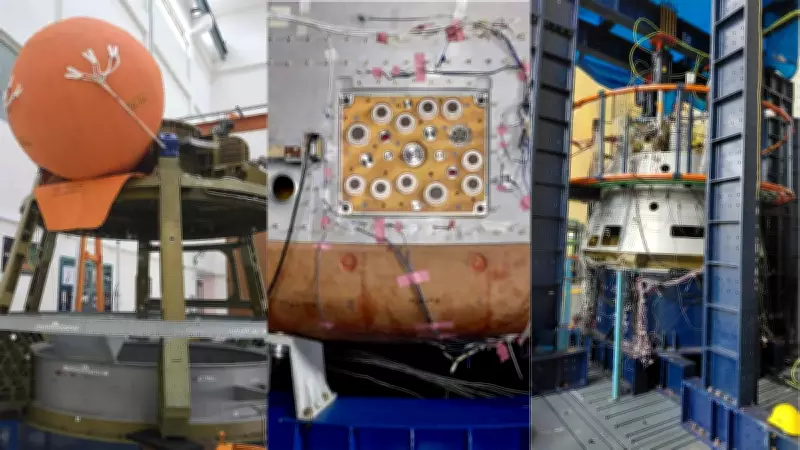
The Indian Space Research Organisation (ISRO) has cleared three major tests for the Gaganyaan crew module, marking a significant milestone in India's first human spaceflight mission, which is now targeted for 2026. The successful completion of these tests fast-tracks the program, bringing the country closer to sending its astronauts into space.
Three Critical Tests Cleared
According to ISRO officials, the three tests involved the crew module's structural integrity, thermal protection system, and parachute deployment mechanism. These tests are crucial for ensuring the safety of the crew during launch, orbit, and re-entry phases. The structural test validated the module's ability to withstand the extreme stresses of launch, while the thermal test confirmed that the heat shield can protect astronauts from temperatures exceeding 2,000 degrees Celsius during re-entry. The parachute test demonstrated the reliable deployment of the main parachutes, which are essential for a soft landing.
ISRO Chairman S. Somanath stated, "The successful completion of these tests is a major step forward. We are on track to meet our 2026 target for the first uncrewed mission, followed by the crewed mission." The agency has already conducted multiple uncrewed test flights, including the Test Vehicle Abort Mission-1 (TV-D1) in October 2023, which validated the crew escape system.

Impact on India's Human Spaceflight Program
The Gaganyaan mission aims to send a three-member crew to an orbit of 400 kilometers for a three-day mission. The program, announced in 2018, has faced delays due to the COVID-19 pandemic and technical challenges. However, with these tests cleared, ISRO is now accelerating the timeline. The first uncrewed mission, Gaganyaan-1, is expected by late 2025, followed by a second uncrewed mission in early 2026. The crewed mission is scheduled for late 2026.
The crew module, designed by ISRO's Vikram Sarabhai Space Centre (VSSC), has a diameter of 3.1 meters and a mass of approximately 3.7 tonnes. It will be launched aboard the GSLV Mk III rocket, now called LVM3. The module includes life support systems, navigation, and communication equipment. The tests cleared this week involved a full-scale prototype of the module.
Global Collaboration and Future Plans
ISRO is collaborating with several international agencies, including NASA and the Russian space agency Roscosmos, for training and technology exchange. Indian astronauts, or "vyomanauts," have completed training in Russia and are now undergoing mission-specific training in India. The agency is also developing a space station, the Bharatiya Antariksha Station, which is expected to be operational by 2035.
The Gaganyaan program is a flagship project for India, demonstrating its capability for human spaceflight. With these tests, ISRO has proven that the crew module meets safety standards, paving the way for the final stages of preparation. The successful mission will make India the fourth country to independently send humans into space, after the United States, Russia, and China.