

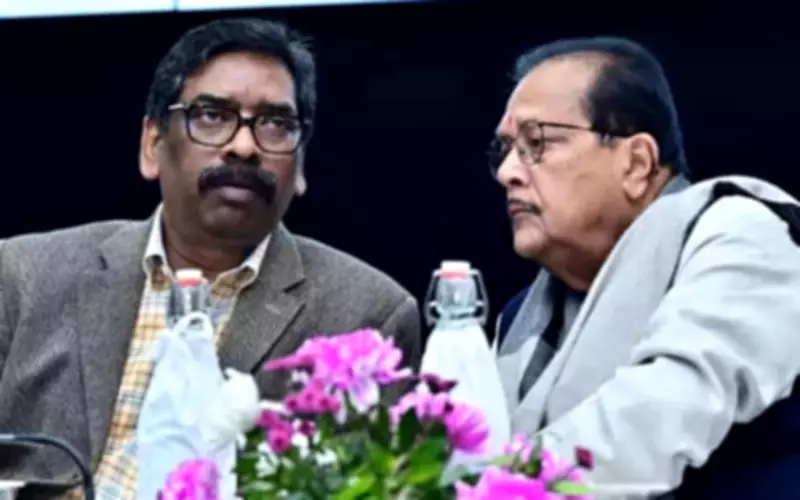
Jharkhand Finance Minister Voices Strong Disappointment Over Union Budget 2026
Ranchi witnessed strong criticism of the Union Budget 2026 as State Finance Minister Radha Krishana Kishore expressed huge disappointment over the financial plan presented by Union Finance Minister Nirmala Sitaraman. The minister's discontent stems from what he perceives as the Centre's complete disregard for Jharkhand's specific demands submitted during pre-budget consultations.
Ignored Demands and Broken Promises
Kishore revealed that despite participating in the pre-budget meeting attended by finance ministers from all states in Delhi, where Jharkhand presented detailed requirements, the Centre completely ignored their submissions. "When the finance minister in her speech outlined the government's three primary duties—accelerating development pace, building capacities, and ensuring inclusive growth—I felt optimistic," Kishore stated. "However, as the budget details unfolded, it turned out to be highly disappointing. There's no clear, concrete indication anywhere in this budget of what roadmap will actually achieve these three objectives."
Inadequate Provisions Across Key Sectors
The state finance minister argued that allocations for crucial sectors appear woefully inadequate and insufficient to meet national development targets. According to Kishore, provisions for:

- Agriculture
- Industry and MSMEs
- Education and healthcare
- Infrastructure development
- Tourism promotion
- Environmental protection
fall far short of what's needed to achieve the goal of transforming India into a developed nation by 2047. He emphasized that without substantial improvements in these areas, the country's developmental aspirations remain distant.
Critical Economic Concerns Overlooked
Kishore highlighted several significant economic issues that the budget failed to address adequately:
- Investment-GDP Ratio: "The country's Investment-GDP ratio has remained consistently low for several years. Without increasing this crucial ratio, achieving desired growth rates becomes impossible. Yet the budget remains completely silent on strategies to enhance this fundamental economic indicator."
- Currency Stabilization: "The budget makes no mention of efforts to stabilize foreign exchange rates. The Indian rupee has weakened considerably over recent years—from approximately 47 rupees per US dollar before 2014 to exceeding 90 rupees currently."
- Precious Metals Pricing: "Gold and silver prices have not only increased excessively in recent months but have shown sharp fluctuations. Despite these serious circumstances, the budget doesn't even acknowledge these issues, let alone propose initiatives to address them."
Complete Neglect of Jharkhand's Specific Needs
The minister expressed particular frustration over what he described as gross neglect of Jharkhand's requirements in the national budget. "Our state has been completely overlooked," Kishore lamented. He detailed several unmet demands:
- Infrastructure: No new railway lines or passenger trains announced for the state
- Sectoral Support: No provisions for agriculture, irrigation, or social sectors specific to Jharkhand
- Financial Compensation: Approximately 5,000 crore rupees annually requested to offset MGNREGA expenditure sharing burdens
- Irrigation Funding: 2,000 crore rupees annually for four years sought to enhance state irrigation capacity
- GST Compensation: 4,000 crore rupees annually demanded to cover losses from GST rationalization
- Coal Dues: 1.36 lakh crore rupees in outstanding dues from various coal companies
"All our carefully presented demands have been disregarded," the finance minister concluded, highlighting what he sees as a pattern of neglect toward regional requirements in national financial planning.

The strong criticism from Jharkhand's finance minister adds to growing voices questioning whether the Union Budget 2026 adequately addresses diverse state-level needs while pursuing national development objectives. As budget discussions continue, the gap between central planning and regional requirements remains a significant point of contention in India's federal financial architecture.





