

Dr. A.P.J. Abdul Kalam, the renowned scientist and former President of India, shared a profound emotional bond with the desert regions of Pokhran and Khetolai. He once expressed, "I love Khetolai… I love Pokhran because the moonlit nights over the sand dunes are beautiful. I want to spend some moments alone under the full moon. Pokhran is a better platform for creativity and freedom." These words reveal the deep affection Kalam held for the area, which stemmed from nearly 24 years of association with India's nuclear mission.
Historic Nuclear Tests at Pokhran
India's journey to becoming a nuclear power was marked by two major test series, both conducted on the soil of Pokhran. The Pokhran-II Nuclear Tests on May 11 and 13, 1998, stunned the world. After the successful detonations, Kalam reportedly conveyed the coded message "Buddha Smiles Again" to then Prime Minister Atal Bihari Vajpayee via a hotline call. The international community was shocked because, unlike in 1995 when American spy satellites detected preparations, this operation remained completely secret.
Operation Shakti: A Masterstroke of Secrecy
The five nuclear explosions near Khetolai village were led by Dr. Abdul Kalam, along with scientists R. Chidambaram and Anil Kakodkar. Code-named "Operation Shakti," the tests were executed with extraordinary secrecy. The Indian Army's Bengal Engineer Regiment, under Colonel Momgen, provided extensive support. Preparations had been underway for years, but the final phase in May 1998 was executed with unmatched precision. Code names like Alpha, Bravo, Charlie were known only to a select few led by Kalam.

The nuclear devices were secretly transported from Mumbai to Pokhran disguised as apple crates aboard an Indian Air Force AN-32 cargo aircraft. The journey began from Santacruz Airport in Mumbai on May 1. The convoy was led by "Major General Natraj" (codename for R. Chidambaram) and "Mamaji" (codename for Anil Kakodkar). At the "Deer Park" control room near Khetolai, command was taken over by "Major General Prithviraj" (codename for Abdul Kalam). The wooden boxes contained nuclear bombs built at the Bhabha Atomic Research Centre. To avoid detection by American surveillance satellites, Kalam and the scientists dressed in Army uniforms and traveled in military vehicles. Local residents often saw them near the Pokhran bus stand without realizing their true identities until after the tests.
Digging the Shafts: Codenames and Precision
Kalam supervised the digging of five deep shafts in the scorching desert heat. Each had a unique codename: the 200-metre-deep shaft for the hydrogen bomb was called "White House," the fission bomb shaft was "Taj Mahal," and a sub-kiloton device shaft was named "Kumbhkaran." Two additional shafts, NT-1 and NT-2, were used for tests on May 13.
Political and Strategic Background
India had originally planned nuclear tests in 1995, but American spy satellites detected preparations, forcing a postponement under international pressure. After the first Vajpayee government came to power in 1996, political approval was given, but avoiding satellite detection remained the biggest challenge. When the Vajpayee government returned in 1998, Abdul Kalam (then DRDO chief) and R. Chidambaram (Atomic Energy Commission chairman) received final approval. Kalam's meticulous planning kept the mission hidden until the explosions.
Prime Minister Vajpayee's Visit to Pokhran
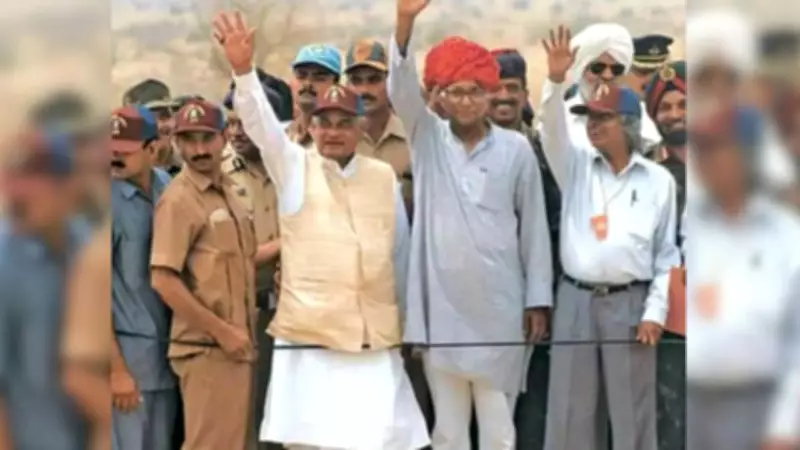
After the successful tests, Prime Minister Atal Bihari Vajpayee visited Pokhran to congratulate scientists, soldiers, and the nation. Accompanied by Defence Minister George Fernandes, Communications Minister Pramod Mahajan, and MP Sona Ram Choudhary, Vajpayee traveled through heavily secured gates to the test site near Khetolai. Standing in 47-degree heat, he praised the Army officers and soldiers for their courage. He described Pokhran as a "land of pride" and said the tests transformed it into a symbol of national strength. Vajpayee revealed that former PM P.V. Narasimha Rao had informed him in 1996 that "the bomb was ready," and he famously remarked, "I only carried out the explosion." He credited R. Chidambaram, Abdul Kalam, and the scientific community for the mission's success, which changed India's strategic standing forever.

Today, the people of Pokhran and Khetolai proudly remember those historic moments when the desert sands witnessed events that altered the global balance of power.





