

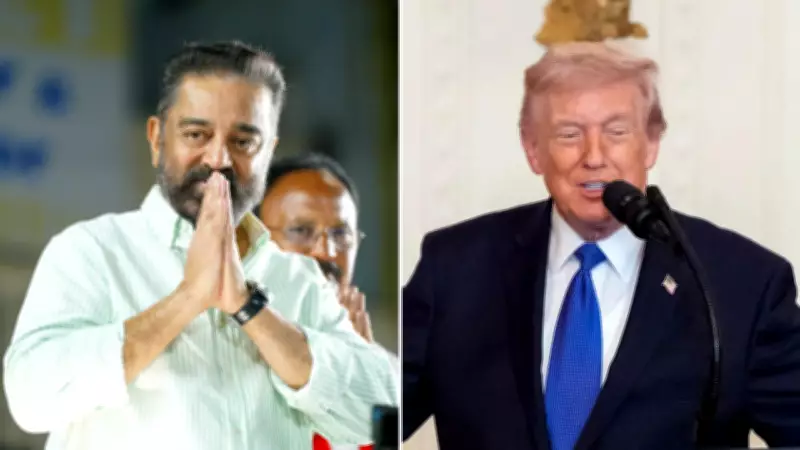
Kamal Haasan Delivers Blunt Message to US President on India's Energy Sovereignty
Veteran actor and prominent politician Kamal Haasan has issued a sharp and direct response to recent remarks from the administration of former US President Donald Trump concerning India's purchase of Russian oil. In a strongly worded message posted on social media platform X, Haasan told the US President to "mind your own business" while staunchly defending India's sovereign right to determine its own energy policy.
A Message of National Independence and Mutual Respect
In his post addressed directly to the US President, Kamal Haasan framed the issue as one of fundamental national independence and the necessity for mutual respect between sovereign nations. "We, the people of India, belong to a free and sovereign nation. We no longer take orders from distant foreign shores," Haasan wrote emphatically in his public statement.
The Makkal Needhi Maiam founder continued with a clear directive: "Please mind your own business to the best of your abilities. Mutual respect between sovereign nations is the only foundation of lasting global peace." Haasan concluded his message by extending goodwill to the United States and its citizens, signing off as "Kamal Haasan – A Proud Indian Citizen, Founder, Makkal Needhi Maiam."

Background: US Temporary Waiver for Indian Refiners
Haasan's remarks came in response to recent developments where US officials announced that Washington had granted Indian refiners temporary authorization to purchase Russian oil that was already at sea. This measure was implemented as part of efforts to stabilize global supply during the ongoing West Asia crisis linked to conflicts involving Iran.
According to detailed information from the US Treasury Department, this specific waiver allows Indian refiners to buy Russian crude oil that had already been loaded onto vessels before March 5. The authorization remains valid for 30 days, until April 4, with the primary objective of releasing oil stranded at sea into global markets to prevent supply disruptions.
US Officials Explain the Rationale Behind the Temporary Measure
US Treasury Secretary Scott Bessent provided clarification about this decision, stating that the move was specifically intended to ease short-term supply disruptions affecting global energy markets. "Yesterday, the Treasury agreed to let our allies in India start buying Russian oil that was already on the water," Bessent explained during an interview with Fox Business network.
Bessent further elaborated that India had previously complied with requests to reduce purchases of sanctioned Russian oil and was actively planning to substitute those imports with American energy supplies. However, he emphasized that this temporary step became necessary to stabilize international markets amid escalating tensions affecting crucial global shipping routes and energy distribution networks.
US Energy Secretary Chris Wright reinforced this position through his own social media communication, writing on X that Washington was "allowing our friends in India" to process Russian oil already on ships near Southern Asia to ensure these energy supplies reach the market quickly and efficiently.
Wright elaborated: "We are allowing our friends in India to take oil that is already on ships, refine it, and move those barrels into the market quickly." This coordinated messaging from multiple US officials highlights the complex diplomatic balancing act between maintaining sanctions pressure while addressing practical energy market realities.
The Broader Context of India-US Relations and Energy Security
This exchange occurs against the backdrop of evolving India-US relations and India's strategic approach to energy security. As one of the world's largest energy importers, India has consistently maintained that its energy purchases are driven by national interest and economic necessity rather than political alignment.
Kamal Haasan's intervention brings a prominent political voice to this ongoing discussion about national sovereignty in foreign policy decisions. His message underscores the sensitivity surrounding external commentary on India's domestic policy choices, particularly in areas as crucial as energy security and economic stability.

The temporary nature of the US waiver indicates the complexity of implementing comprehensive sanctions while maintaining functional international energy markets. This situation demonstrates how global crises can create unexpected diplomatic challenges that require nuanced responses from all involved nations.





