

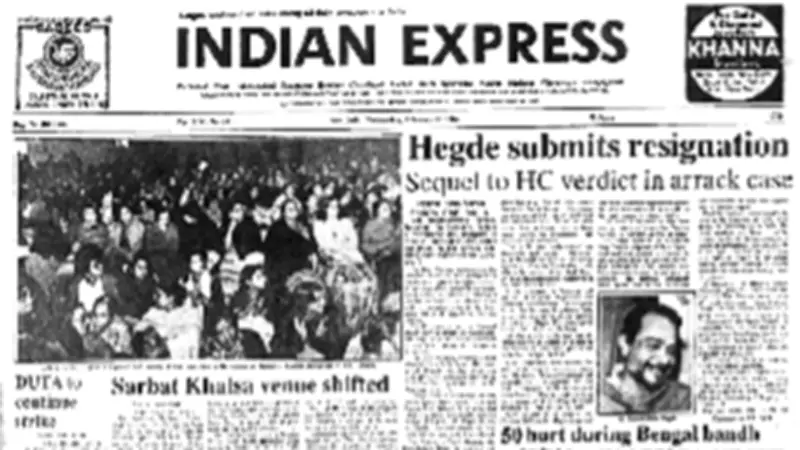
Karnataka Chief Minister Ramakrishna Hegde Resigns Following High Court Ruling
In a significant political development on February 12, 1986, Karnataka Chief Minister Ramakrishna Hegde, who was leading the state's Janata government, tendered his resignation. This decision came directly in response to the Karnataka High Court's judgment delivered on January 31 in the contentious arrack bottling case, which had cast a shadow over his administration.
Swift Political Maneuvering Amid Controversy
Chief Minister Hegde conveyed his initial decision to step down in a letter addressed to Janata Party president Chandra Shekhar. This communication was dispatched via courier, ensuring prompt delivery. Subsequently, Hegde formalized his resignation by sending an official letter to the Governor of Karnataka, Ashoknath Banerji, at precisely 6 pm on that fateful day.
Reports indicate that Hegde was particularly displeased by a "leak" of his letter to Chandra Shekhar in New Delhi, which was quickly disseminated by various news agencies, adding to the political pressure. In light of these events, Hegde considered canceling his planned trip to New Delhi to instead meet with Governor Banerji as soon as possible. However, the Governor was currently away in Dharwad, necessitating a delay in the formal acceptance of the resignation.

Regional Unrest and Political Tensions
Concurrently, the state of West Bengal witnessed severe violence during a 24-hour industrial strike and a 12-hour "Bangla bandh" called by the Left Front. This protest was organized to voice opposition against the rising prices of essential commodities. The situation escalated dramatically, resulting in police firing that injured at least 13 individuals, while approximately 400 people were rounded up by law enforcement authorities.
The Congress (I) party, which had openly opposed the bandh, contested the official figures, claiming that the number of injured was significantly higher than reported. This incident highlighted the intense political strife and public discontent prevalent during that period.
Shifting Dynamics in Punjab
In a separate but equally critical development, the Shiromani Gurdwara Parbandhak Committee (SGPC) and the Akali Dal made a consequential decision regarding the Sarbat Khalsa. Faced with the militants' effective capture of the Golden Temple complex, these organizations opted to relocate the venue of their February 16 Sarbat Khalsa from the Akal Takht to Takht Kesgarh Sahib at Anandpur Sahib.
This strategic shift was determined during a secret meeting of the five Sikh high priests held at Anandpur Sahib. The gathering was notably attended by key political figures, including Punjab Chief Minister and Akali Dal president Surjit Singh Barnala, Finance Minister Balwant Singh, and SGPC president G S Tohra, underscoring the high-stakes nature of the decision.
Academic Strikes in Delhi
Meanwhile, in the national capital, the Delhi University Teachers' Association (DUTA) reaffirmed its commitment to an ongoing strike during a well-attended general body meeting. The strike, which had commenced on December 10, was set to continue with overwhelming support, as only four members voted against its extension. This move reflected the broader tensions within the educational sector at the time.
These events collectively painted a picture of a nation grappling with political resignations, regional violence, religious-political maneuvers, and academic unrest, marking February 12, 1986, as a day of multifaceted challenges across India.






