

Kuki-Zo Council Announces Social Boycott of Community MLAs Joining Manipur Government
In a significant development that underscores the deepening political rift in Manipur, the Kuki-Zo Council (KZC), the apex civil society body representing the hill tribes, has declared a social boycott against Kuki legislators who participated in the formation of the state's new government. The council's strongly worded statement, issued on Wednesday, condemns their involvement as a serious betrayal of the community's collective political stance.
Condemnation of MLAs' Participation
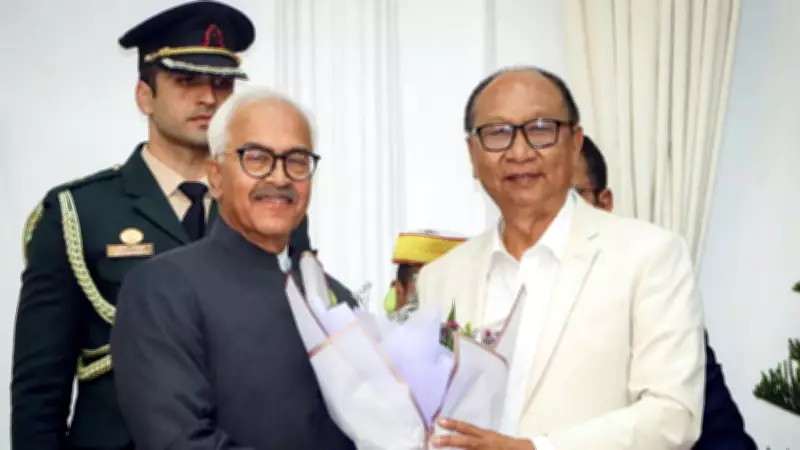
The KZC's reaction came shortly after the swearing-in ceremony, where senior Kuki MLA Nemcha Kipgen took oath as deputy chief minister under Chief Minister Yumnam Khemchand Singh. The council stated that it strongly and unequivocally condemns the participation of certain Kuki-Zo MLAs, labeling it a gross violation of the Lungthu Resolution adopted on January 13, 2026.
This resolution, as noted in the statement, was collectively and unanimously adopted by Suspension of Operations (SoO) groups, MLAs, and the KZC. It resolved not to participate in the formation of the Manipur Government without a written political commitment from both central and state governments to support a negotiated political settlement—specifically, a Union Territory with Legislature under the Indian Constitution.

Escalation of Tensions and Political Fault Lines
The KZC's announcement marks a sharp escalation in tensions within Kuki-Zo politics, exposing widening fault lines between elected representatives operating within the constitutional framework and influential civil society and armed group-backed platforms. These platforms have been pushing for a separate political arrangement following the ethnic conflict that has plagued the region.
Just hours before the oath-taking, the KZC had publicly warned Kuki MLAs against joining what it termed a popular government in Imphal. It reiterated that the community's priority remains a political solution rather than the restoration of a state-level arrangement dominated by the valley-based Meitei political class. Despite this warning, at least one prominent Kuki figure entered the government at a high level, leading to the council's strong response.
Stark Language and Accusations of Betrayal
Framing the issue in stark, conflict-era terms, the KZC statement asserted, In the absence of any political solution to the ongoing ethnic conflict, the Meitei community—whose armed groups and institutions have been responsible for unspeakable suffering, violence, and persecution of the Kuki-Zo people—continue to remain our enemy. It added that by joining a Meitei-dominated government, these MLAs have effectively aligned themselves with this enemy, betraying their own people and disregarding the immense pain and sacrifices endured by the Kuki-Zo community.
Such language highlights the depth of mistrust that continues to define relations between hill-based Kuki-Zo groups and the Meitei-dominated political establishment. This comes even as New Delhi has been pushing for the restoration of an elected government in the violence-hit state.
Announcement of Social Boycott Measures
The KZC views the MLAs' move as a deliberate attempt to undermine the unity, sentiments, and collective political stand of the Kuki-Zo people. In response, it has announced punitive social measures, stating that it condemns in the strongest terms all Kuki-Zo MLAs involved and hereby declares a social boycott against them in all Kuki-Zo areas.
The statement urges the Kuki-Zo people not to cooperate or associate with these MLAs in any social, customary, or public matters. This boycott will remain in force until they refrain from participation in the Manipur Government and realign themselves with the collective position of the community.
Complexities of Hill Politics in Manipur
This development underscores the complex and often fraught nature of hill politics in Manipur. Civil society bodies and insurgent group-linked formations under SoO arrangements have traditionally wielded considerable influence over elected representatives. The current divergence is thus being perceived with some perplexity by the civil population.

For the new government, the inclusion of Kuki faces was projected as a step toward broader representation and reconciliation. However, the KZC's call for a social boycott signals that, on the ground, legitimacy within the community remains deeply contested. It suggests that the path from government formation to a political settlement in Manipur's hills is far from straightforward, with ongoing ethnic tensions and political disagreements continuing to shape the region's future.





