

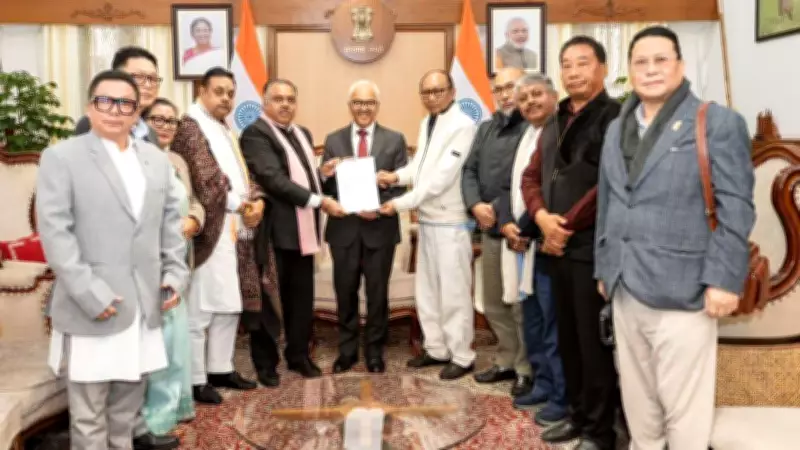
Kuki-Zo Council's Firm Stand Complicates BJP's Manipur Government Formation
In a significant political development that poses challenges to the Bharatiya Janata Party's plans in Manipur, the Kuki-Zo Council has publicly reaffirmed its position that Kuki-Zo representatives will not participate in the state government formation. This stance directly complicates the BJP leadership's reported efforts to install a Kuki Deputy Chief Minister in the new administration led by Yumnam Khemchand Singh, who was recently elected as the BJP Legislature Party leader.
Collective Decisions Amid Ethnic Division
The Kuki-Zo Council, a leading civil society organization representing the Kuki-Zo community in Manipur, issued a statement on Wednesday explaining that their position stems from a series of collective decisions taken over the past month. These decisions were made against the backdrop of continuing ethnic division and displacement in the northeastern state.
The Council explicitly stated: "The Kuki-Zo people cannot and shall not participate in the formation of the Government of Manipur." This declaration refers to a Governing Council meeting held on December 30, 2025, which included all constituent tribes, apex bodies, and regional organizations of the community.

Unanimous Resolution and Political Demands
According to the Kuki-Zo Council, the decision taken at the December meeting was unanimous and rooted in what they describe as "the unspeakable atrocities committed against the Kuki-Zo people and the enforced physical separation imposed by the Meiteis." This position was further reinforced at what the Council called the "Lungthu Meeting" held in Guwahati on January 13, 2026.
This joint meeting of Suspension of Operations groups, the Kuki-Zo Council, and Kuki-Zo MLAs resolved that the community would not participate in government formation unless the State and Central Governments provide a clear and written assurance committing to their political demand.
Setback to BJP's Outreach Efforts
The Council's statement carries substantial political significance as BJP leaders have been engaged in intense back-channel outreach to Kuki legislators in recent weeks as part of government formation talks. Of the BJP's 37 MLAs in the 60-member Manipur Assembly, the party has 7 Kuki-Zo legislators, with the remaining belonging to the Meitei community.
BJP sources had indicated that the emerging formula could include a Kuki Deputy Chief Minister, with senior Kuki leader Nimcha Kipgen reportedly considered for the position under Chief Minister Yumnam Khemchand Singh, who represents the Meitei community. Such a move was viewed as an attempt to signal inclusion and bridge ethnic divides following months of violence and de facto territorial separation between the Meitei-dominated valley areas and the Kuki-Zo hill regions.
Clear Warning to Elected Representatives
The Kuki-Zo Council's latest assertion underscores the intense popular pressure within Kuki-Zo areas against joining any Imphal-based government. Since the eruption of ethnic conflict in May 2023, Kuki civil society bodies and tribal organizations have framed participation in the state government as undermining the community's core political demand for a separate administrative arrangement.
The Council reiterated this demand in unequivocal terms, stating that the Kuki-Zo people have "legitimately demanded a separate administration from the Meitei government in the form of a Union Territory with a legislature." They emphasized that "under these circumstances, it is neither logical nor acceptable for the Kuki-Zo people to join a government formed with those from whom we have been violently separated."
Political Tightrope for Community Leaders
Significantly, the Council drew a clear line between collective decisions and individual political choices, issuing what is being interpreted as a warning to elected representatives who might consider joining the government despite the community's stance.

The Council clarified: "KZC further clarifies that any Kuki-Zo MLA who chooses to disregard the collective decision taken at the Lungthu Meeting will be doing so in their individual capacity and KZC shall not be held accountable for the consequences arising from such unilateral decisions." They urged all concerned MLAs to respect the collective will, sentiments, unity, and political aspirations of the Kuki-Zo people.
Complex Political Calculations
For Kuki MLAs, the current situation presents a politically fraught dilemma. On one hand, participation in government could provide administrative access, development funds, and a formal voice in decision-making at a time when relief, rehabilitation, and security remain pressing concerns for the community.
On the other hand, going against the declared position of apex tribal bodies risks being perceived as betraying a wider political movement that has crystallized around the demand for separate administration. The community's leadership must navigate these competing pressures while maintaining unity and advancing their political objectives.
Balancing Act for the BJP
The BJP faces its own delicate balancing act in Manipur – between projecting a broad-based, inclusive government and not appearing to marginalize ground sentiment in the hill areas. The Kuki-Zo Council's statement presents a clear challenge to the ruling party: merely ensuring symbolic representation of Kuki-Zos in the new administration may not suffice without addressing the larger political question of separate administration.
This development highlights the complex ethnic and political dynamics at play in Manipur, where historical tensions, recent conflicts, and competing governance visions continue to shape the state's political landscape. The coming weeks will reveal how both the BJP leadership and Kuki-Zo representatives navigate these challenging circumstances while addressing the legitimate concerns and aspirations of all communities in the state.





