

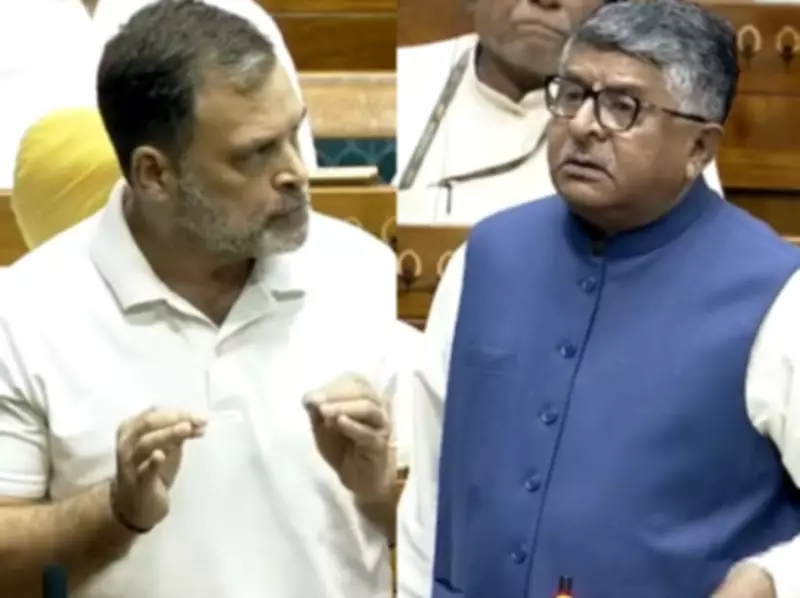
Parliamentary Proceedings Turn Volatile as Opposition and Treasury Benches Clash
The Lok Sabha witnessed a dramatic and heated confrontation on Wednesday as the House resumed debate on the opposition's no-confidence motion against Speaker Om Birla. The parliamentary session descended into chaos with BJP MP Ravi Shankar Prasad and Leader of Opposition Rahul Gandhi engaging in a sharp verbal duel that highlighted deep political divisions.
Gandhi Alleges Repeated Silencing in Parliament
Rahul Gandhi initiated the confrontation by interjecting during Prasad's speech, making explosive allegations about being systematically prevented from raising critical issues in the House. "I was stopped multiple times from speaking in the Lok Sabha," Gandhi asserted forcefully. "Last time I raised the issue of the Prime Minister being compromised. I raised the issue of Mr. Naravane. I raised the issue of Epstein. I was silenced."
The Congress leader made the startling claim that "Our Prime Minister has been compromised, and everyone knows," referring to what he suggested were undisclosed elements in the India-US trade deal and controversial excerpts from former Army chief General MM Naravane's unpublished memoir.

Prasad Fires Back with Vigorous Defense
Ravi Shankar Prasad, the seasoned BJP parliamentarian and former Union Minister, responded with equal vigor, completely rejecting Gandhi's allegations. "I would like to remind the Leader of Opposition that Prime Minister Narendra Modi can never be compromised," Prasad declared emphatically.
Prasad questioned the procedural validity of Gandhi's intervention, asking pointedly: "Is the debate allowed in point of order? It is not." He went further to challenge the very foundation of the no-confidence motion, suggesting it served personal rather than parliamentary purposes.
Motion Origins and Authenticity Questions
The no-confidence motion against Speaker Om Birla was formally moved by Congress MP Mohammad Jawed, following earlier tensions during the motion of thanks on the President's Address. The flashpoint occurred when Rahul Gandhi attempted to quote from General Naravane's unpublished memoir, which reportedly contains a chapter detailing the 2020 Ladakh skirmishes with China.
Ruling benches objected strenuously to this move, with Defence Minister Rajnath Singh noting that the book "had not been published and authenticated." This objection triggered the opposition's decision to table the no-confidence motion, despite facing unfavorable numbers with only 118 opposition MPs having signed the resolution.
Parliamentary Procedure Amidst Political Theater
BJP MP Jagdambika Pal, who presided over the House in place of Speaker Om Birla (who stepped aside due to the motion against him), granted leave to move the no-confidence motion and allocated 10 hours for debate. Pal urged all members to "stick to the resolution" and maintain parliamentary decorum.
Prasad continued his critique during the heated exchange, questioning the authenticity of Gandhi's sources. "I do not understand this motion," he stated. "Gaurav Gogoi asked what the issue was in quoting the book. The book, which was never published, circulated. How can anyone authenticate it?"
The BJP leader issued a stern warning against what he characterized as the weaponization of parliamentary proceedings, urging MPs not to exploit House mechanisms for "personal or political agendas." This remark was widely interpreted as a veiled reference to Rahul Gandhi's leadership and the opposition's strategic positioning.
Broader Implications for Parliamentary Democracy
This explosive confrontation underscores the deepening political polarization within India's parliamentary system. The exchange between two of the country's most prominent political figures reveals fundamental disagreements about:

- The boundaries of parliamentary discussion and debate
- The authentication requirements for materials cited in House proceedings
- The appropriate use of parliamentary tools like no-confidence motions
- The relationship between opposition rights and government prerogatives
As the 10-hour debate period commences, political observers are watching closely to see whether this confrontation represents a temporary flare-up or signals a more sustained period of parliamentary conflict. The outcome may have significant implications for legislative productivity and the tone of political discourse in the world's largest democracy.





