

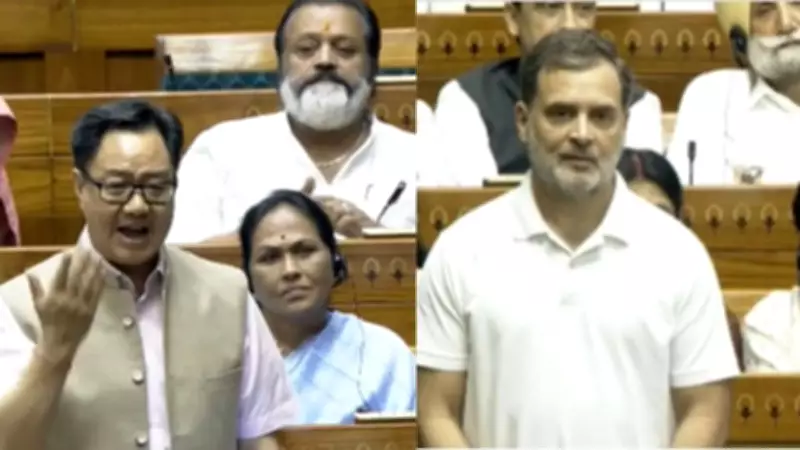
Lok Sabha Erupts in Heated Exchange Over Women's Reservation Bill
A fiery confrontation unfolded in the Lok Sabha on Wednesday as Leader of the Opposition Rahul Gandhi and Union Minister Kiren Rijiju engaged in a sharp verbal duel during the debate on the Women's Reservation Bill. The clash centered on allegations regarding the representation of Other Backward Classes (OBCs) and historical reservation policies, escalating tensions in the parliamentary session.
Rahul Gandhi Accuses Government of Bypassing OBC Representation
In his address, Rahul Gandhi launched a pointed critique against the BJP-led central government, asserting that the proposed legislation is an attempt to circumvent granting power and representation to OBC communities. He emphasized the historical treatment of marginalized groups in Indian society, stating, "It is a historical fact how Indian society treated Dalits, OBCs and their women. What is being attempted here is a bypass of the caste census. They are trying to avoid giving power and representation to my OBC brothers and sisters and instead take power away from them."
Gandhi further accused the government of seeking to alter India's electoral landscape by linking women's reservation to the delimitation process. He declared that the opposition would not allow the bill to pass under these conditions, setting the stage for a contentious parliamentary battle.

Kiren Rijiju Counters with Historical Accusations Against Congress
Union Minister Kiren Rijiju swiftly interjected, redirecting the focus to the Congress party's historical record on OBC reservation. He alleged that Rahul Gandhi's father, former Prime Minister Rajiv Gandhi, had opposed OBC reservation both during his tenure in power and when out of office. "When Rajiv Gandhi was prime minister—and even otherwise—he opposed OBC reservation. Can Rahul Gandhi explain why?" Rijiju challenged.
The Parliamentary Affairs Minister also questioned why the Congress, despite ruling the country for nearly six decades, failed to grant constitutional reservation to OBCs. "When Congress ruled this country for more than 60 years, why did it not provide constitutional reservation for OBCs? The Congress has to answer," he stated emphatically, turning the tables on the opposition's accusations.
Context of the Legislative Battle
The exchange occurred ahead of voting in the Lok Sabha on the Constitution (131st Amendment) Bill, which proposes increasing the number of Lok Sabha seats to 850. While the ruling National Democratic Alliance (NDA), with 293 MPs, holds a majority in the 545-member House, it requires a two-thirds majority to pass the constitutional amendment. This mathematical reality adds significant weight to the political maneuvering and rhetoric witnessed during the debate.
The Women's Reservation Bill, a long-pending legislative measure aimed at enhancing female representation in Parliament, has now become entangled in broader discussions about caste representation and electoral reforms. The heated arguments highlight deep-seated political divisions and the complex interplay of gender and caste politics in India's legislative process.
As the debate continues, observers note that such confrontations are likely to intensify, with both sides digging in their heels on issues of representation, historical accountability, and the future direction of India's democratic institutions. The outcome of this parliamentary showdown could have far-reaching implications for social justice policies and political alliances in the country.






