

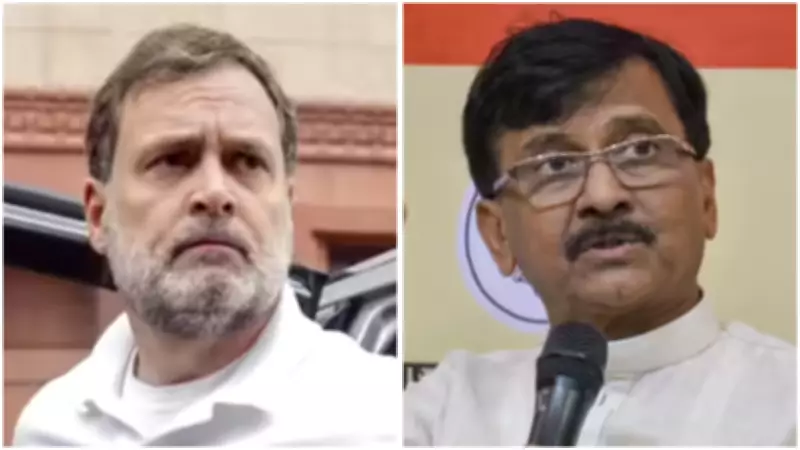
Parliamentary Proceedings Disrupted as Rahul Gandhi Cites Unpublished Army Chief Memoir
The Lok Sabha witnessed unprecedented chaos and heated exchanges on Wednesday after Leader of Opposition Rahul Gandhi quoted from former Army chief General MM Naravane's unpublished memoir during the Motion of Thanks debate. The controversial reference sparked immediate objections from treasury benches, leading to multiple adjournments and a complete breakdown of parliamentary proceedings for the day.
Defence Minister Rajnath Singh Leads Objections
Defence Minister Rajnath Singh and Home Minister Amit Shah strongly objected to Gandhi's citation, arguing that quoting from an unpublished book violated parliamentary norms and could not be permitted. The ministers emphasized that such references to sensitive military matters required proper authorization and verification before being raised in the House.
Rahul Gandhi defended his right to speak, accusing the Bharatiya Janata Party of questioning the Congress party's patriotism and attempting to suppress legitimate parliamentary discussion. The exchange quickly escalated into shouting matches between Opposition and ruling party members, with Speaker Om Birla struggling to maintain order.

BJP Launches Counterattack on Opposition Conduct
The BJP launched a strong counteroffensive against the Opposition following the adjournment, accusing Rahul Gandhi of deliberately defying the Speaker's rulings and violating established parliamentary rules. Union ministers and BJP MPs termed Gandhi's actions as irresponsible and undignified, claiming his conduct had led to a complete waste of the House's valuable time.
"The Leader of Opposition's disregard for parliamentary decorum has reached new heights," said a senior BJP leader. "Quoting unpublished material and then refusing to heed the Speaker's directions shows complete disrespect for our democratic institutions."
Sanjay Raut Raises Suspicion Over Ajit Pawar's Death
In a separate development, Shiv Sena (UBT) MP Sanjay Raut raised serious questions about the death of Nationalist Congress Party chief and Maharashtra Deputy Chief Minister Ajit Pawar in a plane crash near Baramati. Raut described the incident as "suspicious" and demanded a thorough investigation into the circumstances surrounding the tragedy.
Drawing parallels with the Justice Loya case, Raut alleged that Pawar had been planning an NCP reunion and faced significant pressure over past legal cases. The remarks have added a new dimension to the political discourse in Maharashtra, with Sharad Pawar urging restraint and caution in making such allegations.
Bangladesh Court Sentences Former PM Sheikh Hasina to 10 Years
A Dhaka court delivered a landmark verdict on Wednesday, sentencing former Bangladesh Prime Minister Sheikh Hasina to 10 years in prison in two separate corruption cases. The cases were related to irregular residential plot allocations under the Purbachal New Town project, a major urban development initiative.
Multiple Convictions in Corruption Cases
Judge Robiul Alam of the Dhaka Special Judge Court-9 awarded five years imprisonment in each case, to be served consecutively. Hasina's niece, Tulip Siddiq, received four years imprisonment, while several other relatives and associates were also convicted in the matter.
The cases were originally filed by Bangladesh's Anti-Corruption Commission, which has been pursuing multiple corruption allegations against the former prime minister and her family members. The verdict marks a significant development in Bangladesh's political landscape and anti-corruption efforts.
China Condemns Dalai Lama's Grammy Award Recognition
China has strongly criticized the Grammy Award won by Tibetan spiritual leader the Dalai Lama, describing it as a platform for "anti-China activities." Beijing reiterated its longstanding position that the Dalai Lama engages in separatist activities under the guise of religion and spiritual leadership.

Beijing Reiterates Opposition to International Recognition
The Chinese government's statement emphasized its firm opposition to what it called the misuse of international awards for political purposes. "We resolutely oppose any attempts to use cultural or artistic platforms to interfere in China's internal affairs or support separatist activities," said a Chinese Foreign Ministry spokesperson.
The Dalai Lama, who won his first Grammy Award for a spoken-word album, responded by saying the recognition was not personal but rather a means to spread messages of peace, compassion, and global unity. The spiritual leader emphasized that his work focuses on universal human values rather than political objectives.
Key Developments Across Multiple Fronts
The day's events highlight several significant developments across political, legal, and international arenas:
- Parliamentary proceedings disrupted by controversy over unpublished military memoir references
- Bangladesh's judicial system delivering major verdict in high-profile corruption cases
- Political allegations emerging about circumstances surrounding a senior politician's death
- International cultural recognition sparking diplomatic tensions between China and Tibetan leadership
- Multiple adjournments in Lok Sabha reflecting deepening political divisions
These developments collectively underscore the complex interplay between domestic politics, international relations, and legal proceedings that continue to shape the regional and global landscape. The events have significant implications for parliamentary democracy, anti-corruption efforts, and international diplomatic relations in the coming days.





