

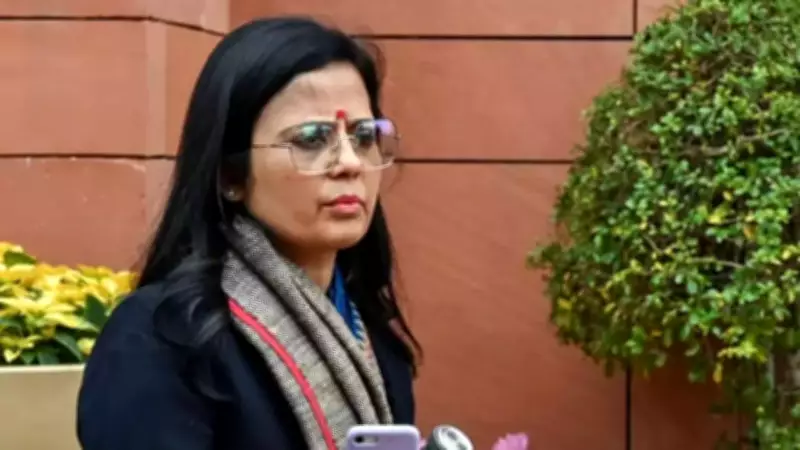
Trinamool Congress MP Mahua Moitra Criticizes Government's Treatment of Opposition in Parliament
Trinamool Congress MP Mahua Moitra launched a scathing attack on the central government during the ongoing Parliament Budget Session on Monday, dismissing claims of "ruckus in the House" and accusing the ruling party of systematically targeting opposition members by branding them as "deshdrohi" (anti-national).
Moitra Questions Restrictions on Opposition Speeches
Speaking to reporters outside Parliament, Moitra expressed disbelief at how ruling party members, including Prime Minister Narendra Modi, Home Minister Amit Shah, and Parliamentary Affairs Minister, could make sweeping statements about the opposition without facing consequences. "There was no ruckus in Parliament," she asserted, challenging the narrative put forth by treasury benches.
Moitra pointedly questioned the restrictions placed on opposition speeches, asking: "Are you telling me India–China relations cannot be referred to in the House? India–Pakistan relations cannot be referred to in the House? India–US relations cannot be referred to in the House?" She added sarcastically, "What should we talk about? Sit down and do Jai Pradhan Mantri? Is that all we should do in the House?"

Allegations of Unfair Treatment and Patriotic Branding
The TMC MP alleged that opposition leaders are routinely labeled as unpatriotic without any checks. "They call us unpatriotic. They call us deshdrohi. They cast aspersions on us and it’s all okay. There is no rule ever stopping that. They can say anything," she remarked, highlighting what she described as a double standard in parliamentary conduct.
Moitra contrasted the treatment of ruling party members with that of opposition MPs, citing BJP MP Tejasvi Surya as an example. "Somebody like Tejasvi Surya can stand up and say anything and it is applauded. And then, when we as the Opposition stand up to say something, our rights are taken away and we are told there is a ruling on it," she alleged.
Context of Parliamentary Ruckus and Rule 349
Moitra's remarks came amid heated exchanges in the Lok Sabha following an incident where Leader of Opposition Rahul Gandhi attempted to quote from a report citing excerpts from the unpublished memoir of former Army Chief General MM Naravane during the motion of thanks on the President's Address.
Gandhi challenged the government's objections, asking: "What does it contain which is scaring them so much? If they are not scared, I should be allowed to read on." Defence Minister Rajnath Singh objected, stating that the book had not been authenticated and should not be referenced in Parliament.
Responding to allegations by BJP MP Tejasvi Surya questioning the Congress's patriotism, Gandhi said he wanted to read from the memoir to clarify matters. "A young colleague over there made an allegation against the Congress Party… because he has raised the issue about our patriotism, our understanding of Indian culture, I'd like to start by reading something," Gandhi stated.
He added, "And this is from the memoir of Army Chief Naravane. And I'd like you to listen nicely. You will understand exactly who is patriotic, who is not." Referring to the Doklam standoff, Gandhi mentioned, "It will take a little while, so this is about when four Chinese tanks were entering Indian territory. They were taking a ridge in Doklam."
Speaker's Ruling and Escalating Tensions
While Gandhi maintained that the excerpts appeared in a published magazine article citing Naravane's memoir, Lok Sabha Speaker Om Birla ruled that unpublished material could not be read out in the House and denied permission to proceed. This decision sparked protests from opposition members, who demanded that Gandhi be allowed to read the excerpts, while treasury bench members insisted that House rules barred references to unpublished works.
The episode led to sharp verbal exchanges in the Lok Sabha, further escalating tensions during the Budget Session. Moitra referenced Rule 349 to argue that discussions were well within parliamentary business, noting, "What is in the business of the House today is the President’s Address, and the President talks about everything."

The ongoing conflict highlights deepening political divisions and concerns over freedom of speech within India's parliamentary democracy, with opposition figures like Moitra and Gandhi pushing back against what they perceive as attempts to silence critical voices.





