

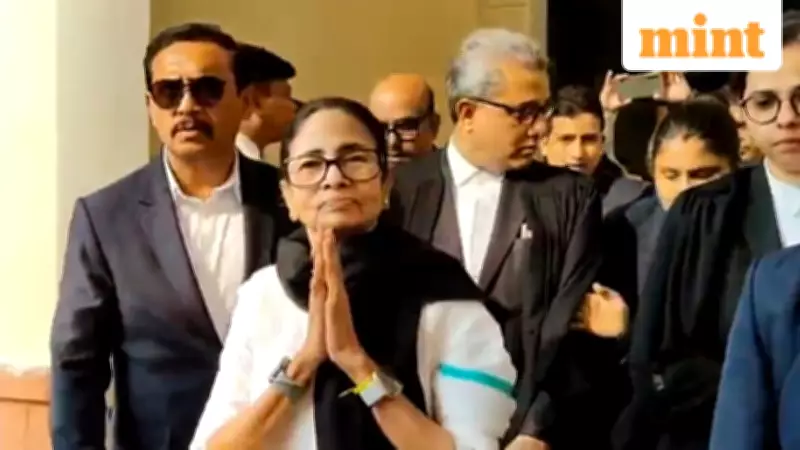
West Bengal Chief Minister's Fiery Supreme Court Appearance Over Voter List Controversy
West Bengal Chief Minister Mamata Banerjee made a dramatic personal appearance before the Supreme Court on Wednesday, February 4, 2026, delivering scathing criticism of the Election Commission's Special Intensive Revision (SIR) process for electoral rolls in her state. The Chief Minister, who had filed an interlocutory application to argue in person, appeared in Courtroom One alongside her legal team as the apex court heard petitions challenging the ongoing revision exercise.
Constitutional Battle Over Electoral Integrity
The bench comprising Chief Justice Surya Kant and Justices Joymalya Bagchi and Vipul M Pancholi heard arguments from Banerjee and three other petitioners including Mostari Banu and TMC MPs Derek O'Brien and Dola Sen. The Supreme Court promptly issued notices to the Election Commission and West Bengal's chief electoral officers regarding the SIR matter, scheduling the next hearing for February 9.
Banerjee framed her appearance not as a political maneuver but as a constitutional appeal of last resort, stating she had exhausted all other avenues after writing six letters to the Election Commission that went unanswered. "We are not getting justice anywhere," she told the court, emphasizing that her presence stemmed from the belief that justice must remain accessible when institutions fail to respond.

Allegations of Systematic Voter Exclusion
The Chief Minister presented what she described as documented evidence of the SIR's implementation flaws, citing reports from reputable newspapers to support her claims. According to Banerjee, the revision process has been transformed into what her party calls "almost entirely a deletion exercise" targeting specific demographics without proper due process.
She highlighted several categories of voters allegedly affected:
- Women who changed surnames after marriage, with even this common practice being labeled a "mismatch"
- Daughters who shifted to their in-laws' homes following marriage
- Poor families and migrant workers who changed addresses for employment
- Economically disadvantaged citizens who purchased small flats
Banerjee asserted that these deletions were being justified under vague categories like "logical discrepancy" or "incorrect mapping," which she argued violated previous court directives on voter registration procedures.
Questioning Selective Implementation and Human Costs
The West Bengal leader raised pointed questions about why similar intensive revision measures weren't being implemented in other states, particularly neighboring Assam. "Why was Bengal singled out on the eve of elections?" she demanded, adding, "If this was genuine reform, why not Assam? Why only Bengal?"
Banerjee criticized the rushed timeline of the exercise, noting that a process typically spanning two years was being compressed into just three months during harvest season and peak migration periods. She placed on record what she described as the human cost of this accelerated implementation: over 100 reported deaths, fatalities among Booth Level Officers (BLOs), and widespread hospitalizations.
Documentation Disparities and Micro-Observer Concerns
While welcoming the Supreme Court's previous order accepting Aadhaar as valid identification proof, Banerjee questioned why Bengal residents were being denied documents accepted elsewhere, such as domicile or caste certificates. "The Bengal people were so happy with your order," she told the justices. "But now the EC is violating court order and not allowing that document alone."
A particularly contentious issue raised was the role of micro-observers appointed specifically in West Bengal. Banerjee argued that these officials, who she claimed lacked official authority, were systematically deleting voter names. "To bulldoze the people of Bengal, they have appointed micro-observers only in our state - Why?" she asked, requesting that deletion authority should not rest with these observers.

Quantifying the Scale of Deletions
The Chief Minister presented staggering numbers to illustrate the scale of the alleged voter exclusion:
- First phase: Approximately 58 lakh (5.8 million) names already deleted
- Second phase: 1 crore 30 lakh (13 million) names targeted for deletion
Banerjee made a final plea to the court regarding the "logical discrepancy" cases, requesting they be re-examined rather than automatically deleted. Concluding her arguments with a declaration of commitment to democratic principles, she stated firmly: "I will save the democracy."
The Supreme Court's forthcoming decision on February 9 will determine the next steps in this constitutional confrontation between West Bengal's government and the national election authority, with significant implications for voter rights and electoral procedures ahead of upcoming elections.





