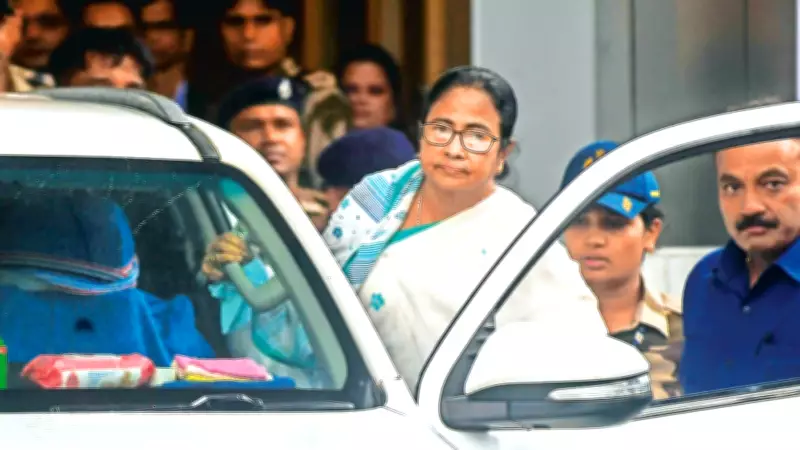
West Bengal Chief Minister Mamata Banerjee has once again raised serious concerns about the electoral processes in her state, penning a detailed letter to Chief Election Commissioner Gyanesh Kumar on Saturday. This marks her third formal communication with the election body regarding the ongoing Special Intensive Revision exercise, coming just two days before her scheduled meeting with the CEC in Delhi.
Allegations of Data Manipulation by Micro Observers
In her strongly-worded letter, Banerjee has alleged that approximately 8,100 micro observers deployed by the Election Commission of India in West Bengal are manipulating data with ulterior motives to subvert the electoral roll revision process. She emphasized that this deployment represents the first instance in India's electoral history where such a large number of micro observers have been engaged during an SIR exercise.
The Chief Minister raised fundamental questions about the legal basis for these appointments, noting that these micro observers are being unilaterally engaged by the EC without adequate training or demonstrated expertise for what she described as a specialized, sensitive, and quasi-judicial exercise.

Legal Concerns and Constitutional Questions
Banerjee's letter delves deep into constitutional and legal concerns, questioning the very authority under which these micro observers are operating. She pointed out that the role, functions, and authority of micro-observers during electoral roll revision are neither defined, contemplated, nor authorized under the Representation of the People Act, 1950, the Registration of Electors Rules, 1960, or any other statutory instrument governing the preparation and revision of electoral rolls.
The West Bengal CM specifically highlighted that the RP Act, 1950 and the RER, 1960 exclusively vest the statutory responsibility of maintaining electoral rolls in the Electoral Registration Officers and Assistant Electoral Registration Officers. This includes the conduct of claims and objections, verification of documents, and passing of final orders on inclusion or deletion.
Questioning Constitutional Validity
Banerjee raised significant constitutional questions, stating that in the absence of any statutory amendment or valid rule-making under Articles 327-328 of the Constitution, the ECI cannot create or empower a parallel cadre of observers to intervene in this quasi-judicial process. She emphasized that this deployment appears to be selectively applicable to West Bengal, as no similar deployment of micro observers for decision-making through the ERONET portal has been undertaken in any other state or Union territory where SIR processes are currently underway.
Specific Allegations and Concerns
The Chief Minister provided specific details about the appointments, noting that four IAS officers belonging to the Tripura cadre have been appointed as observers via a letter dated January 10, 2026, in addition to five other observers from the Centre and twelve from West Bengal. She reported that some observers are functioning from the office of the Chief Electoral Officer, West Bengal, and have taken control of the EC portal without any legal authority.
Banerjee made serious allegations that these observers are manipulating data to subvert the roll revision process with ulterior motives, suggesting this is being done as a backdoor mechanism for the exclusion and disenfranchisement of a large number of eligible electors.
Fundamental Questions Raised
The letter poses critical questions about the functioning of these non-statutory authorities:
- Are these micro-observers and observers empowered under the statute to act as approving authorities?
- Are they merely mandated to oversee the process and guide and assist the statutory authorities?
- Are the AEROs and EROs being rendered helpless, isolated, and reduced to mere spectators in the face of illegal, unauthorized, and unwarranted actions by such non-statutory authorities?
Banerjee emphasized that these developments raise grave concerns regarding the credibility and integrity of the SIR and warrant immediate investigation.

Inconsistent Application of Rules
The Chief Minister highlighted what she described as inconsistent application of rules across states, noting that an exercise governed by a uniform Act and Rules applicable across the country is being implemented differently across states. She pointed out specific areas of concern:
- The manner of hearings and disposal of logical discrepancy cases
- The deployment of micro-observers and observers for backend verification and disposal
- The applicability and admissibility of documents such as family registers and domicile certificates
For West Bengal, it appears that an entirely different set of rules is being applied, contrary to statutory provisions and for reasons that remain inexplicable, according to Banerjee's letter.
Broader Implications for Democracy
Banerjee concluded her letter with strong statements about the broader implications of these developments, stating that this is wholly against our democratic ethos, federalism, and fundamental rights. She described it as reflecting a dangerous design that must be stopped immediately.
This latest communication follows her previous letters to the CEC on January 3 and January 10, where she had flagged concerns on several issues related to the electoral exercise. The timing of this letter, just before her scheduled meeting with the CEC, underscores the seriousness with which the West Bengal government views these developments in the electoral process.