

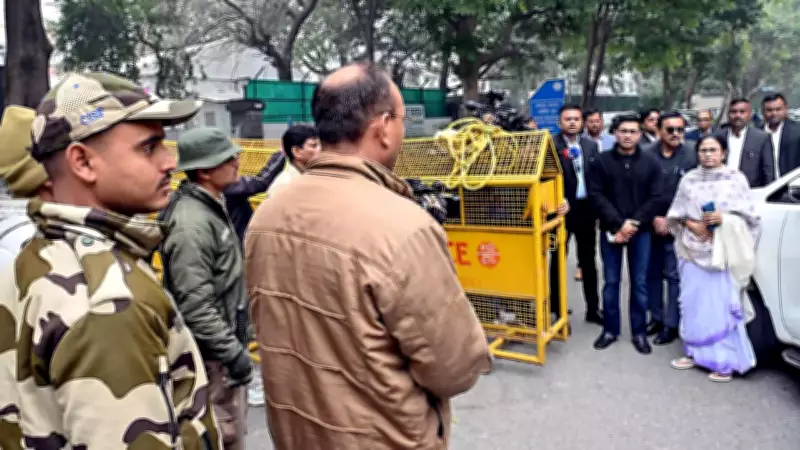
West Bengal CM Mamata Banerjee Sends State Police to Delhi, Triggering Security Confrontation
In a dramatic escalation of tensions, West Bengal Chief Minister Mamata Banerjee on Monday decided to deploy her own state police personnel to safeguard families of the SIR victims during her visit to the national capital. This move sparked an immediate and tense standoff with Delhi Police authorities, raising questions about jurisdictional boundaries and political symbolism.
Bengal Police Team Dispatched to National Capital
By evening, official confirmation emerged that a 25-member Bengal Police team would be immediately dispatched to Delhi. The contingent, led by a deputy superintendent of police and an inspector, includes a specialized Rapid Action Force unit. Their primary mission is to provide protection for approximately 100 families affected by the SIR incident who are currently in Delhi.
The police team is scheduled to reach the city today, setting the stage for potential operational conflicts with local law enforcement agencies. This unprecedented move represents a significant breach of conventional security protocols governing VIP protection in the national capital.

Delhi Police Clarifies Security Protocols
Delhi Police special commissioner Devesh Chandra Srivastava responded by clarifying that Chief Minister Banerjee has been accorded Z+ category security in Delhi, with full responsibility for her protection resting with Delhi Police as per established protocol. "Adequate deployments were made at Banga Bhavan, Hailey Road, and various guest houses where VVIPs and senior leaders were staying," Srivastava stated.
The special commissioner emphatically denied allegations of police overreach, asserting, "At no point did police enter Banga Bhavan or restrict movement of its occupants." This statement directly contradicted claims made by the West Bengal chief minister and her party members.
Morning Tensions Escalate at Guest Houses
The confrontation began escalating Monday morning when reports emerged that barricades had been set up outside one of West Bengal's two guest houses in Delhi. This development prompted immediate action from Trinamool Congress leadership.
TMC MPs, joined personally by Chief Minister Banerjee and national general secretary Abhishek Banerjee, rushed to the locations. Addressing gathered media representatives, the chief minister delivered a passionate critique of the central government's approach.
"As many as 150 people have died during the Bengal SIR. Some of their relatives are here. Why can't they speak with the media?" Banerjee questioned. "Wherever these people have been put up, the Union government has sent cops."
Political Accusations and Symbolic Protest
The West Bengal chief minister carefully directed her criticism, stating, "I won't blame the cops, I will blame the one on top. He cannot provide security to the country." She leveled serious allegations against officers, accusing them of "torturing and harassing" the affected families and claimed police were "searching rooms and threatening people."
When a Delhi police officer attempted to explain that deployments were for security purposes, Banerjee interrupted sharply, "What security are you speaking of? You are coming to Banga Bhawan, which belongs to us, to threaten our people." She emphasized the symbolic nature of her protest, noting that only about 50 victims' relatives were actually present at the location.
Delhi Police Maintains Precautionary Stance
Delhi Police authorities maintained their position that no personnel entered Banga Bhawan, describing the deployment as purely precautionary. Officials cited intelligence reports indicating that 150-200 party supporters and senior leaders were staying in guest houses across Delhi, necessitating enhanced security measures.
This explanation failed to satisfy the West Bengal administration, which viewed the police presence as intimidation rather than protection. The differing interpretations of the same security situation highlighted the deepening political divide between state and central authorities.

Parliamentary Protests Erupt
The chief minister's stand sparked immediate political repercussions in Parliament. TMC MPs stormed the Lok Sabha well, raising slogans against the Union government in a dramatic display of protest. They were joined by members of the Samajwadi Party, broadening the opposition to the central government's actions.
In the Rajya Sabha, TMC MP Sagarika Ghose raised the issue, ensuring the confrontation received attention in both houses of Parliament. The coordinated parliamentary protest underscored the political dimensions of what began as a security disagreement.
Sharp Political Contrasts Drawn
Concluding her remarks with characteristically sharp rhetoric, Chief Minister Banerjee drew pointed political comparisons. "Amit Shah gets a red carpet in Bengal, but when I come here, I get a black carpet," she stated, referencing the Union Home Minister's reception in her state versus her own treatment in the national capital.
The West Bengal leader issued a defiant challenge, declaring, "If no one else fights, I will," while accusing the central government of transforming Delhi into "a zamindari" with no space for the poor. This language evoked historical land ownership systems to critique contemporary power dynamics between center and state.
The unfolding situation represents more than a simple security disagreement—it has evolved into a symbolic battle over federal authority, political space, and the rights of state governments to operate independently in the national capital. With Bengal police personnel en route to Delhi, the standoff appears poised to continue developing through the coming days.





