

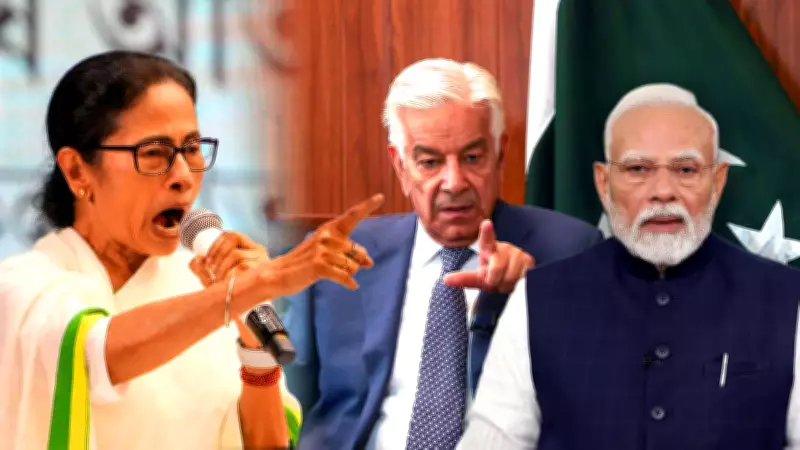
Mamata Banerjee Confronts PM Modi Over Pakistan's Kolkata Threat During Bengal Election Campaign
A significant political controversy has emerged in West Bengal as Chief Minister Mamata Banerjee has launched a direct attack on Prime Minister Narendra Modi regarding his perceived silence on a recent provocative statement from Pakistan. With the state's election atmosphere intensifying, Banerjee has raised critical questions about why the Prime Minister has not publicly addressed Pakistan Defence Minister's specific mention of Kolkata as a potential target during his campaign rallies across Bengal.
Election Timing Amplifies Security Debate
The timing of this confrontation is particularly crucial as West Bengal approaches its electoral phase, with political narratives becoming increasingly sharp and polarized. While Prime Minister Modi has consistently focused his campaign speeches on highlighting governance failures and law and order issues within the state, Mamata Banerjee has strategically shifted the debate toward matters of national security and leadership accountability.
This calculated move by the Trinamool Congress leader has effectively introduced external security threats into the already heated Bengal election discourse, transforming what was primarily a state-level political battle into a discussion about India's national defense posture and diplomatic responses.

Contrasting Political Narratives on Security
Interestingly, while Mamata Banerjee questions the Prime Minister's public response, India's Defence Minister Rajnath Singh has already issued a firm warning to Pakistan, clearly reinforcing India's deterrence stance and commitment to national security. This creates a complex political landscape where different government figures are presenting varying approaches to the same security concern.
The controversy has undeniably added a new and volatile dimension to the Bengal election narrative. What began as a debate about local governance and development has now expanded to include questions about how national leadership handles international threats and whether such security matters should influence state election campaigns.
Intensifying Political Messaging Battle
As tensions continue to rise, the political messaging battle has become as intense as the security narrative itself. Both major political factions are actively attempting to shape public perception regarding:
- The appropriate response to international threats during election periods
- The balance between state-level issues and national security concerns
- Leadership accountability in addressing external provocations
- The politicization of defense and diplomatic matters
This development represents a significant escalation in Bengal's political warfare, where external security threats are now being strategically deployed as political ammunition. The situation highlights how international relations and domestic politics increasingly intersect during election seasons, particularly in border states with complex security environments.
The ongoing controversy raises important questions about the boundaries between electoral politics and national security discussions, and how such intersections might influence voter perceptions in the crucial Bengal elections.






