

Surrendered Maoist Leader Provides Rare Insight Into CPI (Maoist) Crisis
In a revealing conversation from Hyderabad, surrendered Maoist leader Malla Rajireddy, also known as Sangram, has offered unprecedented insights into the deepening crisis within the Communist Party of India (Maoist). The senior functionary made the startling admission that the party's foundational principle of seizing power through armed struggle is no longer viable in the contemporary era.
The Technological Challenge to Maoist Organization
Rajireddy pointed to a fundamental shift in Indian society that has undermined traditional Maoist recruitment and organization methods. The widespread proliferation of smartphones and android devices among youth has created new social dynamics that the party has struggled to navigate. This technological revolution has made it increasingly difficult for the organization to connect with potential recruits and maintain its traditional organizational structures.
Operation Kagar's Devastating Impact
The surrendered leader described Operation Kagar as a turning point that dealt a severe blow to the Maoist organization. "The operation broke our leadership chain completely," Rajireddy explained. The communication collapse across regional units became so severe that after the general secretary's death in May 2021, the Central Committee could not even convene to select a successor.

Rajireddy detailed how the operation created strategic paralysis at the highest levels:
- Top leaders were either killed in encounters or chose to surrender
- Communication links between Central Committee members across Odisha, Chhattisgarh, and Maharashtra broke down
- Coordination between different regional units became nearly impossible
- The organization's command structure suffered irreparable damage
Government Outreach and Continued Resistance
Despite the severe setbacks, Rajireddy emphasized that the Maoist movement is not yet finished. He expressed skepticism about government claims that the organization could be completely wiped out by March 31, noting that guerrilla squads and committee members continue to resist in various regions.
Rajireddy revealed that government intelligence officials had reached out with an offer: "An IB joint director informed us that Operation Kagar would be paused temporarily to facilitate talks with other revolutionaries." However, he clarified that while the government made this offer, the actual military operations have continued without significant interruption.
Arrest Versus Surrender: A Crucial Distinction
In a significant clarification, Rajireddy rejected the characterization of his apprehension as a surrender. "We did not come out to surrender," he insisted. "We came out to stay in the plains secretly and guide the party cadres." He explained that within days of emerging, the Special Intelligence Bureau arrested him in Hanamkonda, and authorities subsequently portrayed this arrest as a voluntary surrender.
Rajireddy detailed the coordinated nature of his apprehension: "I was arrested in Hanumakonda, and Devji was arrested in Hyderabad on the same day. We both decided to come out, but I arrived earlier and the other later; the SIB caught both of us on February 18 at 6:30 PM."
Internal Pressure and Changing Assessments
The decision to emerge from hiding stemmed from mounting pressure within the organization. Rajireddy revealed that politburo member Sonu wrote to him stating that the intense military pressure made survival increasingly difficult and that it was time to consider alternative approaches. "In that letter, he stated that surrender is the only way left," Rajireddy recounted.
After meeting Sonu in late July, Rajireddy discovered that significant sections of the leadership had dramatically shifted their assessment of the situation. "Our adopted tactics were failing against the state, we were suffering heavy losses. Forests are turning red and, to stop this, surrender is the only path," he explained, quoting internal discussions.
Strategic Failures and Changing Realities
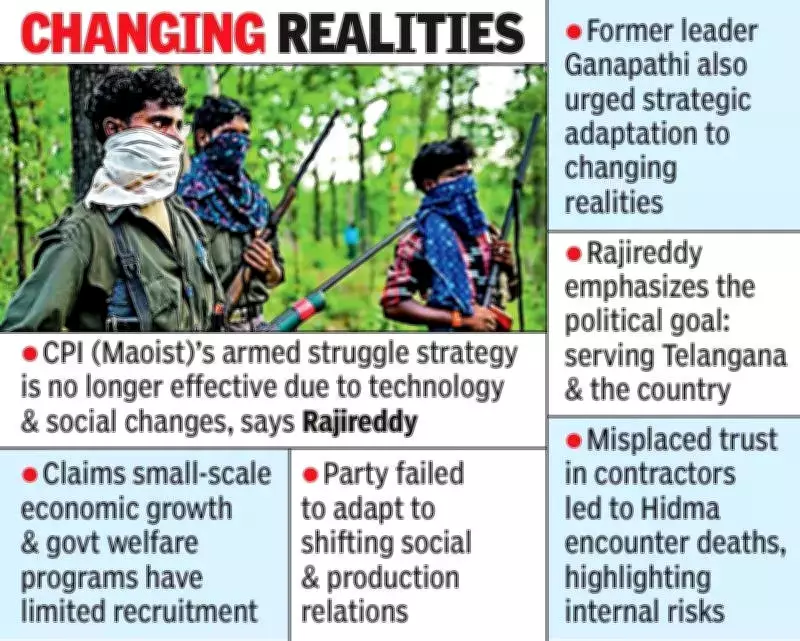
Rajireddy offered a comprehensive critique of why the Maoist traditional approach has become unsustainable:

- Technological disruption: Smartphone proliferation has fundamentally altered youth engagement and social organization
- Economic changes: Small-scale development and government welfare programs have reduced traditional recruitment pools
- Strategic miscalculation: The party failed to analyze India's shift from traditional feudalism to comprador bureaucratic capitalism
- Internal recognition: Even former top leader Ganapathi argued for strategic adaptation during a meeting two years ago
Future Directions and Political Objectives
Despite acknowledging the retreat from armed struggle, Rajireddy maintained that the political objectives remain unchanged. "We want to serve the people of Telangana and the country," he stated. "If the government permits us as a political party, we will certainly come forward."
He emphasized the continued belief in organized struggle while expressing willingness to operate within legal political frameworks if permitted. The conversation also touched on internal disputes, including controversies around the Hidma encounter where misplaced trust in contractors allegedly working with state intelligence led to casualties, and rejected allegations of caste-based dominance within the party structure.





