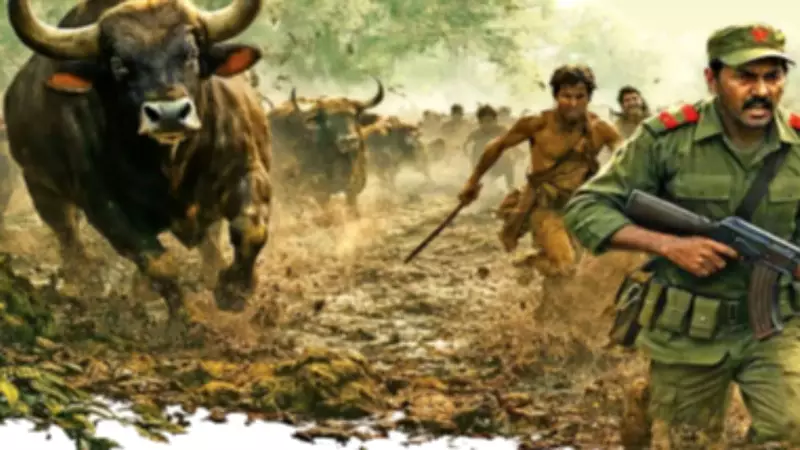
Surrendered Maoist Commanders Reveal Jungle Realities: Gaur More Feared Than Tigers
In the dense, shadowy forests of central India, recently surrendered Maoist commanders have shared extraordinary insights into their jungle survival, revealing that while they gradually adapted to the presence of tigers, it was the massive Indian bison, known as the gaur, that instilled the deepest fear and disrupted their operations most significantly.
Learning to Coexist with Silent Predators
Former Maoist commander Rakesh Hodi, a resident of Gadchiroli who carried a bounty of Rs 62 lakh before surrendering, described surprisingly frequent encounters with tigers during his years in the forest. "You get used to them. In the dark, you can sense where they are. Tigers watch you for a moment and then move away," Hodi explained. He recalled a particularly close encounter in the forest area inside Kanha National Park in Mandla district, when a tiger suddenly appeared while his squad was moving through the jungle. "The tiger jumped over me and ran away. We were frightened, but the animal had no interest in attacking," Hodi said.
According to Hodi, leopards exhibited similar behavior, slipping quietly into the undergrowth once they detected human presence. "After some time, we understood their pattern. We slowed down, stayed quiet and let them pass. In the forest, you learn to live with tigers," he emphasized.

The Jungle as Early Warning System
Hodi revealed that the jungle itself often functioned as a crucial early warning system against approaching security forces. Sudden alarm calls from monkeys, birds rising together from tree canopies, or deer sprinting through the undergrowth frequently indicated approaching police patrols or Hawk Force teams. "Animals react before humans realise anything. When monkeys scream suddenly or birds fly together, you know something is moving in the forest," Hodi stated. Such natural cues often provided Maoist squads with vital minutes to scatter or change direction, potentially saving lives during security operations.
The True Terror: The Indian Bison
Despite these frequent predator encounters, the commanders unanimously identified the gaur (Bos gaurus gaurus) as the animal that most disrupted their movements and operations. Deepak alias Sudhakar Uike, a resident of Sonwani in Balaghat and former DVCM of the Malajkhand Dal carrying a bounty of Rs 29 lakh, described how gaurs repeatedly chased cadres during night movements. "They don't move aside like other animals. They stand on the trail or charge straight at you," Uike explained.
According to Uike, encounters with gaur herds often forced Maoist groups to abandon carefully planned routes entirely. "If we saw a herd near a water source or trail, we had to retreat immediately. Night marches were cancelled and sometimes supplies were left behind because everyone ran in different directions," Uike recounted, adding with emphasis, "Gaurs don't bluff. They keep coming."
Other Dangerous Encounters
Uike also shared experiences with sloth bears during his early years in the Maoist organization. When he first joined the group, he was deployed as a security guard in the Keradehi area of the Tanda region when a bear suddenly attacked. "I ran and climbed a tree to escape. My companions later came to my rescue," Uike recalled. In another incident, a bear charged at their group again. "One of my companions shone a torch light directly into the bear's eyes," he said. "The light confused it and the animal ran away." Although bear encounters were dangerous, Uike noted that cadres sometimes managed to escape. "With bears there is still a chance. But when a gaur starts chasing you, there is no certainty."

Wildlife as Unintentional Allies
The surrendered commanders revealed that wildlife sometimes inadvertently helped them avoid security operations. Hodi recalled an incident in Bichhiya tehsil of Mandla district, when members of his squad had gone to collect food and water while security forces moved into the area following an informant's tip-off. "Suddenly animals started running through the forest," Hodi said. "That told us something was wrong." By the time police and Hawk Force teams reached the area and firing broke out, the cadres had already dispersed.
In another incident near Parswada area of Balaghat, unusual monkey alarm calls alerted the Maoist squad to possible movement of security forces. "When monkeys start shouting continuously, you know someone is approaching," Hodi explained. The warning allowed the squad to reposition and escape even as firing occurred nearby.
Conservation and Supply Practices
One of the surrendered commanders stated that during their years in the forest, they never killed or poached wildlife for food. However, he admitted that in some areas, Maoist groups occasionally received supplies of dried meat from local villagers. According to him, the meat was usually believed to be from wild boars and was carried by sympathizers to remote forest camps during long stays in the jungle.
Ecological Context and Recent Developments
Forest officials confirm that the Kanha-Balaghat-Mandla landscape hosts one of the highest densities of gaurs in central India. These massive animals dominate forest trails, clearings, and water points, known for their territorial behavior and powerful charges that can pose serious threats to anyone traveling on foot through the jungle.
More than a dozen Maoists have surrendered in Balaghat district in recent months. Several of them acknowledge that wildlife encounters were an unavoidable part of their years in the forest—sometimes offering warning signals, sometimes posing grave danger. But among all the animals they encountered, they maintain that one species remained the most feared: the formidable Indian bison, whose presence shaped their jungle survival strategies in ways they never anticipated.